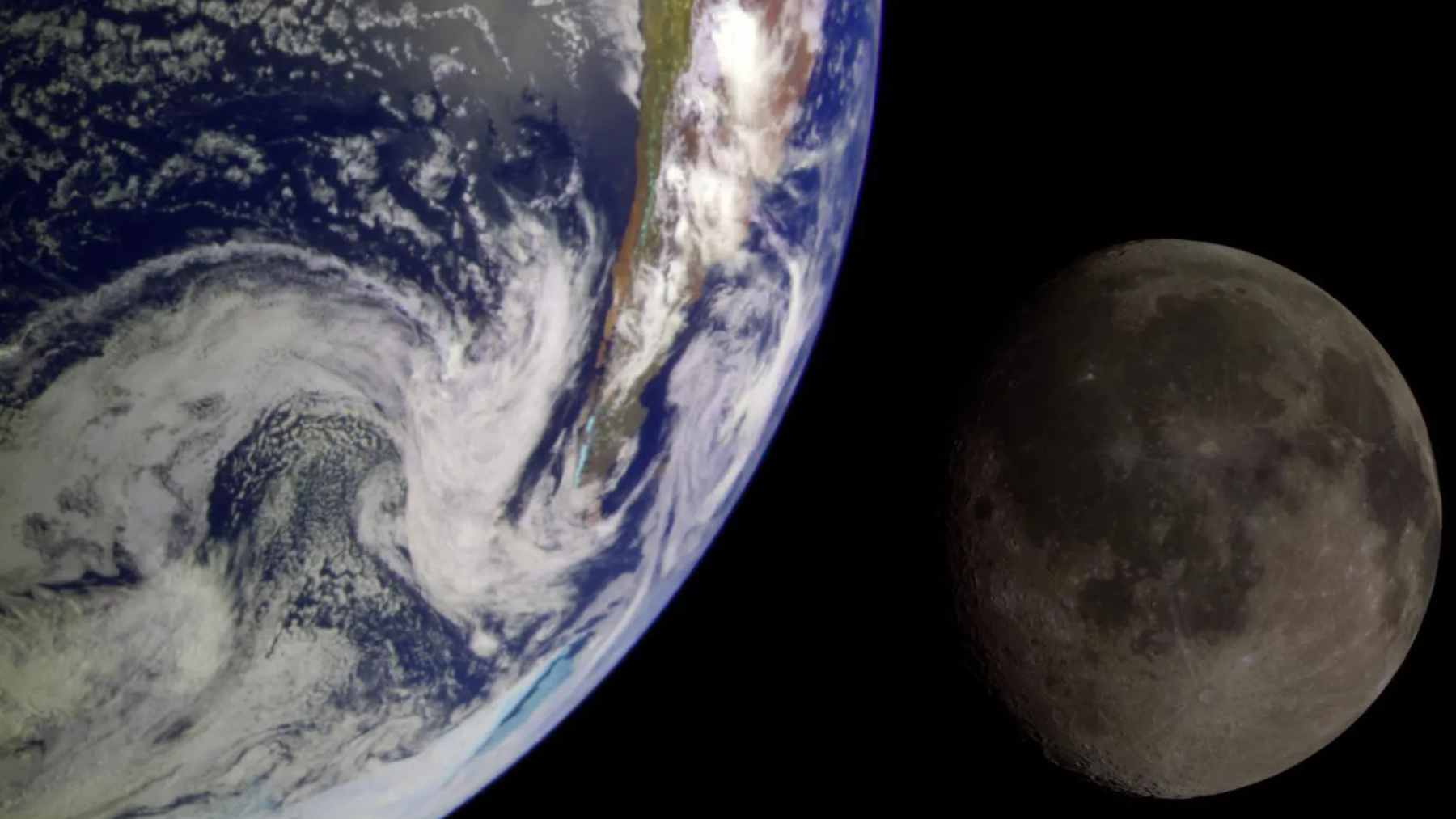
For as long as humans have looked up at the Moon, it has seemed like a silent, separate world. A new study suggests it has actually been catching tiny pieces of Earth’s air for much of its history, quietly storing a chemical record of our planet’s atmosphere in its dusty soil.
At first glance, the idea sounds backwards. We usually picture Earth’s magnetic field as a shield that keeps the solar wind from stripping away our atmosphere. In many ways, that picture is still true.
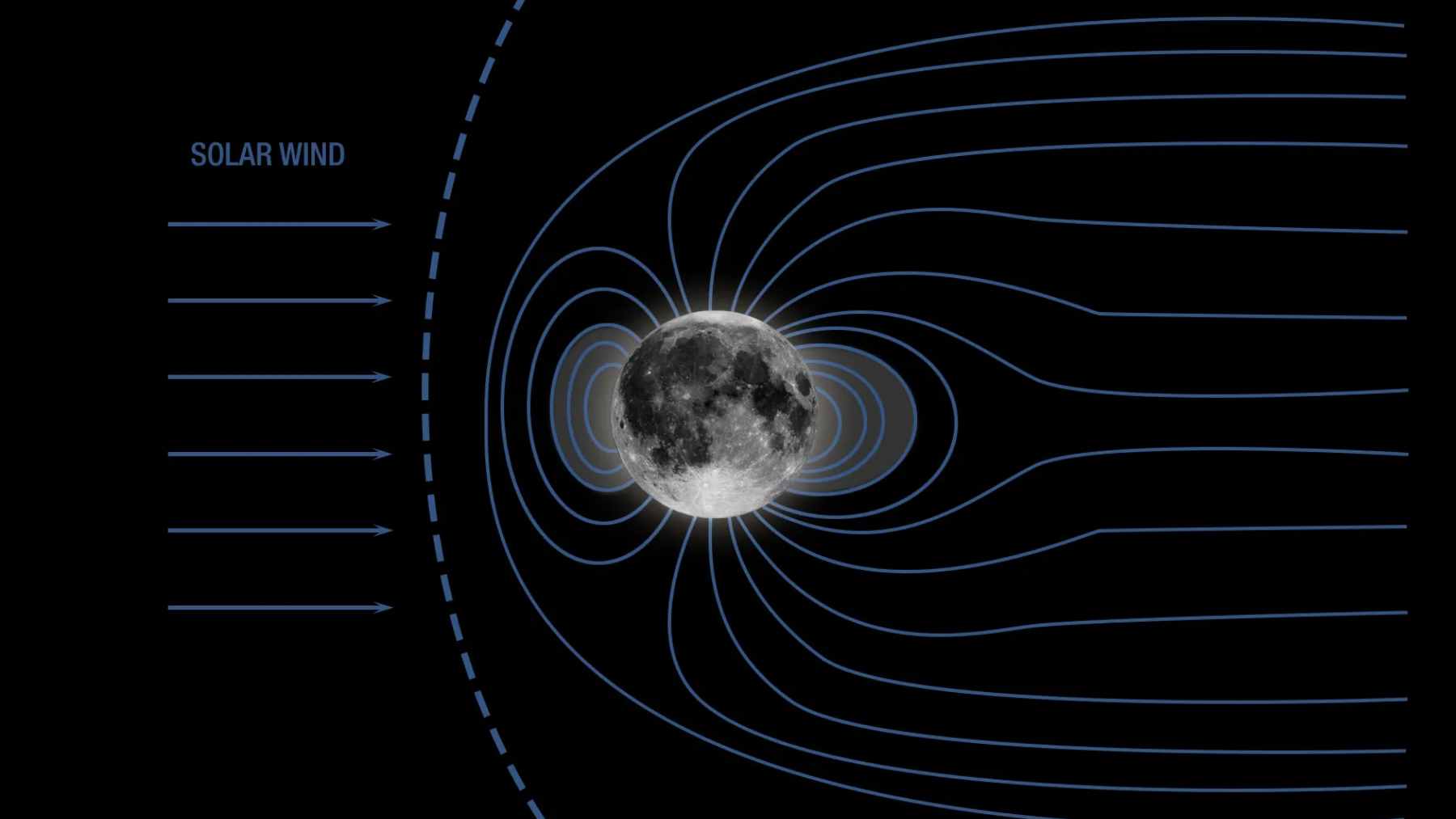
But the new modeling shows a more nuanced story. When the solar wind hits Earth’s magnetic bubble, it can grab charged particles from the upper atmosphere and sweep them down Earth’s long magnetic tail, the magnetotail.
When the Moon happens to pass through that tail, some of those particles get implanted into the lunar surface instead of being lost to deep space.
The team behind the work combined advanced 3D magnetohydrodynamic simulations with models of how different gases in the upper atmosphere become ionized and escape. Their results suggest this “leak” has been happening efficiently throughout the long history of Earth’s dynamo rather than during a brief, unshielded phase in the planet’s early past.
In practical terms, that means the Moon has been quietly collecting a thin but steady drizzle of terrestrial material for billions of years.
Why lunar soil is a time capsule for Earth
Apollo astronauts brought back samples of the lunar regolith in the 1960s and 70s. Those grains turned out to be loaded with “volatile” elements such as nitrogen, hydrogen, noble gases and traces of water, even though the Moon itself is almost completely dry inside.
NASA’s Lunar Sample Compendium and decades of lab work have shown that much of this material comes from the solar wind, which implants particles directly into the top layer of dust.
The puzzle was nitrogen. There is more nitrogen in the lunar soil than the Sun alone can explain, and its isotopic “flavor” does not quite match the solar wind either. Earlier studies proposed that this extra nitrogen might come from ancient interstellar grains, comet impacts or a brief period when Earth lacked a magnetic field and its atmosphere was easily stripped.
The new simulations take a different approach. By tracking how solar wind flows around Earth and how atmospheric ions behave with and without a magnetic field, the authors find that a magnetized Earth still sends plenty of atmospheric material down the magnetotail.
When the Moon passes through that region, some of those ions slam into the surface and become trapped in the regolith.
To a large extent, that steady trickle can account for the “non‑solar” component measured in Apollo grains, especially for nitrogen and light noble gases.
In other words, the Moon’s soil may be recording the chemistry of Earth’s atmosphere over a huge span of time, not just during some short, violent episode in the early solar system.
A leaky shield, not a perfect wall
For years, scientists have debated whether having a strong magnetic field always protects a planet’s atmosphere. On paper, a global field should deflect charged particles from the Sun and help a world stay habitable. Reality looks a bit messier.
The new work supports the idea that magnetospheres are more like leaky umbrellas than solid domes. The field does reduce direct erosion by the solar wind, but it also stretches the upper atmosphere into a long tail. In that tail, the wind can still grab and accelerate ions away from the planet.
The simulations compare an early unmagnetized Earth with a stronger young solar wind to the modern, magnetized Earth under today’s calmer conditions.
Surprisingly, the researchers find that the magnetized case can send as much or more atmospheric material toward the Moon when you average over time. What really matters for escape is the power of the solar wind and the structure of the upper atmosphere, not just whether a field exists.
That nuance is important far beyond our own backyard. It feeds into ongoing questions about why Mars lost much of its atmosphere while Earth did not, and how long other rocky planets around distant stars can stay friendly to oceans and life.
What this means for future lunar explorers
For future astronauts and robotic explorers, this result is more than a curiosity. If pieces of Earth’s atmosphere are locked into lunar grains, then the Moon’s regolith is not just a scientific archive but also a potential resource.
NASA’s overview of Moon water and ices already highlights how even tiny amounts of hydrogen and oxygen in the soil could help support long‑term missions.
The new study adds nitrogen and other light gases to the list of interesting targets. In principle, processing regolith in certain regions could yield ingredients for breathable air, fertilizers or fuels, instead of hauling everything from Earth at tremendous cost.
It will not be as simple as scooping up dirt and shaking out air, of course. Extracting these atoms will take energy, hardware and clever engineering, much like any other in‑situ resource use on the lunar surface.
Still, the idea that the Moon has been catching and storing traces of Earth for eons gives future missions one more reason to treat the regolith as more than just dust.
Reading Earth’s past in lunar dust
If the Moon has been acting like a slow‑motion sampler of our atmosphere, then buried soil layers could preserve a kind of environmental timeline. Deeper layers would reflect older conditions in Earth’s upper atmosphere, while shallower ones would record more recent states.
Careful drilling and analysis could, in theory, reveal how the mix of gases escaping Earth has changed through time. That might tell us something about long‑term shifts in volcanic activity, the buildup of oxygen, or even how life altered the air long before humans started worrying about climate change and the electric bill.
In everyday terms, the Moon may be holding onto “air fossils” from different eras of Earth history. Reading them will not be easy, but the payoff could be huge for scientists trying to understand how a habitable planet evolves.
And this story connects to our present‑day sky as well. As people prepare to watch upcoming celestial shows like a total Blood Moon or a particularly bright full Moon, it is worth remembering that our satellite is not just a pretty disk.
It is also a partner in Earth’s long environmental story, storing tiny clues about where our air has been and where it might be headed.
A new way to think about Earth and its neighbor
At the end of the day, this research invites us to see Earth and the Moon less as separate worlds and more as a linked system. Earth’s atmosphere, solar activity, the shape of our magnetotail and the lunar regolith are all part of the same slow exchange.
For most of us, that exchange is invisible. We notice the Moon during special events like a pink micromoon or a red eclipse, then go back to traffic, deadlines and the glow of city lights. Up there, though, the dust keeps quietly storing atoms that once floated high above our heads.
Future missions that combine surface drilling, sample return and high‑precision lab work could turn the Moon into one of the best archives we have for Earth’s atmospheric history. That record would not replace satellites, ice cores or ocean sediments, but it could stretch much farther back in time than any of them.
The study was published in Communications Earth & Environment.