Far below the surface of Antarctica, IceCube is listening for some of the quietest messengers in the universe. Its latest all-sky search combined two kinds of neutrino signals for the first time in this way, giving scientists their most sensitive IceCube scan yet for steady sources of high-energy neutrinos.
The big clue is not a brand-new discovery, at least not yet. Instead, the search points again toward NGC 1068, a nearby active galaxy with a powerful central engine, adding weight to the idea that some hidden galactic cores may be factories for the particles tied to the universe’s most extreme cosmic rays.
A detector buried in ice
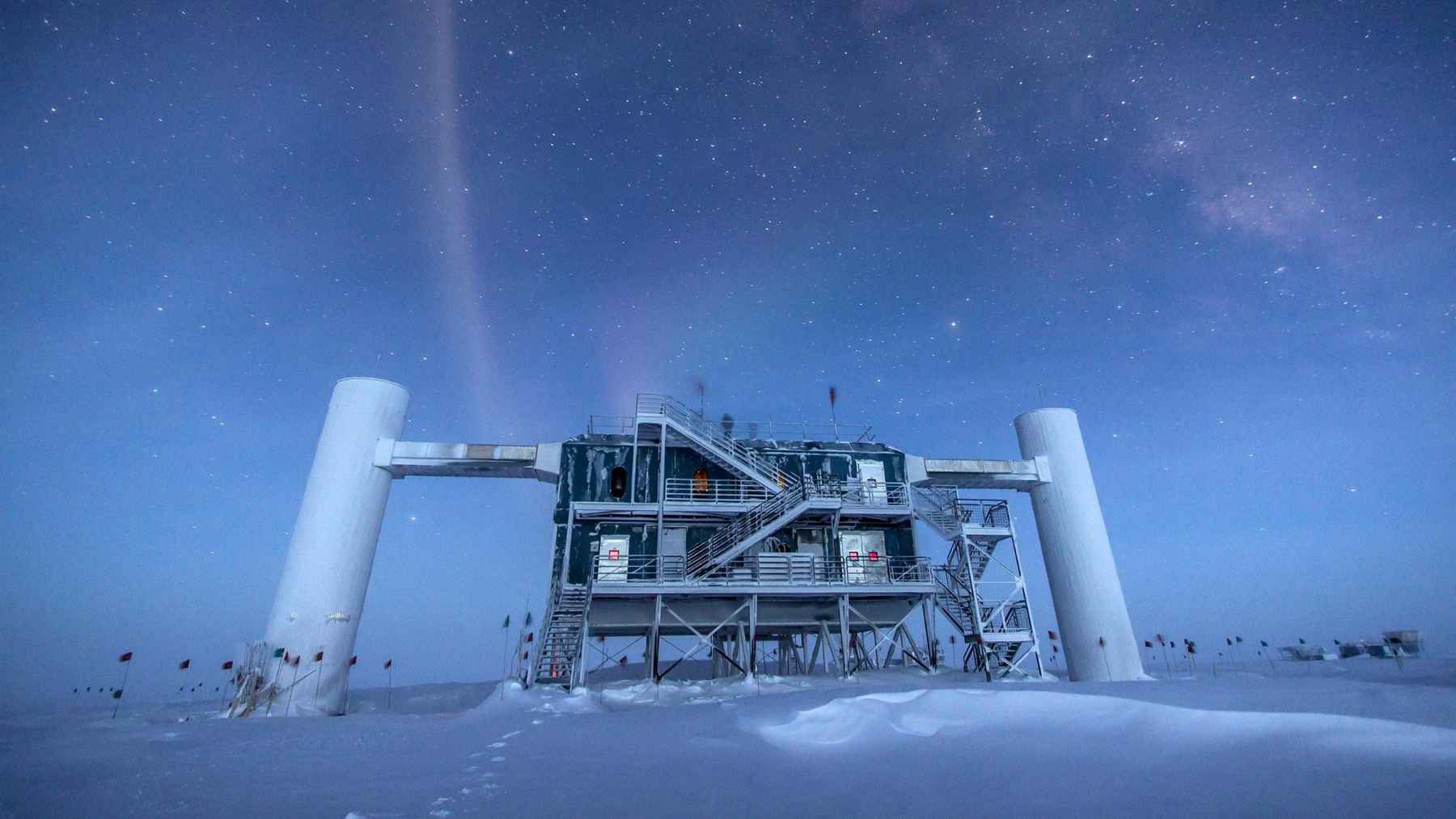
IceCube is not a telescope in the everyday sense. There is no shiny mirror, no mountaintop dome, and no eyepiece waiting for a patient stargazer.
Instead, the observatory uses optical sensors frozen deep in Antarctic ice at the South Pole. The in-ice array includes 5,160 digital optical modules spread through about 0.24 cubic miles of ice, at depths of roughly 4,757 to 8,038 feet.
When a neutrino finally interacts with the ice, it can create a flash of blue light. IceCube catches that faint signal and uses it to estimate where the particle came from and how much energy it carried.
Tiny particle. Huge question.

Tracks and cascades
In this new analysis, the IceCube Collaboration combined 14 years of track data with 10 years of cascade data. Tracks are long, narrow signals often produced by muon neutrinos, and they are especially useful because they can point back toward a source with sharper angles.
Cascades look more like compact bursts of light. They usually have less precise directional information, but they can give scientists better energy measurements, which matters when the goal is to separate ordinary background noise from a possible cosmic source.
The two signal types help cover different parts of the sky. Tracks tend to perform well in the Northern Hemisphere, while cascades are especially valuable in the Southern Hemisphere, where the background is harder to handle.
The brightest northern clue
The team used a maximum likelihood method to scan the whole sky for places where neutrinos appeared more often than expected by chance. They also checked 167 known gamma-ray sources to see whether any lined up with a stronger neutrino signal.
After accounting for the many sky positions tested, the most interesting northern point lined up with NGC 1068. Riya Shah, a PhD student at Drexel University who led the study, said, “We found that one spot in the sky, very close to the galaxy NGC 1068.”
That does not mean scientists can call it a confirmed discovery from this search alone, but it does matter, because NGC 1068 has already shown up in earlier IceCube work as one of the strongest candidates beyond the Milky Way.
Why NGC 1068 matters
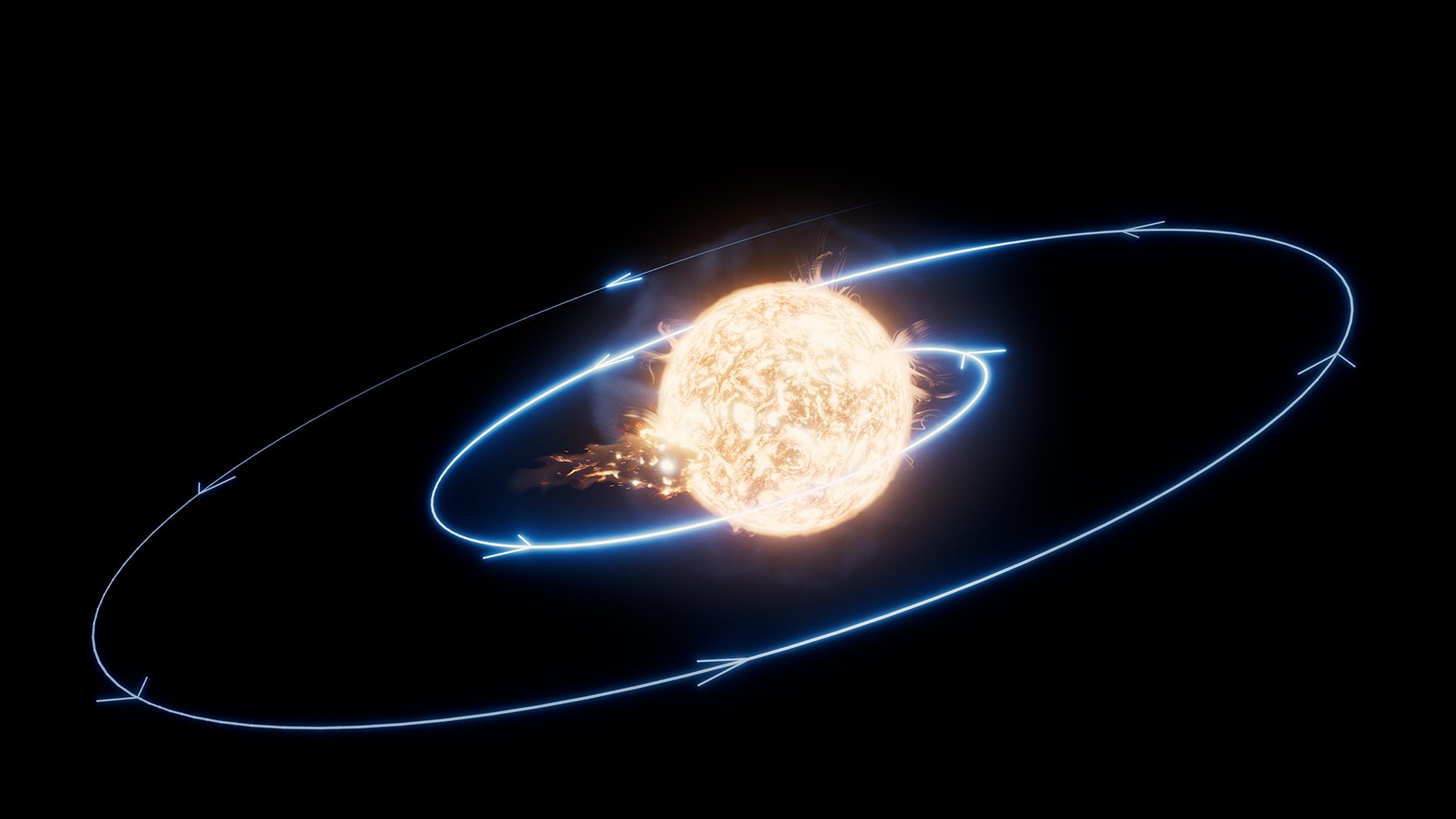
NGC 1068 is a Seyfert II galaxy, meaning it has an active center powered by a supermassive black hole pulling in gas and dust. That crowded, energetic environment is exactly the kind of place where researchers suspect cosmic rays may be accelerated to extreme energies.
In 2022, IceCube reported evidence for high-energy neutrino emission from NGC 1068, with an excess of 79 neutrinos at tera-electron-volt energies and a global significance of 4.2 sigma.
The new search strengthens the case because the same galactic region appeared again using a different and broader analysis method. That is the sort of repeat clue scientists look for when a signal might be real, not just a statistical oddity.
Not a quick flare
The team also asked a key question. Was the NGC 1068 signal caused by a short burst, or has the galaxy been glowing steadily in neutrinos for years?
The analysis ruled out flares shorter than four years as the sole explanation for NGC 1068’s appearance as a neutrino source. That points, for the most part, toward steadier emission over a long period.
That detail is important. A steady source is easier to compare with physical models of what might be happening near the galactic core, where dense gas and radiation fields can help turn cosmic-ray collisions into neutrinos.
The southern mystery
The Southern Hemisphere result is also intriguing, but less settled. The hottest southern point did not line up with any source in the catalog, and it did not appear as the top hot spot when tracks or cascades were analyzed separately.
That is where the combined method earns attention. By putting both signal types into one framework, IceCube may be able to spot features that single-channel searches miss.
Still, caution matters here. After statistical corrections, neither the northern nor southern hot spot was strong enough to reject the background explanation on its own. In science, close is exciting, but close is not the same as confirmed.
Why neutrinos are special
Neutrinos are often called “ghost particles” because they almost never interact with ordinary matter. They can pass through planets, stars, and vast cosmic distances with very little interference.
That makes them hard to detect, but it also makes them powerful messengers. Unlike charged cosmic rays, neutrinos are not easily bent by magnetic fields, so they can point more directly back to where they were born.
For anyone wondering why this matters, here is the simple version. If scientists can identify the sources of high-energy neutrinos, they may also get closer to solving where the most energetic cosmic rays come from.
What comes next
IceCube will keep gathering data, and every additional year helps when researchers are looking for sources that shine steadily over time. Better catalogs of active galaxies, especially dusty or hidden ones, could also help separate real sources from background noise.
The bigger picture is easy to miss because the particles are invisible and the detector is buried in ice, but the stakes are large. This work is part of a growing effort to map the universe not only with light, but with particles that can escape places light cannot. And NGC 1068 keeps turning up.
The study was published in The Astrophysical Journal.