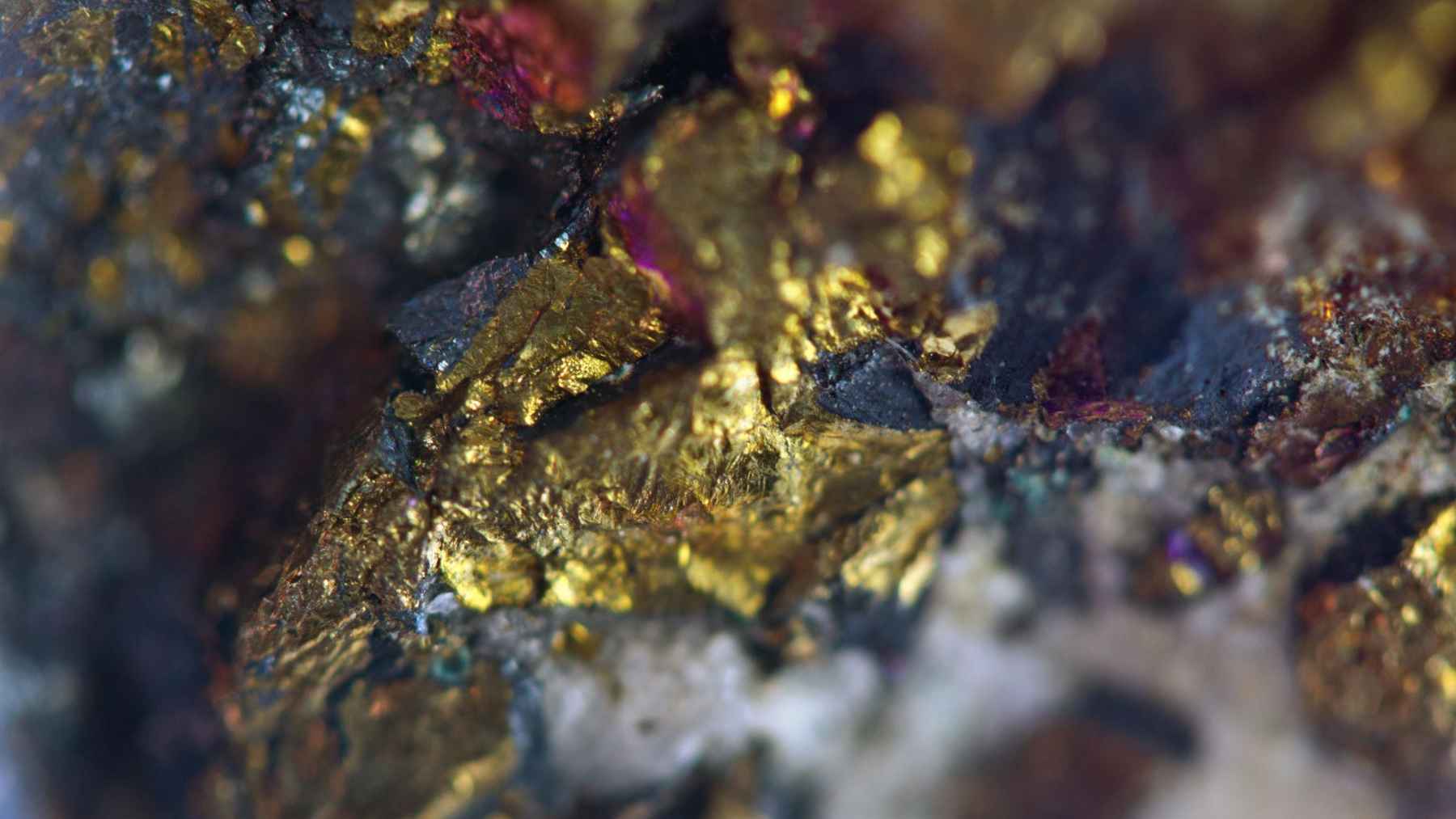
Gold has a reputation for staying calm under pressure. That is why people trust it in jewelry, electronics, and scientific experiments where researchers need a material that will not easily react. However, in a recent high-pressure lab test, gold did something scientists did not expect at all.
An international team accidentally created a new compound called gold hydride, made only from gold and hydrogen. The finding shows that even one of chemistry’s most famous “quiet” metals can change its behavior when squeezed and heated far beyond everyday conditions.
Gold was not supposed to react
The experiment was led by Mungo Frost, a staff scientist at SLAC National Accelerator Laboratory, and involved work at European XFEL in Germany. The team was not trying to make a new gold compound. They were studying how simple hydrocarbons, materials made from carbon and hydrogen, behave when they are pushed toward diamond-forming conditions.
Gold was added as a thin foil because it usually acts like a passive tool in these tests. It absorbs X-rays and helps heat the tiny sample, rather than joining the chemistry itself. That is exactly why the result caught researchers off guard.
“It was unexpected because gold is typically chemically very boring and unreactive,” Frost said in the SLAC report. In practical terms, the metal that was supposed to sit quietly in the background became part of the main story.
How gold hydride formed
The researchers squeezed tiny hydrocarbon samples between diamond tips inside a device called a diamond anvil cell. Think of it as a miniature press that can crush a sample with forces far greater than anything we experience at the surface.
The pressure climbed above about 5.8 million pounds per square inch. Then the team fired intense X-ray pulses into the sample, heating it to more than 3,500 degrees Fahrenheit, according to the SLAC report.
Under those brutal conditions, hydrogen released from the hydrocarbons entered the gold structure. X-ray scattering data showed that the gold atoms shifted into a new ordered pattern while hydrogen moved through the gaps, creating solid gold hydride.
A strange state of hydrogen
Hydrogen is the lightest element, which makes it difficult to track directly with X-rays. Here, the gold helped. The heavier gold atoms changed the way they scattered X-rays, giving researchers a clearer sign of what the hydrogen was doing.
The hydrogen entered what scientists call a superionic state. That means the gold atoms stayed in a solid framework, while the hydrogen moved through it more freely, almost like a liquid inside a solid. This unusual behavior also made the material more conductive.
Why does that matter? Dense hydrogen is believed to play a major role inside giant planets and stars. A related study in Physical Review Letters found that superionic compounds involving silica, water, and hydrogen could help explain unusual magnetic fields in Uranus and Neptune.
Why planets are part of the story
Inside worlds such as Jupiter, pressure can become so intense that hydrogen stops behaving like the simple gas we know from school science class. It can become dense, electrically active, and deeply important to how planets move heat and generate magnetic fields.
The new gold hydride gives scientists a controlled way to study that kind of hydrogen in the lab. It is not the same as taking a sample from deep inside a planet, of course. However, it gives theorists something real to measure against, and that can sharpen models of faraway worlds.
That is the wider point. A tiny sample squeezed between diamonds may help scientists understand places we cannot visit, from the interiors of giant planets to the extreme conditions linked to fusion, the process that powers stars like the Sun.
What it means for fusion research
Fusion experiments depend on knowing how hydrogen behaves when it is packed under enormous pressure and heat. Small errors in that behavior can change how researchers predict fuel performance.
By watching how hydrogen moved through gold under known conditions, the team created a useful benchmark. It gives modelers another way to test whether their calculations match physical reality, not just a computer screen.
That does not mean gold hydride is about to power a reactor. Not even close. However, extreme-materials research often works this way, with a strange lab result opening a door that seemed locked before.
Gold is still gold at home
This discovery does not mean your wedding ring or necklace is suddenly unstable. Gold hydride formed only under crushing pressure and extreme heat, then separated back into ordinary gold when the conditions relaxed.
That detail is important. Gold remains valuable in everyday life because it resists corrosion, keeps its shine, and rarely reacts under normal conditions. The new work shows that “rarely” does not mean “never.”
The finding also gives high-pressure chemists a warning. If gold can react under these conditions, other supposedly inert materials may not be as silent as researchers once assumed.
A new map for extreme chemistry
Researchers are now building a bigger picture of chemistry under pressure. Water, hydrogen-rich materials, and now gold hydride all show that atoms can form unexpected phases when conditions move beyond ordinary experience.
Some of these phases vanish as soon as pressure or temperature drops. Still, their brief existence matters because similar conditions may be common inside planets, stars, and high-energy laboratory experiments.
At the end of the day, the discovery is a reminder that the periodic table still has surprises left. Even gold, the metal famous for not changing, can behave differently when nature’s rules are pushed hard enough.
The main study has been published in Angewandte Chemie International Edition.