Most spacecraft are built to avoid disaster. Venera 13 was built to meet one head-on. On March 1, 1982, the Soviet lander touched down on Venus and kept transmitting for 127 minutes, nearly four times its planned 32-minute life, from a surface that should have destroyed it in half an hour.
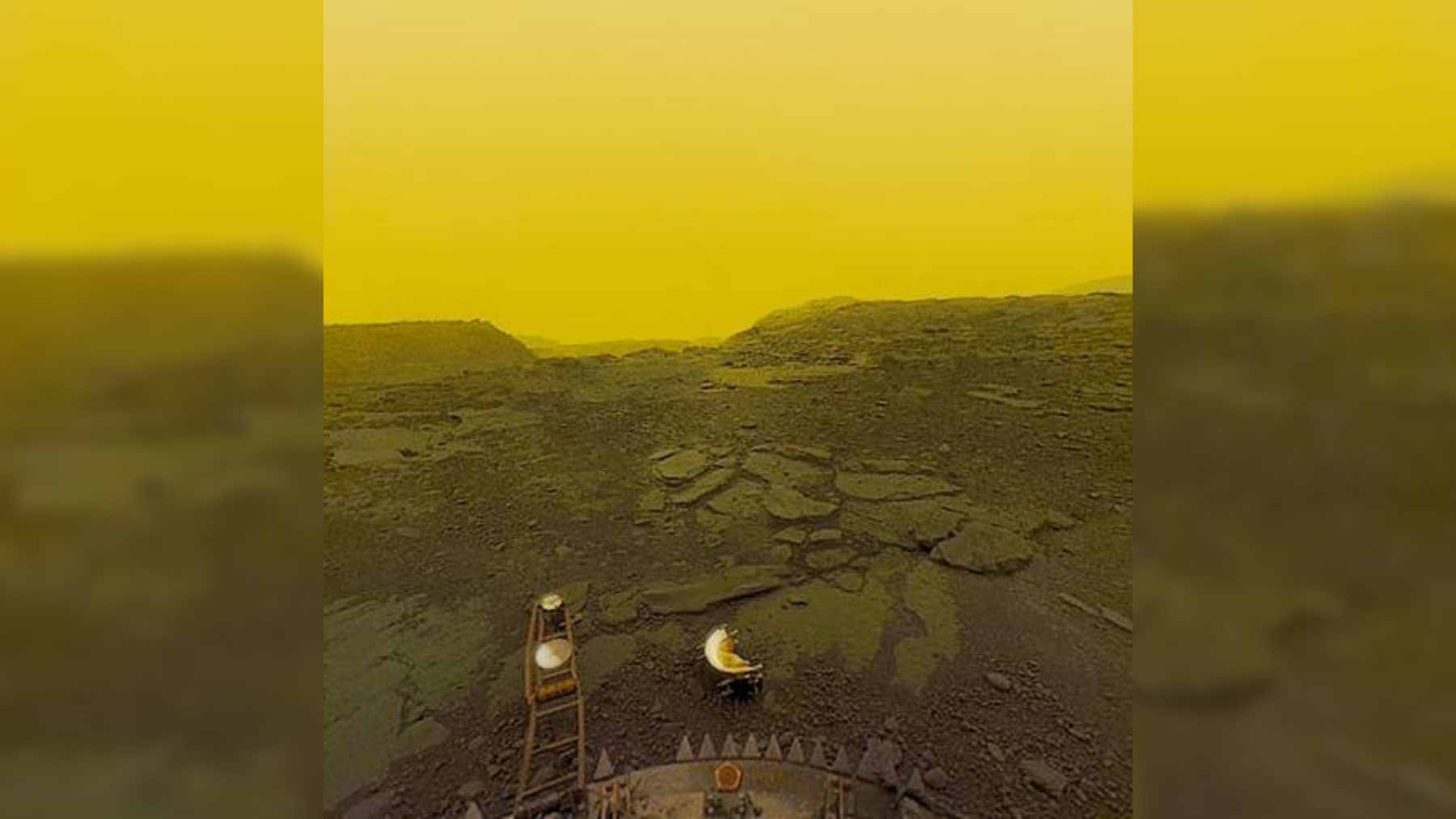
What did it send back? Panoramic views of a dim, orange-tinged world covered with flat rocks and dark soil, plus measurements from one of the harshest environments any machine has ever entered. NASA describes Venus as the hottest planet in the solar system, with surface heat “hot enough to melt lead” and atmospheric pressure about 93 times Earth’s sea-level pressure.
A landing in hell
Venera 13 landed east of Phoebe Regio, at about 7.5 degrees south latitude and 303 degrees east longitude. The numbers matter because Venus is not just “hot” in the way a desert afternoon is hot. It is another category entirely.
Read More: {{post_title link:post}}
At the landing site, the temperature was about 855 degrees Fahrenheit. Lead melts at about 621 degrees Fahrenheit, so the comparison is not a metaphor. The pressure was about 89 Earth atmospheres, or roughly 1,300 pounds per square inch, similar to being more than 3,000 feet underwater.
Think about that for a second. Mars is cold, the Moon is airless, and Titan is frozen. Venus does something nastier, since it cooks and crushes a lander at the same time.
Why 127 minutes mattered
Venera 13 was expected to function for about 32 minutes. Instead, it sent data for two hours and seven minutes, a small window by Earth standards but a major engineering win on Venus.
That extra time was not just a bragging point. It meant the pressure vessel, insulation, thermal mass, and cooling design performed better than expected while the planet’s atmosphere kept forcing heat inward.
For scientists, every added minute mattered because surface data from Venus remains extremely rare. NASA notes that 10 Soviet probes reached the Venusian surface, with the longest survivor lasting about two hours.
What the cameras saw
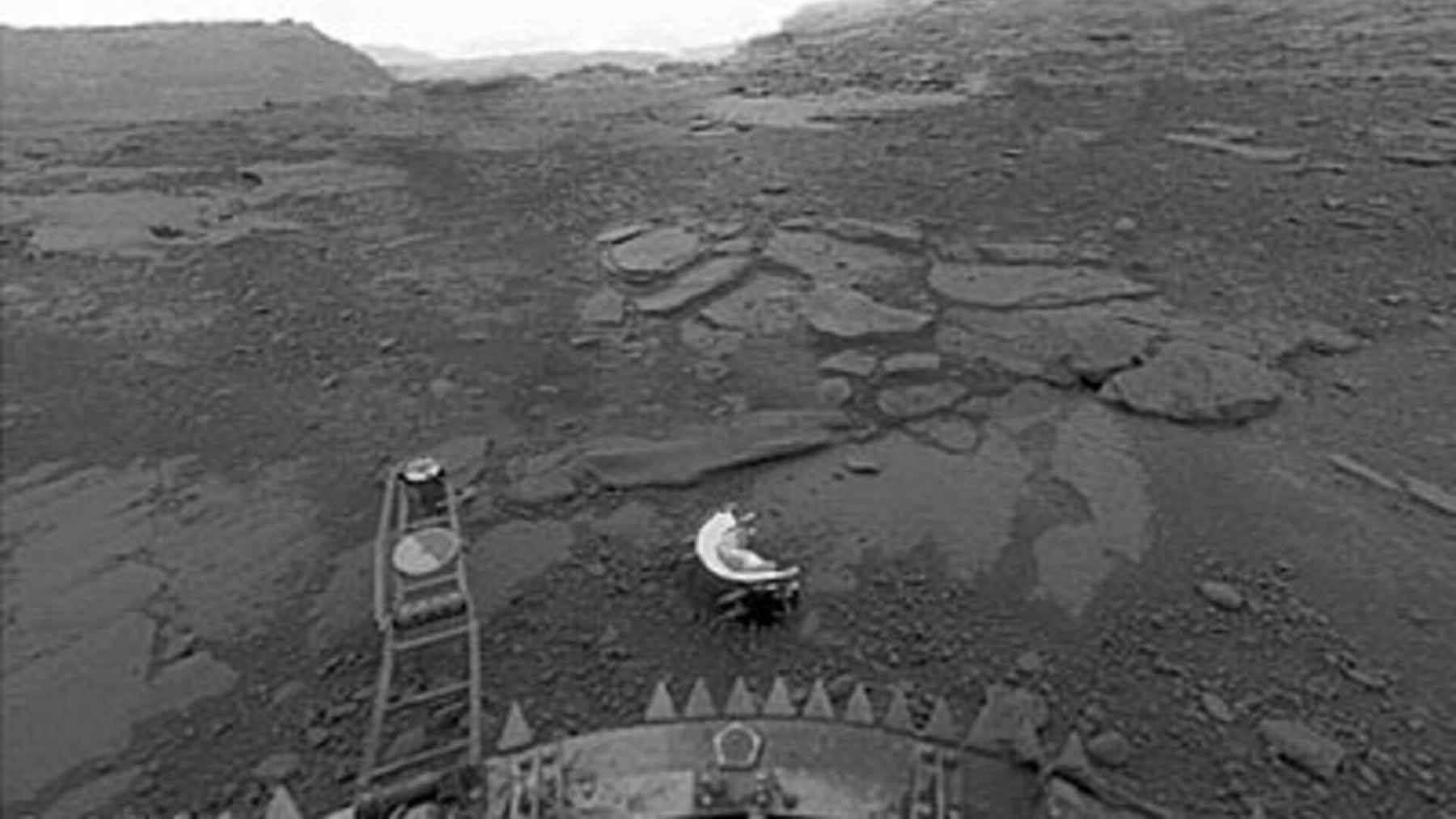
Venera 13 carried two camera systems facing opposite directions and became one of the missions that returned color images from the Venusian surface. The panoramas showed flat, plate-like rocks, darker fine-grained material, and a sky that appeared orange after the thick atmosphere filtered the sunlight.
That color is not as simple as opening a phone camera and taking a snapshot. The balance depends on how the original data is processed, and researchers have produced different versions over time. Still, the broad impression remains hauntingly consistent, a rocky plain under a heavy, sulfur-colored sky.
Read More: {{post_title link:post}}
The lander also revealed why Venus is so hard to study from orbit alone. Dense clouds made mostly of sulfuric acid hide the surface, while the lower atmosphere is thick with carbon dioxide. In practical terms, Venus wears a permanent mask.
A drill on another world
The lander did more than take pictures. A mechanical arm drilled into the surface, collected a sample, and moved it into a sealed onboard chamber kept at about 86 degrees Fahrenheit and roughly 0.7 pounds per square inch.
That protected chamber allowed an X-ray fluorescence spectrometer to study the sample before the heat outside won. The results linked the Venera 13 site to alkaline, basalt-like rocks, while Venera 14, which landed about 590 miles away four days later, found chemistry closer to oceanic tholeiitic basalts.
Why should anyone care about two rock samples from the 1980s? Because Venus’ crust is still poorly understood. A later review in Space Science Reviews noted that the only direct in-place measurements of Venus surface materials come from Soviet Venera and Vega landers, and that major-element data were measured by X-ray fluorescence at Venera 13, Venera 14, and Vega 2 sites.
The sound of Venus
The pictures get most of the attention, and understandably so. However, Venera 13 also carried instruments that measured the lower atmosphere, surface composition, electrical discharge during descent, and wind conditions near the ground.
One especially fascinating detail is its microphone. Venera 13 is widely recognized for returning acoustic data from another planet’s surface, including information used to estimate wind speed.
It is easy to picture Venus as silent because it looks so alien. However, a dense atmosphere changes that. On the ground, beneath the clouds, Venera 13 was not only looking at another world but also listening to one.
The lesson Venus still teaches
More than four decades later, Venera 13 still holds a special place in planetary exploration. Not because it lasted long, but because it lasted long enough.
Those 127 minutes gave scientists real ground truth for a planet often described as Earth’s twin gone wrong. Venus is similar in size and structure to Earth, but its runaway greenhouse atmosphere turned it into a place where electronics fail, metal softens, and ordinary spacecraft design becomes almost useless.
Read More: {{post_title link:post}}
NASA is now developing new Venus missions, including VERITAS and DAVINCI, to investigate the planet again.
At the end of the day, Venera 13 reminds us that exploration is sometimes measured in minutes, not years. A probe can die quickly and still change what humanity knows about a planet.
The official mission summary was published on the NASA Science website.