Climate change may bring a strange twist to one of the world’s most important crops. A new study suggests that soybeans exposed to higher carbon dioxide, hotter temperatures, and drought could produce more grain, but with a weaker nutritional profile.
That sounds like good news at first. More soybeans could mean more supply for food, cooking oil, and animal feed, but the catch is hard to ignore. According to researchers at the University of São Paulo in Brazil, the projected grain increase came with less protein, less starch, and a major shift in amino acids.
More soybeans, lower quality
The study, published in Food Research International, looked at what scientists call the “triple effect” of climate change on soybeans. That means elevated CO₂, high temperature, and drought acting together, not just one stress at a time.
Using artificial intelligence models fed with experimentally verified data, the team projected that soybean grain production could rise by 50% under the combined climate scenario. At the same time, the seeds showed a 20% drop in starch and a 6% drop in protein, while amino acid content rose by 175%.
Why does that matter? For the most part, soybeans are valued because they pack protein and energy into a small seed. If the crop becomes more abundant but less nutritious, farmers, food companies, and livestock producers may not get the same value from every harvest.
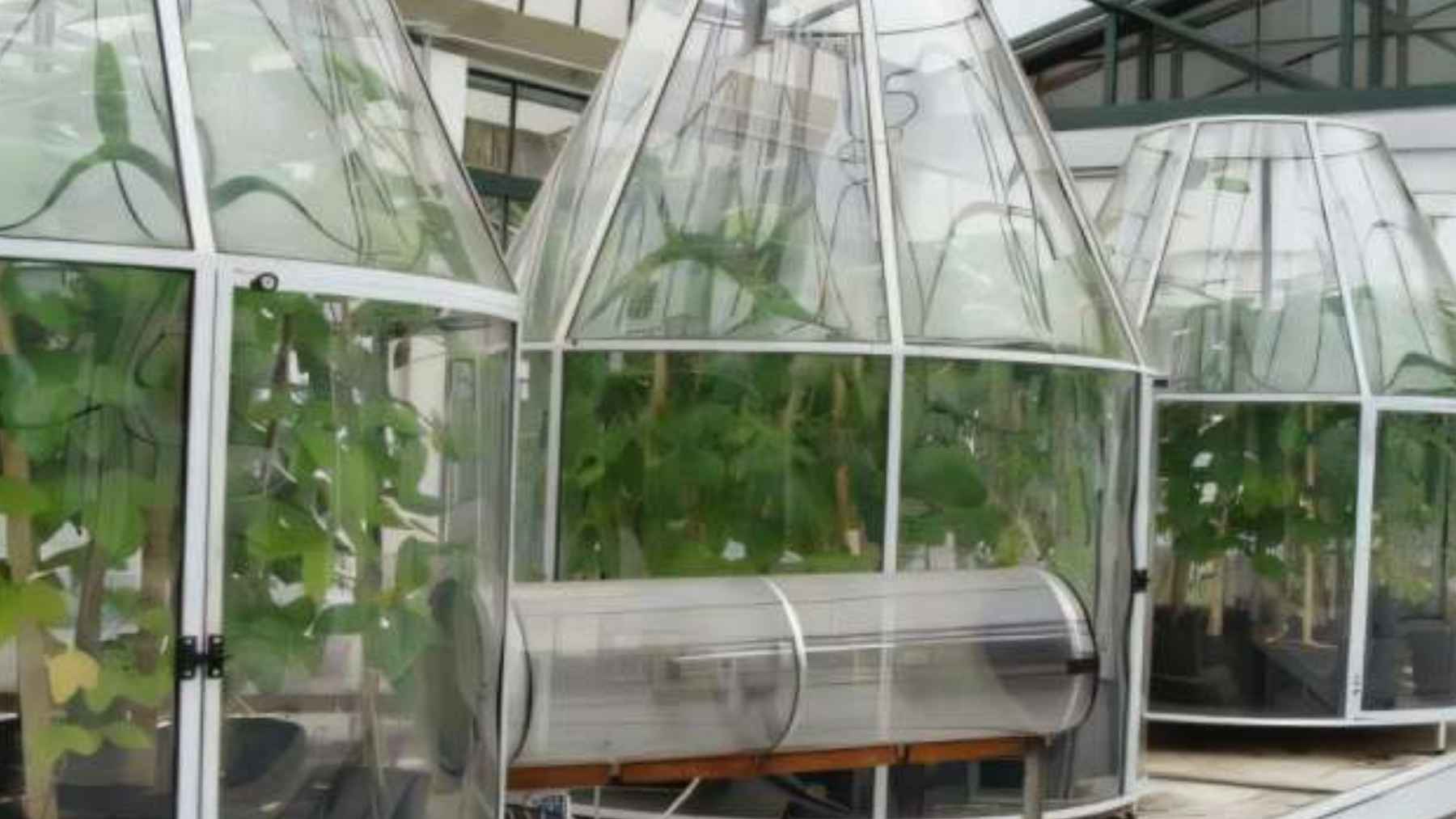
Experimental open-top chambers where researchers exposed soybean plants to higher CO₂ levels, increased temperatures, and drought conditions to simulate future climate scenarios.
The surprise in the seed
The research was led by scientists from the Laboratory of Ecological Plant Physiology at the University of São Paulo’s Institute of Biosciences. Marcos Buckeridge, coordinator of the lab, said the amino acid jump was not expected.
“That increase in amino acids was unexpected,” Buckeridge said. He also warned that researchers still do not know what that shift could mean for animals that eat soy-based feed.
In practical terms, the issue is not just how many soybeans grow in a hotter world. It is what those soybeans are made of. Less starch means less stored energy, while less protein could affect the crop’s value as a key ingredient in feed and food systems.
Why CO₂ changes the story
Carbon dioxide can act like fertilizer for some plants. When more CO₂ is available, the plant can photosynthesize more easily and, in many cases, grow faster.
Buckeridge explained that higher CO₂ can also help plants save water. The tiny pores on leaves, called stomata, close slightly, allowing the plant to take in carbon dioxide while losing less moisture. That matters when drought is part of the picture.
But plants are not machines. When too much carbon enters the system, the plant may not process it in the usual way. In soybeans, the researchers found signs that carbon was being redirected toward cell wall material, such as cellulose and hemicellulose, rather than staying in the seed as starch.
Heat, drought, and a messy mix
When studied separately, higher CO₂ increased soybean grain production by up to 142%. High temperature and drought moved in the opposite direction, cutting yield by 91% and 60%, respectively.
So what happens when all three arrive together? That is where the path gets muddier. The researchers found that the stresses did not simply cancel each other out.
“I was surprised that it grew more with all three stress factors,” Buckeridge said. The trouble is, the extra growth came with a nutritional trade-off, showing how climate pressure can change not only the size of a harvest but the biology inside the seed.
How the experiment worked
The team used open-top chambers, which are tube-like structures that allow scientists to expose plants to controlled climate conditions. The chambers were about 5.2 to 5.6 feet tall, and the researchers could inject CO₂ into them.
In some treatments, CO₂ was raised from about 400 parts per million to 800 parts per million. The chambers also raised temperature by 9 °F, and drought was simulated by reducing irrigation.
The soybean variety used was MG/BR-46 Conquista, from the Brazilian Agricultural Research Corporation. Biomass measured 60 days after the experiment began was used to help predict grain yield at 125 days, giving scientists an early window into how the crop might finish the season.
AI filled the hardest gap
There is an important caveat here. The full three-factor combination was not directly validated in one giant experiment.
Instead, researchers used generalized linear models, XGBoost, and CatBoost to estimate the triple effect from experimental data on individual and dual stresses. The study itself notes that the specific three-factor combination was not experimentally validated.
That does not make the work meaningless. It means the finding is a projection based on tested pieces of the puzzle. For scientists trying to prepare agriculture for a hotter and drier future, that kind of modeling can be a warning light on the dashboard.
What comes next for crops
The next step, according to the research team, is to identify the genes behind soybean responses to heat, drought, and CO₂. With that knowledge, scientists may be able to develop plants that keep more protein and starch even under climate stress.
Buckeridge also suggested that other crops may behave in similar ways. The group has already studied dual effects in sugarcane and wants to add temperature testing and AI simulations there as well.
More food is not always the same as better food. That may be the biggest takeaway. In a warming world, the harvest basket could look fuller while the nutrition label quietly tells a more complicated story.
The study was published in Food Research International.