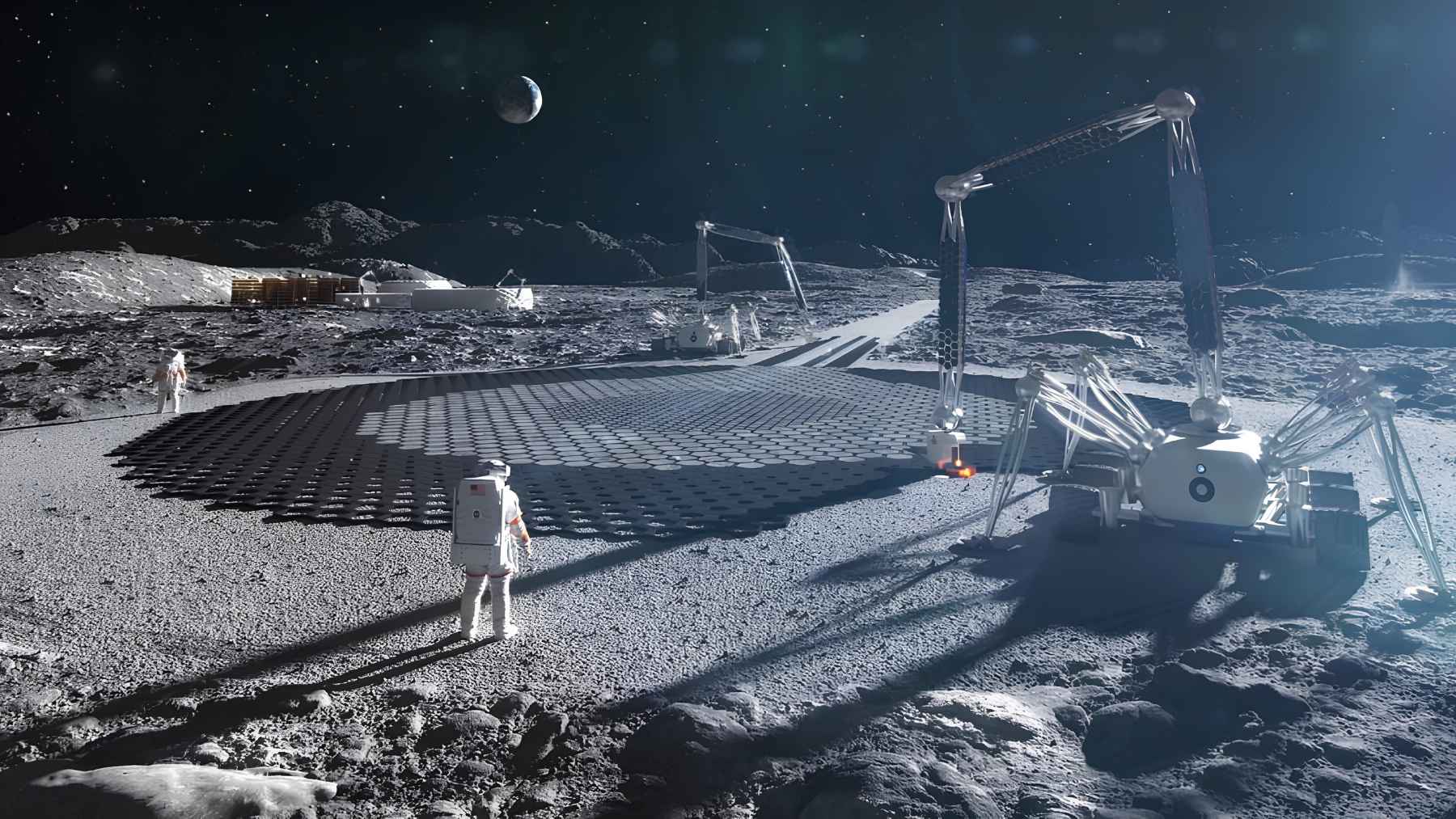
Humanity is not just planning to visit the Moon again. It is preparing to build there, with habitats, landing pads, equipment shelters, power systems, and tall structures meant to survive far longer than a short Apollo-style stay.
That raises a simple question with a complicated answer. Who decides what is safe on another world? At a recent space resources meeting in Golden, Colorado, engineer Nerma Caluk argued that lunar construction needs its own building code, because Earth’s rules were written for Earth’s gravity, soil, air, and risk tolerance.
Building on a shaky world
On Earth, building codes are a quiet part of everyday life. They help decide how a school, apartment block, hospital, or bridge should stand up to wind, fire, heavy loads, and earthquakes.
The Moon has no long tradition of inspectors, local soil maps, or lessons from past construction failures. Yet space agencies are now talking about a future where astronauts and robots live and work near the lunar south pole, a region seen as important for science and possible resources. NASA says its Moon Base effort is meant to build an enduring human presence near that area.
Why moon gravity changes everything
The Moon’s gravity is only about one-sixth as strong as Earth’s. That sounds like good news for launching, lifting, and moving heavy equipment, but it creates a strange problem for buildings.
A structure still has mass, so it can still resist sudden motion during a moonquake, yet because it weighs much less, it has less downward force helping its foundation grip the ground. In practical terms, a low building could slide, while a tall tower could have a harder time staying upright.
Caluk, a lunar specialist at Skidmore, Owings & Merrill, told Space.com that Earth structures benefit from gravity when resisting sideways shaking. On the Moon, she warned, that stabilizing help is sharply reduced, especially on poorly understood regolith, the dusty, broken rock covering the surface.
Moonquakes are not science fiction
Moonquakes are real. Apollo astronauts left seismometers on the lunar surface, and those instruments showed that the Moon can shake for several reasons, including cooling inside the Moon, Earth’s gravitational pull, meteorite impacts, and big temperature swings.
NASA explains that some shallow moonquakes can begin roughly 12 to 19 miles below the surface, reach a magnitude around 5.5, and last more than 10 minutes. That is a long time when your “house” is also your air supply.
A 2024 NASA-funded study added a sharper warning. Researchers reported that faults and moonquake risks exist near or inside some candidate Artemis landing areas around the lunar south pole, and that even light shaking could trigger landslides in loose lunar soil.
Earth’s earthquake strategy may not work there
Here on Earth, many buildings are designed to absorb earthquake energy by bending, cracking, or deforming in controlled ways. It sounds unsettling, but it can save lives by keeping a structure from suddenly collapsing.
That logic gets tricky on the Moon. If a wall shifts enough to jam a hatch or misalign a pressure seal, the problem is not cosmetic. It could threaten the mission, because even a small breach can mean loss of air.
That is why a lunar building code would not just be a paperwork exercise. It would need to define how much movement a habitat can tolerate, how foundations should be tested, and what counts as failure when astronauts are depending on every seal, panel, and cable.
The code is starting to take shape
A group inside the American Society of Civil Engineers has been working onLunar Infrastructure Engineering, Design, Analysis, and Construction guidelines, known as LIEDAC. Caluk said the effort aims to classify lunar hazards, rank the consequences of failure, and set performance targets so commercial development can proceed on a stronger technical basis.
The idea is familiar to anyone who has watched a road crew test soil before pouring concrete. Engineers need to know what is underneath. On the Moon, that means studying regolith at the actual site before building, not assuming one patch of lunar ground behaves like another.
Caluk also described a NASA-supported response-spectrum analysis, a method that estimates how structures might react to shaking. The result points to a practical rule for future bases. Investigate local ground conditions whenever possible, because a landing pad, a habitat, and a tall solar tower may face different risks.
The race to build adds urgency
The timing matters. NASA is developing surface technologies for long-duration exploration, including landing pads, roads, power systems, dust control, and construction methods that use lunar material.
The agency even compares the challenge to building a new neighborhood, only this one sits under a black sky and has no atmosphere.
China is also moving ahead through the International Lunar Research Station, which its government describes as an expandable system for long-term robotic operation with short-term human participation. A basic facility is planned for the lunar south pole region by 2035, followed by a broader network by 2050.
So the question is not whether lunar infrastructure will be discussed someday. It is already on the table. The trouble is, ambition can move faster than standards, and standards are what keep a bold plan from becoming a dangerous one.
Building safer homes off Earth
A lunar building code would not make the Moon safe in the way a city street feels safe. Dust is abrasive, temperatures are extreme, radiation is a constant concern, and help is days away at best.
But rules can reduce avoidable risk. They can tell designers how much shaking to plan for, when a site needs more testing, and how to judge whether a structure protects both people and equipment.
That may be the real shift. The Moon is no longer just a place to plant flags and collect rocks. It is becoming a construction site, and every construction site needs rules before people start trusting it with their lives.
The main report has been published in Space.com.