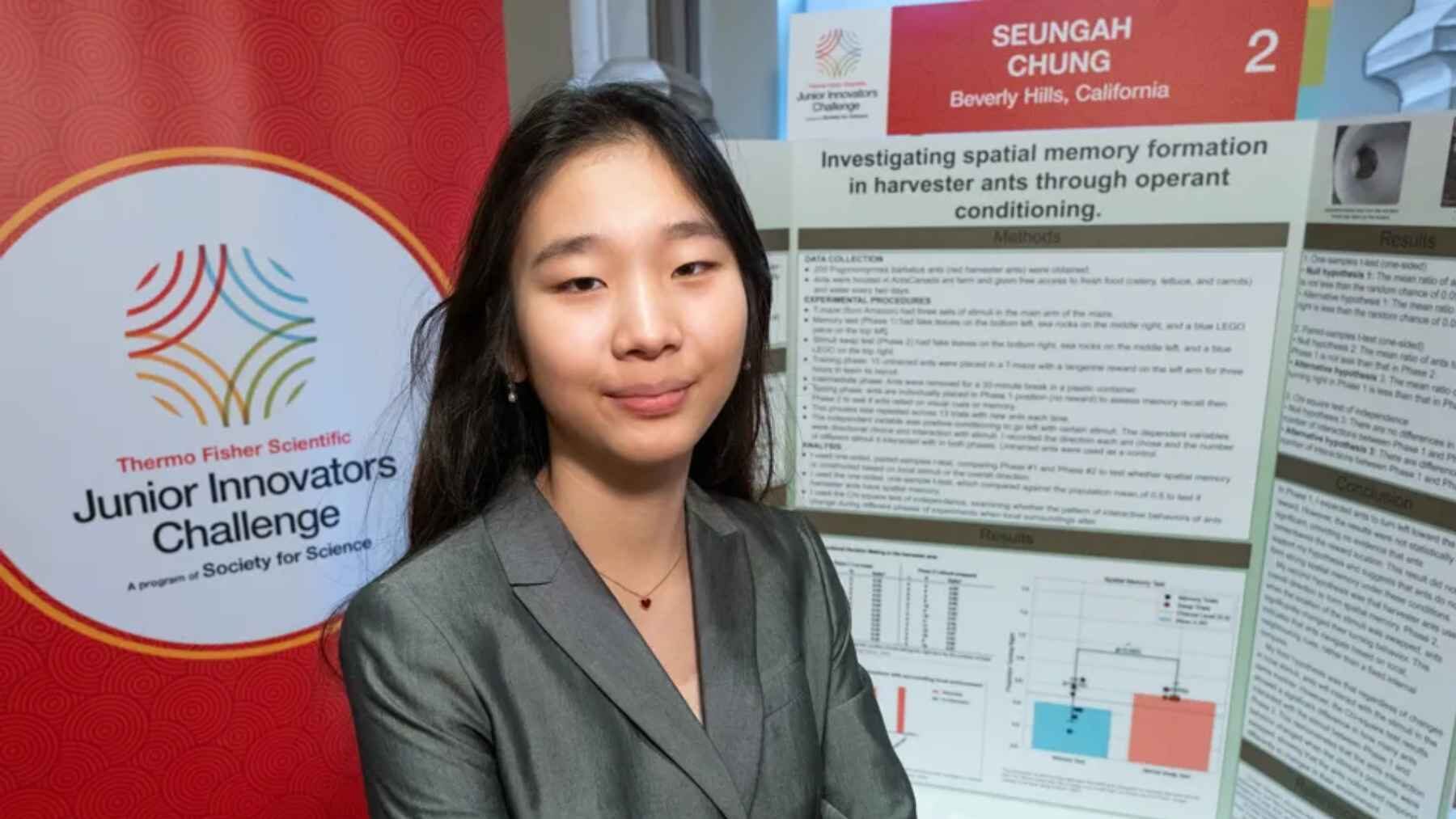
We usually notice ants only when they appear on the kitchen counter or form a line along the sidewalk. Seungah Chung studied how these insects with small brains find food, remember a route, and return directly to it.
She used a T-shaped maze to find the answer. After the ants learned a route to a tangerine reward, she moved the artificial landmarks. The ants changed direction, suggesting that they relied more on nearby objects than on a memorized left turn.
Learning from the maze
Seungah was an eighth grader at Beverly Vista Middle School in Beverly Hills, California, when she carried out the project, titled “Investigating Spatial Memory Formation in Harvester Ants Through Operant Conditioning.”
“What fascinates me is how they manage to do this with such small brains, while mammals rely on much larger and complex systems,” she said.
She had previously studied how these insects use their senses to search for food. Then she started looking at how they used their surroundings to find their way.
A simple maze with a twist
Seungah obtained 200 red harvester ants (Pogonomyrmex barbatus) and ran 13 trials with 15 untrained ants in each one. Each group spent three hours in a T-maze where a piece of tangerine was placed in the left arm and fake leaves, rocks, and a blue building block served as landmarks.
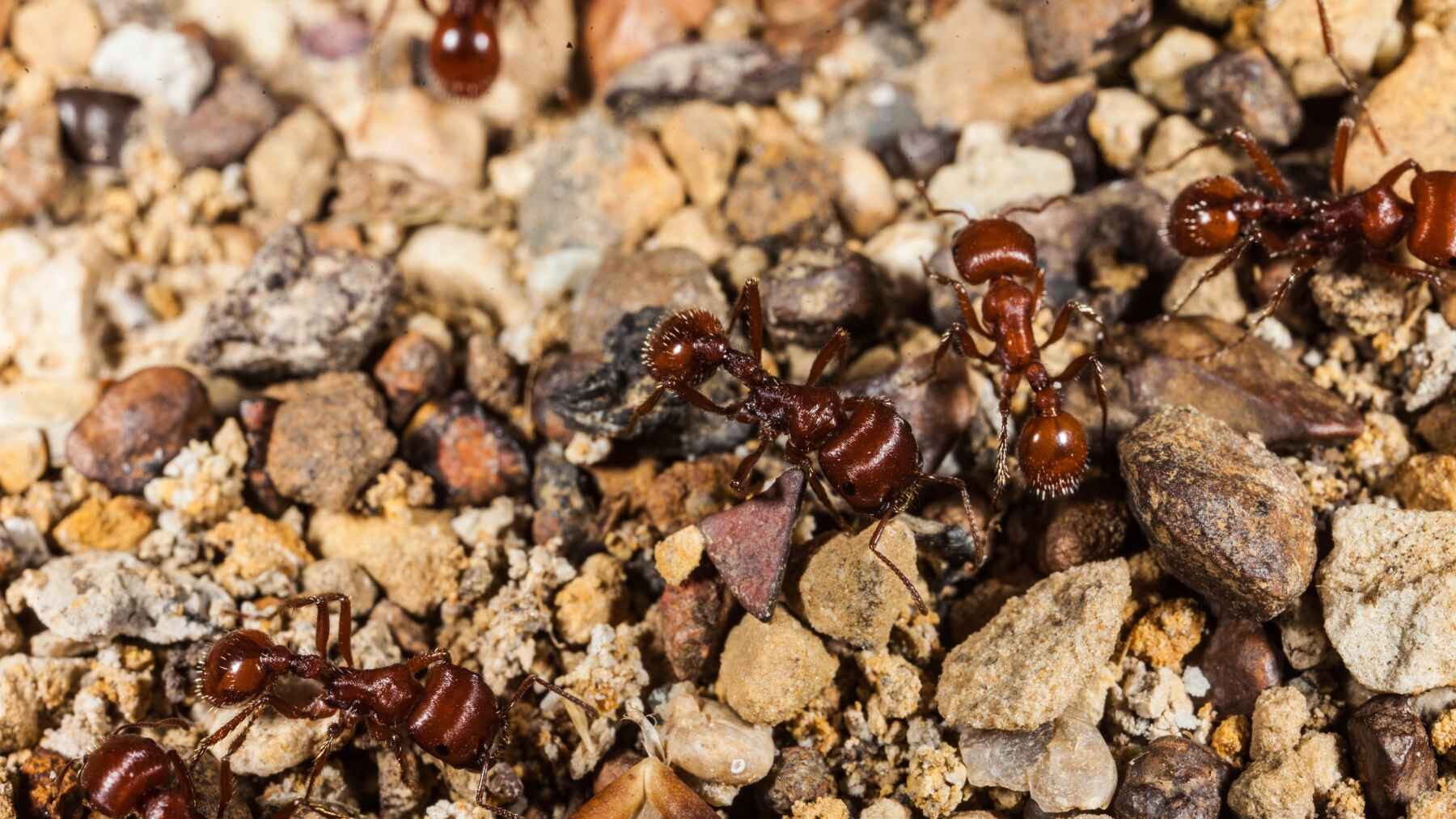
30 minutes later, she tested the ants individually without a food reward. First, she left the landmarks in their initial positions, and then moved them to the opposite side, recording turns and interactions.
Discoveries from a wrong turn
The project poster indicated that 82 of 195 ants turned right when the landmarks were not moved, but after the objects were moved, 123 of 195 turned right, showing a significant increase from 42 to 63 percent.
The official profile showed that the ants were more confused after they moved their reference points were moved. Their interactions with the objects also changed, so this tells us that they noticed a difference in the previous scene.
There is still more to learn
We can conclude from these results that what really influenced the ants was the nearby objects, more than the right and left turns they had memorized. However, we cannot determine if they relied on sight, smell or touch, as they were able to approach and touch the landmarks.
This is particularly important because published research shows that ants use several navigation tools, including distance, direction, panoramic views, and in some cases chemical trails.
Engineering and insects
This investigation is also important for engineers developing small robots that are designed to travel without using complex computers.
A 2025 Nature Communications study conducted a navigation test inspired by ant navigation, and followed 113 autonomous robots over a distance of 1.6 kilometers. They used a panoramic view of 32 x 32 pixels, with just 18.75 kilobytes of memory.
A big future for a young researcher
Seungah was named one of 30 finalists in the 2025 Thermo Fisher Scientific Junior Innovators Challenge. The competition’s top 300 were selected from 1,890 participants.
She also brings art in community service and hopes to become a microbiologist, and has a particular interest in infections and antibiotic resistance.
Initial results from a small maze
These findings come from a competition poster, which has not been reviewed by peers, so it should not be considered as an official conclusion on red harvester ant navigation. Further studies could repeat the experiment using several colonies, assess how they use their different senses, introduce blinded scoring, and repeat the experiment outdoors.
Although this was a preliminary investigation, the project shows that a small change in the ants’ surroundings can affect their behavior. The idea came from observing an insect that most people overlook.
The official project profile was published by Society for Science.