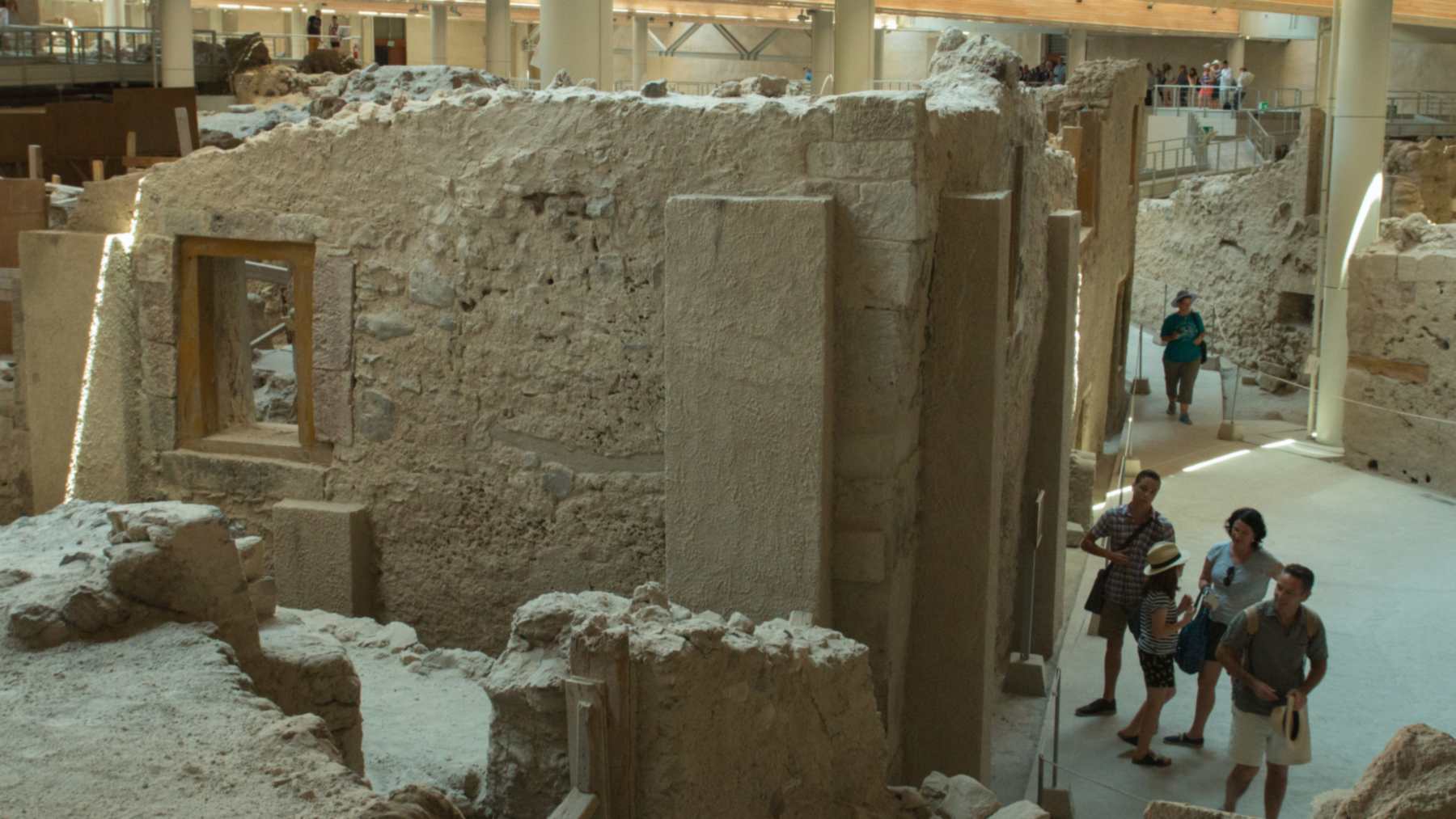
Room 4a of the West House at Akrotiri, on the Greek island of Santorini, is an upstairs space partitioned off with mudbrick walls. A database entry on the house’s architecture says it “has a lavatory, with a built bench and a pipe, leading to the sewage installation that is linked to the public network of the settlement,” a Bronze Age toilet that has survived for about 3,600 years.
That entry comes from TiMMA, a project on timber in Minoan and Mycenaean architecture hosted by the French School at Athens, which draws largely on the published studies of the building by architect Clairy Palyvou.
The publisher’s summary of Palyvou’s 2019 book on the West House, which counts floors the European way so that the first floor is the one above street level, lists “large, multiple windows, brightly painted murals, toilet on the first floor of the house” as evidence of “advanced building technology and the high standard of living of that time.”
Two benches and a hole in the floor
A 1:4 scale model of the installation, based on a study by Palyvou and held in the collection of the Association for the Research of Ancient Greek and Byzantine Technology, went on show in an exhibition at the Herakleidon Museum in Athens.
“On the upper floor there is a perfectly preserved lavatory. Built into a recess in the wall there are two benches, and between them there is a hole in the floor. This is the mouth of a conduit consisting of vertical clay pipes that channel waste into a pit outside the house, itself connected to the main sewerage system of the town,” the exhibition catalog reads.
“A set of slabs within the pit indicates a rudimentary form of siphon,” it adds, using another word for a trap, the bend that stops smells from rising out of a drain.
Writing in Greek in September 2026, Thessaloniki’s Parallaxi magazine said the seat stood next to a window that ventilated the room and was tied straight into the town’s central drainage through clay pipes built into the walls.
A sewer under paved streets
In a 2005 review in Water Research, water engineers Andreas N. Angelakis, Demetris Koutsoyiannis and George Tchobanoglous wrote that in the prehistoric town on Santorini “a sewerage network has been found under the paved streets, connected directly to bathrooms and sanitary facilities, including toilets, that were common in the houses. In cases, these facilities were located in the upper floor.”
Greece’s Ephorate of Antiquities of Cyclades, in its official description of the site, invites visitors to take in “the entire area of some 3 acres revealed to date out of this urban centre, marvelling at its excellent urban organization, the cobblestone streets with the faultless sewage system, the open squares as well as the more than 30 multi-storey public and private buildings.”
Among the signs of the town’s wealth, the ephorate names “the building techniques used during their construction, with emphasis on an anti-earthquake protection, their layout and organization, the thorough integration of the sanitary areas to the city’s sewage system, their rich furnishings and household goods.”
Flushing meant pouring in water
A 2016 review in Sustainability, led by Georgios P. Antoniou of the Department of Architecture Engineering at the National Technical University of Athens, put the Santorini toilet next to its relatives on Crete.
“In addition to the toilets with flushing systems operated by pouring water into a conduit which discovered in Minoan Crete, a toilet of such an installation was found in the island of Thera (Santorini) in the Cyclades,” the authors write. “This is the best-preserved example belonging to ca. 1550 BC, in the Bronze Age settlement of Akrotiri, which shares the same cultural context with that of Crete.”
At the Palace of Minos in Knossos, the review explains, “water was poured through a hole in the floor immediately outside the toilet door, while an under-floor channel linked the hole with the vertical clay pipe under the lavatory seat.” That wooden seat sat about 22 inches (57 centimeters) off the ground.
“The toilet could thus be flushed even during a rainless summer, either by an attendant outside the lavatory or by the user,” Antoniou and his colleagues add, calling it “probably the earliest flush lavatory in history.”
Describing the palace sewers at Knossos, Angelakis and his co-authors write that “the total extent of the sewerage system, including outlets and tributaries, exceeds one hundred and fifty meters,” or about 490 feet, and that “the sewers were large enough to permit a person to enter for cleaning or maintenance; in fact, access ports (i.e., manholes) were provided for that purpose.”
Visitors who saw the old drains work
The 2005 review opens with Italian scientist Angelo Mosso, who described in a 1907 book watching the drains of the Minoan villa at Hagia Triada on Crete after a storm. “One day, after a heavy downpour of rain, I was interested to find that all the drains acted perfectly, and I saw the water flow from the sewers through which a man could walk upright. I doubt if there is any other instance of a drainage system acting after ca. 4000 years,” he wrote, in the English version the review quotes.
The sanitary engineer H. F. Gray, writing in 1940 in the Sewage Works Journal, was blunter. “Indeed, in the light of history it is a matter of astonishment, if not chagrin, that man in this respect has progressed so very little, if at all, in some 4000 years,” he wrote.
Angelakis, Koutsoyiannis and Tchobanoglous reached their own verdict, writing that Minoan achievements “were so advanced that they can only be compared to modern urban water systems, developed in Europe and North America in the second half of the 19th century A.D.” Archaeologists keep turning up ancient water channels under later cities across the region.
A wealthy port with painted rooms
The ephorate traces the first settlement at Akrotiri to the Late Neolithic, around 4500 BC, and says the town later kept “its network of relations with Crete, mainland Greece, the Cyclades, the southeastern Aegean and centres of the Eastern Mediterranean.” Its richness, the ephorate adds, “seems to have been due to commercial and maritime activities,” in a sea long crossed by Bronze Age ships.
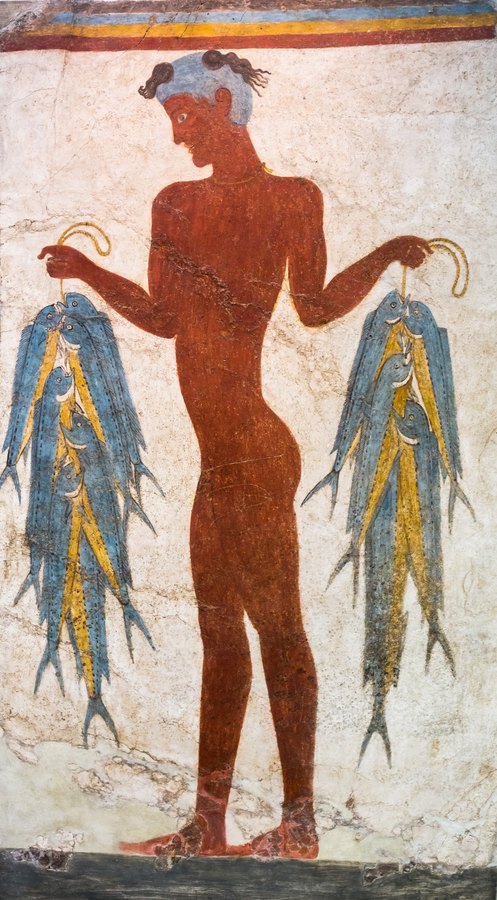
The West House stands on the northwest side of what excavators named Triangle Square, and the ephorate calls it an impressively preserved three-story building. Wall paintings from two rooms on its second floor are on display at the Museum of Prehistoric Thera, including a young fisherman holding two strings of fish.
An earthquake, then the eruption
“The city, emerging as one of the most important urban centres and ports of the Aegean since the Middle Cycladic period, was hit again, at the height of its prosperity, by an earthquake,” the ephorate writes. Residents set up “a makeshift camp on the outskirts of the city” to prepare for rebuilding. “This time, however, the quake was followed by the volcanic eruption a few score of days later.”
The ash also kept what rotted away. “Impressions or negatives left in the ash allow the recovery, by plaster casts made, of objects or architectural elements from perished organic materials,” the description says.
The date of the eruption is still argued over. The ephorate says “probably at the end of the 17th century BC,” while the Antoniou review uses about 1550 BC.
In a 2023 study in Scientific Reports, Charlotte Pearson of the University of Arizona’s Laboratory of Tree-Ring Research and colleagues dated an olive shrub carbonized by the eruption on neighboring Therasia. “The Therasia olive shrub dates slightly younger than the previous olive branch,” they write, referring to an olive tree branch buried under the pumice on Thera, whose radiocarbon date was published in 2006.
“Calibrated results and growth increment counts indicate increased probabilities for a mid-16th century BCE date for the eruption, overlapping with multiple volcanic sulfate markers from ice core records,” the team reports. Either date puts the toilet at roughly 3,600 years old.
The island is still seismically active, and in 2025 Greece declared an emergency after more than 15,000 earthquakes in the area.
Excavations that began in 1967
“The systematic excavation research was begun at the site in 1967 by Professor Spyridon Marinatos and continues to this day with Professor Christos Doumas, under the auspices of the Athens Archaeological Society,” the ephorate says. A bioclimatic shelter designed by architect N. Fintikakis now covers the ruins.
Parallaxi recalls that prehistoric remains first surfaced in 1866, when Theran volcanic earth was dug up for the Suez Canal works of French engineer Ferdinand de Lesseps.
What the drains cannot prove
Much of the town is still underground. The ephorate says the digging “has revealed part of the densely built centre of the thriving Late Cycladic city,” and the 2005 review described the site as one “which has only been investigated to a limited degree.”
Who had a toilet like this is another open question. “In general, during most eras the well formed examples were found regularly in wealthy rather than in ordinary houses,” Antoniou’s team writes, while “the rural examples generally were more impromptu and therefore fewer examples have survived.”
A pipe that takes waste out of a house also does not make it harmless downstream, and none of the sources describe any treatment at Akrotiri. The 2016 review still stresses the stakes: “Undoubtedly, the lack of sanitation and the consequential bacterial infections have killed more victims than armed conflicts throughout human history.”
“Studying the history of lavatories offers the possibility to study the history of mankind from a very unique perspective: it is as if someone rummages in the garbage bin trying to understand the habits of a family,” Antoniou and his colleagues wrote.
The full review was published in Sustainability in August 2016.
In the words of the publisher’s note on Palyvou’s 2019 book, her drawings of the West House as it once stood “illustrate the quality of a distant, but paradoxically familiar, architectural conception.”
Photo: Zde / Wikimedia Commons, CC BY-SA 4.0, cropped