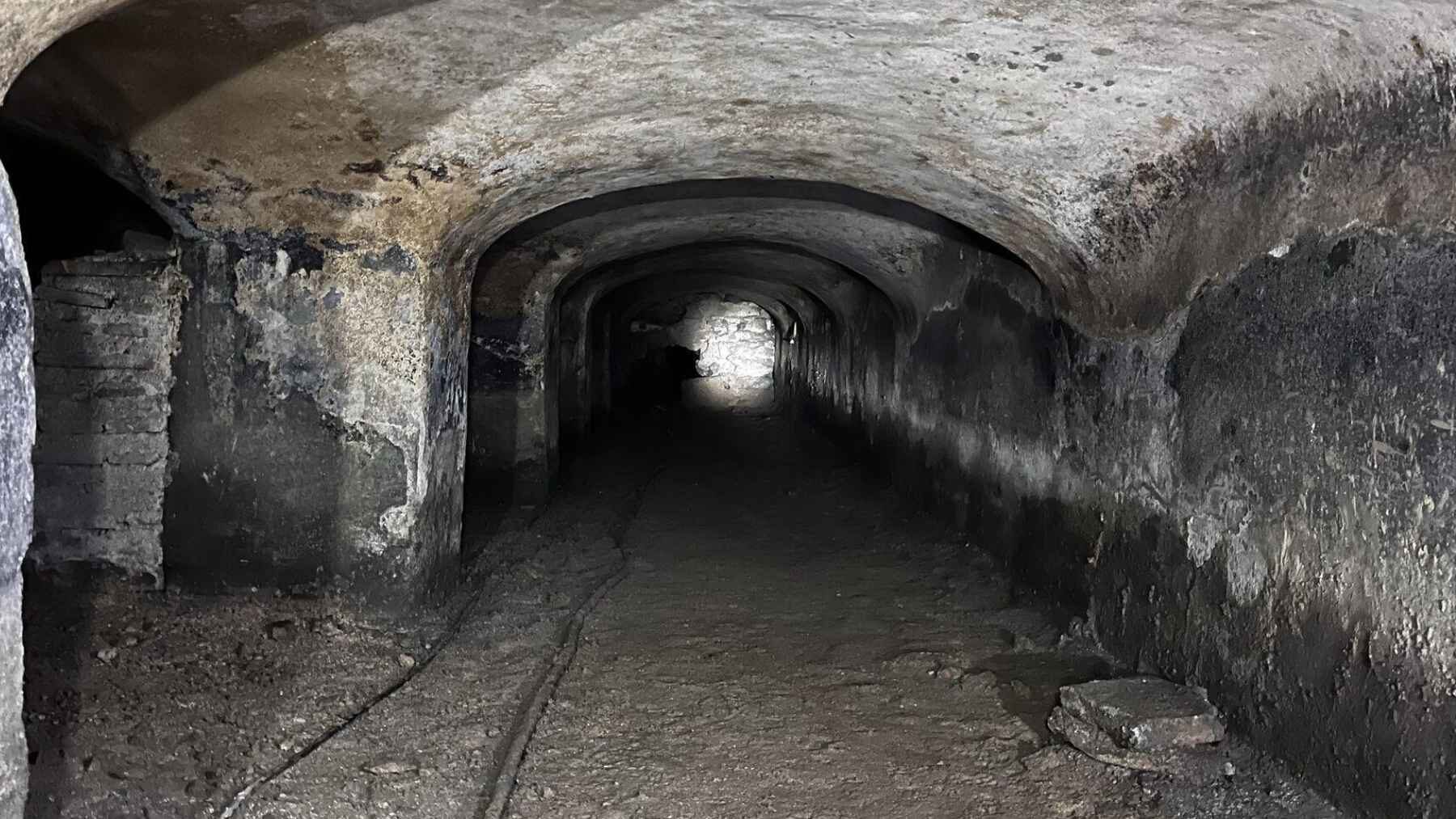
Archaeologists working beneath Hagia Sophia’s vanished atrium in Istanbul have documented a hidden underground network of tunnels, cisterns, and water lines that had spent centuries buried under debris. The most striking discovery is a rock-cut passage more than 520 ft. long that may line up with an ancient Roman route through Constantinople, according to a 2026 study by architect Hasan Fırat Diker in Open Archaeology.
This was not supposed to be a headline-making excavation. In early 2025, cleaning teams working for Türkiye’s Directorate General of Foundations began clearing semi-buried vaults under the great mosque’s atrium area, and the routine maintenance job quickly opened into something far bigger. Behind the rubble were unknown branches, water conduits from different centuries, and a layered underground system that hints at how much of old Constantinople still sits out of sight.
A routine cleaning opened the way
The atrium of Hagia Sophia once served as the large colonnaded courtyard before the basilica’s narthex. Most of that aboveground space disappeared in the 18th and 19th centuries as new buildings reshaped the area, but its underground support structures survived in the dark.
Earlier researchers had seen pieces of this system, especially after Hagia Sophia became a museum in the 20th century. Still, debris blocked much of the view, and no full systematic effort had been carried out until a 2020 laser scan helped reveal how complex the hidden spaces really were.
The 2025 work focused first on what researchers call ‘Structure 1’, a vaulted chamber under the northeastern wing of the atrium. It measures about 16 ft. wide and 51 ft. long, with a maximum height of about 13 ft. and a floor sitting 16 ft. below today’s courtyard level.
Seven water lines under one courtyard
Inside Structure 1, researchers found seven water conduits from different periods. Some were terracotta pipes linked to the age of Justinian, while others were cast iron pipes from the 19th or 20th century.
This discovery changes the way we picture the site. Hagia Sophia was not only a monument of worship and imperial power. For more than 13 centuries, to a large extent, its atrium also seems to have worked as a water distribution point for nearby buildings.
Essentially, the underground story is also an everyday story. Before faucets, pumps, and modern pipes, cities depended on hidden channels like these, the kind of infrastructure people rarely notice until it stops working.
The tunnel that points across Constantinople
The most dramatic space is Structure 4, a tunnel cut through leveled bedrock. It is about 5 ft. wide and 6.6 ft. high, and by September 2025 workers had cleared more than 520 ft. of it.
Its ends are still blocked by collapses. One side appears to continue northeast toward Topkapı Palace, while the other points southwest toward Sultanahmet Square, which raises a tempting question: could this have been part of a major road beneath what later became Hagia Sophia’s atrium?
Diker’s study suggests the orientation and position of the tunnel match a route proposed in 2000 by historian Albrecht Berger, known as Street E. If that identification is correct, the tunnel could preserve part of a Roman artery that once crossed the Historic Peninsula from Sarayburnu toward Little Hagia Sophia.
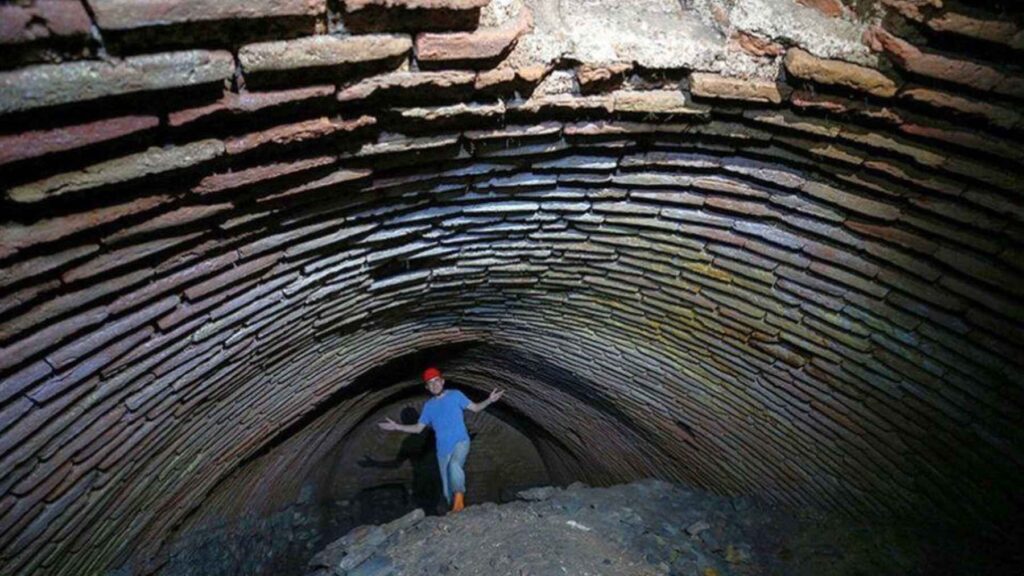
A massive brick-vaulted tunnel beneath Hagia Sophia reveals part of the hidden underground network of passages and ancient water channels preserved beneath historic Istanbul.
Ancient engineering in an earthquake city
Istanbul knows earthquakes. That makes one detail inside Structure 4 especially important, because the tunnel walls include stone reinforcements set at regular intervals.
UNESCO consultant Hassan Radoine interprets those reinforcements as seismic joints, a Roman engineering solution that may help explain why the tunnel shows no visible cracking despite the many earthquakes that have shaken the city. It is a quiet kind of brilliance.
No gold, no movie-style treasure chamber. Just careful engineering, still doing its job after well over 1,500 years.
A maze built across centuries
The cleaning campaign also documented other structures under the atrium, each adding another layer to the story. Structure 2 sits beside the northwestern wing and has concave walls coated with hydraulic mortar, which suggests it was used as a cistern.
If that reading holds, Structure 2 may be the largest known cistern inside the Hagia Sophia complex. Structure 3 is narrower, a tunnel a little over 3 ft. wide and roughly 4 to 5.6 ft. high, branching southeast and linking with other galleries that may connect to passages beneath the building itself.
Then there is Structure–the odd one. It has irregular corridors, side openings, and at least eight rectangular niches that were later sealed, but no water conduits in its main stretch. That makes its purpose less clear, and maybe more intriguing.
More rubble may hide more answers
The work was not easy. Teams removed about 330 tons of rubble over four months, and the spaces were so narrow, dark, and poorly ventilated that mining specialists had to be brought in.
Researchers used terrestrial laser scanning to create detailed plans, sections, and three-dimensional models of the underground network. That matters because this is not just about discovery. It is also about preserving fragile architecture before more cleaning, consolidation, and possible public access.
Diker notes that unexcavated sectors under the northwestern wing and possible extensions under the southwestern wing could still hold surprises. What else is sealed behind those blockages?
Hagia Sophia’s hidden future
For visitors, Hagia Sophia is usually a story told upward, through domes, mosaics, minarets, and light. This discovery asks us to look down instead, beneath the stone floor, where water systems, corridors, and older urban routes may still carry the memory of Constantinople.
That is the real power of the find. It does not replace the famous monument we already know. It deepens it.
The study was published on Open Archaeology.