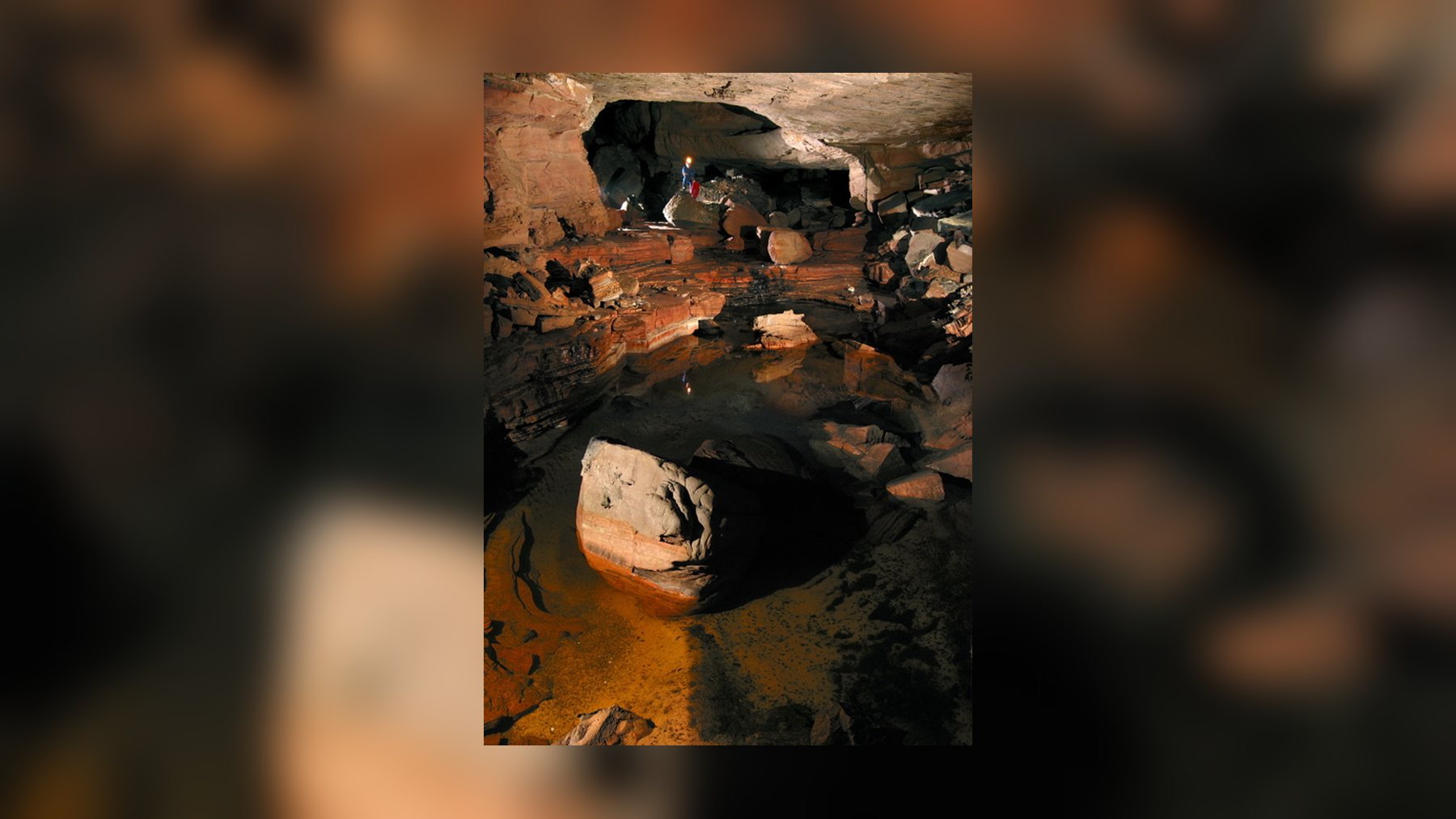
Slovak cavers say the quartzite cave Ojos de Cristal, under the summit of Venezuela’s Mount Roraima, runs 16.14 kilometers (10 miles), a length they registered in 2007, and a 2014 microbe study found that up to 84 percent of the bacteria deeper inside belonged to Ktedonobacterales, a class never before identified in a cave.
Zoltán Ágh of the Slovak Speleological Society and Marek Audy of the Czech Speleological Society found a small entrance near the southern edge of the plateau in 2002 and stopped after about 300 meters (980 feet), where the passage got low. The floor was dotted with potholes full of rounded quartz crystals, which gave the cave its name, Cueva Ojos de Cristal, or Crystal Eyes Cave.
Quartz is not supposed to make caves
Roraima is a tepui, a sheer-sided table mountain where Venezuela, Brazil and Guyana meet. The cave lies on the Venezuelan side, in quartzite of the Matauí Formation, sand grains glued together with silica.
Most caves are dissolved out of limestone, like the huge passage of a Vietnamese mountain cave with its own forest. Quartz hardly dissolves at all. In 2014, cave microbiologist Hazel Barton and her colleagues wrote that the glass-like nature of this quartz-cemented sandstone makes it resistant to the weathering processes that routinely form caves.
Earlier quartzite caves were mostly deep vertical cracks. This one runs flat, with a stream flowing from south to north, and the Slovak team wrote that a cave crossing the entire mountain is at least theoretically possible.
Two teams, two maps, two names
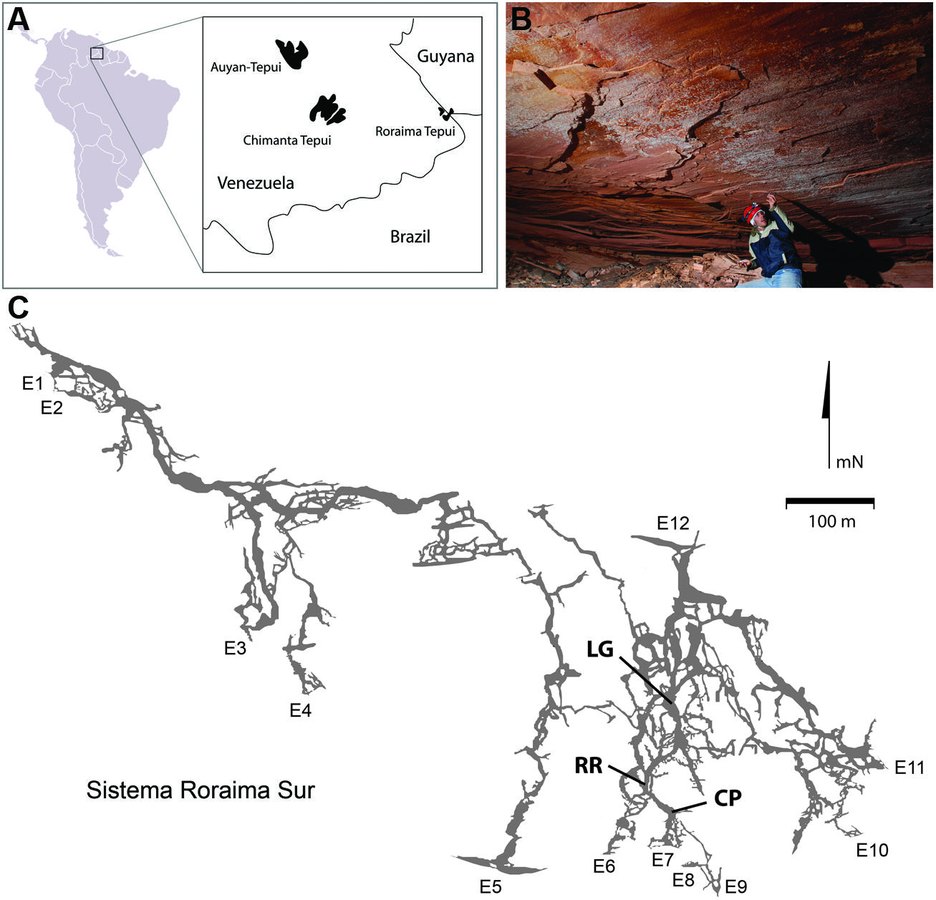
A week-long Slovak-Czech trip in 2003 mapped 2.41 kilometers (1.5 miles) of stream passages in the cave. A Venezuelan team, helped by the Oxford University Cave Club and Spain’s Sociedad de Ciencias Aranzadi, then remapped it in 2004 and 2005 as Sistema Roraima Sur. Its March 2005 report counted 10,820 meters (6.7 miles) and 18 entrances.
According to the Slovak authors, the discovery “evoked heated debates about its legitimacy” inside the International Union of Speleology, and papers still use both names.
The Slovaks went back in 2006 and reached 15.28 kilometers (9.5 miles). In 2007 they connected two upper caves and registered 16.14 kilometers with 73 meters (240 feet) of depth, figures published in a 2012 monograph by Comenius University in Bratislava. The system has 23 known entrances, five of them windows in the cliff face up to 70 meters (230 feet) below the top.
Who holds the record now
Before Roraima, the record for a quartzite cave was about 3 kilometers (1.9 miles), in Brazil, according to the Venezuelan report, whose title called Roraima Sur the longest cave in quartzites of the world. Both are tiny next to limestone giants such as Kentucky’s Mammoth Cave, the longest cave in the world.
The Roraima title did not last. In 2010 the Charles Brewer Cave System on Churí Tepui was revised to 17.8 kilometers (11.1 miles), which the monograph says created a new world record. Imawarì Yeuta, found on Auyán-tepui in 2013, now has 23,079 meters (14.3 miles) of mapped conduits, according to a 2022 paper in Frontiers in Microbiology that calls it “the world’s longest orthoquartzite cave.”
A January 2026 paper in the Brazilian Journal of Microbiology still calls Roraima Sur the world’s longest and deepest quartzite karst system, but two tepui caves have since been mapped longer. The monograph itself says the total length is still debatable because no complete detailed map has been published.
Sand, red mud and opal
The Venezuelan team blamed arenization: water slowly dissolves the silica cement between the grains, the rock falls back into loose sand, and the stream washes it away. Barton’s group found signs of it. Every surface they sampled was covered in loose sand, and dissolved silica in the stream rose from 4 to 15 milligrams per liter between their first and last sites.
The Slovak geologists argue that quartz dissolution is not necessarily the main factor. Some layers, they say, were never cemented well, and feldspar and mica rotting into red mud account for up to 30 percent of the empty space.
Limestone caves grow calcite, like the cave pearls explorers found in Vietnam. Here most formations are opal, a glassy silica that slowly turns to quartz. In Ojos de Cristal and the Chimantá caves, the monograph says, most of them are the largest known cryptic stromatolites, layered lumps built by microbes, grown in caves.
Bacteria nobody had seen in a cave
Barton, then at the University of Akron and now at the University of Alabama, worked with researchers from Venezuela’s Universidad Simón Bolívar, NASA’s Jet Propulsion Laboratory and other institutions. In January 2007 the team collected sand at three sites, 55, 90 and 300 meters (180, 295 and 985 feet) in.
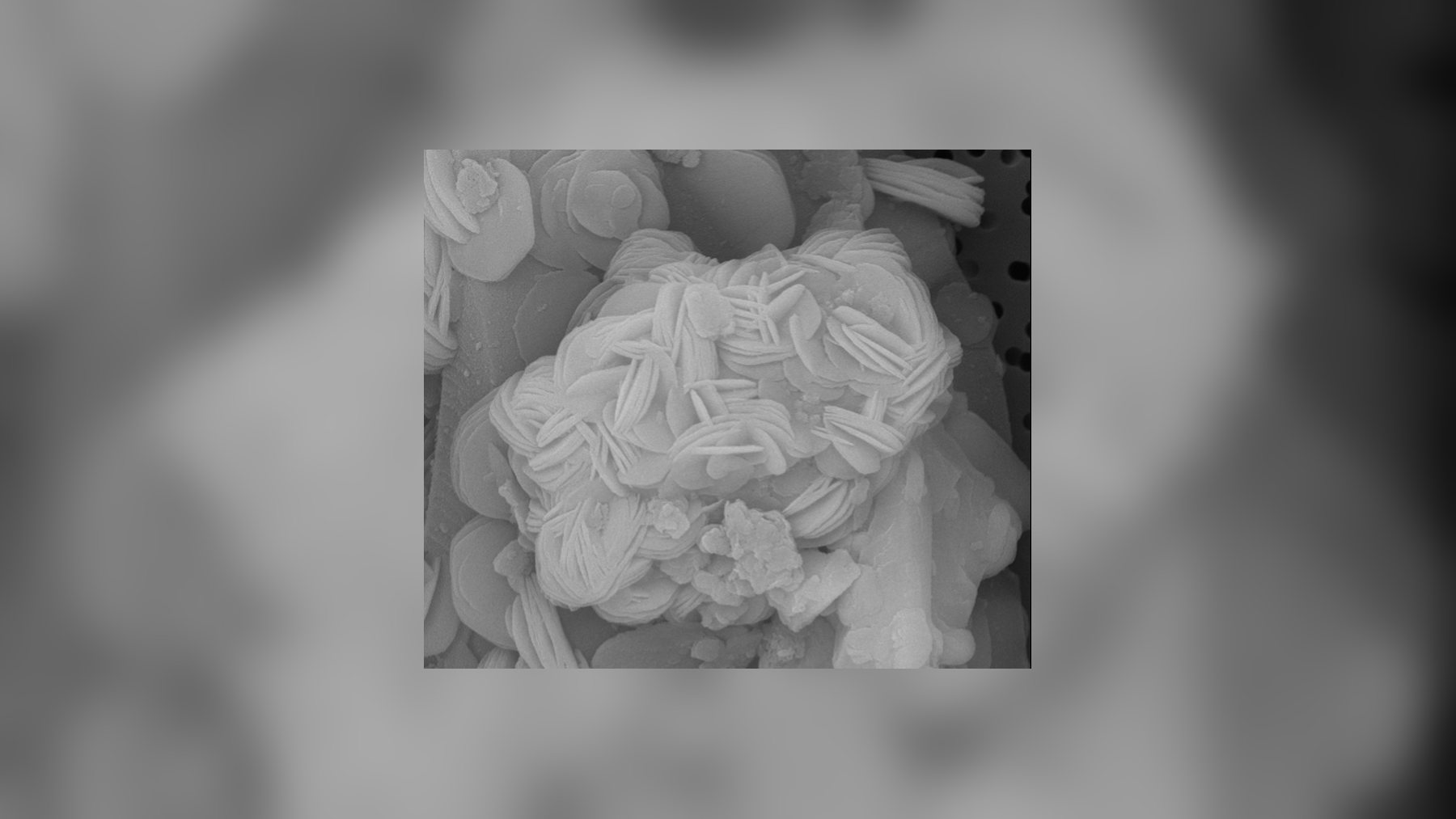
An ATP test, which picks up the energy molecule in living cells, read as high as 34,062 units, while limestone caves usually score 80 to 1,400. Deeper in, 82 to 84 percent of the bacteria were Ktedonobacterales. Their phylum, the Chloroflexi, is common in caves, but the authors call this “the first identification of members of the Class Ktedonobacterales” there.
The team’s best guess for the microbes’ food is the stream, which carries about 19 milligrams of dissolved organic matter per liter off the plants on top, against less than 0.5 in typical carbonate caves.
In 2020, researchers including Paula Suárez, a co-author of Barton’s study, isolated Pseudomonas aeruginosa from the cave’s water that resisted ceftriaxone, tigecycline and imipenem. It recalls the 5,000-year-old drug-resistant bacterium from a Romanian ice cave. On June 22, 2026, a team in Italy published genomes of Ktedonobacteria from silica-rich caves in ISME Communications, using samples from Imawarì Yeuta and an Antarctic ice cave, not Roraima. They found genes to use trace gases from the air and fix carbon dioxide in the dark.
What is still unknown
There is still no agreed map, and the Slovaks think at least 3 kilometers (1.9 miles) more may lie near the cliff and further into the mountain. The microbe work came from one trip, three sites and small clone libraries of 184, 52 and 43 sequences. “This initial work has only allowed us a snapshot,” Barton’s team writes.
The full study was published in Frontiers in Microbiology, and the cave survey is in the 2012 monograph Venezuelan tepuis: their caves and biota.
Photo: Marek Audy / Wikimedia Commons (public domain)