The Kellogg family of Hardin County, Ohio, has won a 2026 Conservation Farm Family Award from the Ohio Department of Agriculture. Bill and Shane Kellogg run a 5,000-acre corn and soybean farm near Forest. For ten years they opened part of it to water quality research in the Lake Erie basin.
The department named six winning families on September 24 at the Farm Science Review in London, Ohio, according to the Ohio Farm Bureau announcement. The Kellogg family is first on the list. Department director Brian Baldridge praised the honorees for “innovation, integrity, and dedication to conservation.”
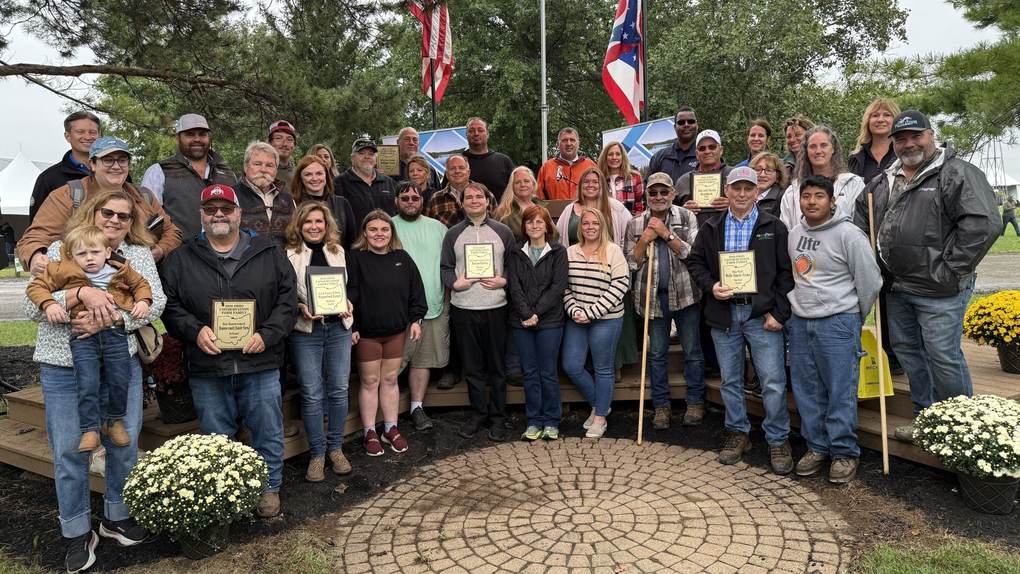
Six families and $400 each
Each winning family receives $400 from the Ohio Farm Bureau Federation. The families also appear in the September issue of Ohio Farmer magazine, which has sponsored the awards since the program began in 1984.
Winners came from five regions of the state. A sixth award went to a small farm, a category added this year, the bureau said.
About 40 percent less fertilizer
Bill and Shane Kellogg own and operate Kellogg Farms in Forest, the Ohio Farm Bureau reported in 2020. The farm grows corn and soybeans on 5,000 acres. The family committed 305 of those acres to research on strip tillage and placing fertilizer below the soil surface.
Strip tillage works up only the narrow band where the next row of crops will go. The machine puts fertilizer into that band and leaves the rest of the field alone.
“We are applying about 40% less dry fertilizer in the strip than we would if we broadcast,” Shane said in a 2020 Ohio Farm Bureau report. He said the method is far more efficient because the fertilizer goes right where the seed is planted.
The bureau noted that fertilizer is one of the top costs on most farms. The Kelloggs had also added a second strip-till unit. That let them apply fertilizer in the fall instead of the busy spring season, which also helped their cover crops.
Ten years on the Blanchard River
In fall 2015, Kellogg Farms became one of three farms in the Blanchard River Demonstration Farms Network. Ohio Farm Bureau ran it with USDA’s Natural Resources Conservation Service as a Great Lakes Restoration Initiative project.
A 2017 field day notice from Ohio State University Extension said the project was measuring the cost savings and yield gains of placing nutrients below ground. Earlier edge-of-field research had linked that practice to much lower nutrient losses, the notice said.
The network wrapped up on September 30, 2025, after 18 conservation practices. Jordan Hoewischer, the bureau’s director of water quality, counted nearly 200 tours and events on the three farms, with nearly 4,000 visitors. Kellogg Farms put in nine of the practices.
Bill Kellogg’s open books
When the network ended, Bill told Ohio Farm Bureau he had hesitated at first. He warned his son that joining would end the family’s habit of keeping its business private.
“I was very apprehensive, scared to death to open up my books to everybody, (but) it ended up being a wonderful experience for us,” Bill said. Shane had argued that farmers needed to show people they were trying to make a difference.
Toledo’s 2014 tap water ban
Hoewischer said the project began right after the Toledo water crisis. In August 2014, Toledo told almost 500,000 people in northwest Ohio and southeast Michigan not to drink their tap water. Microcystin, a toxin tied to algal blooms on Lake Erie, had hit a treatment plant, the EPA said at the time.
Phosphorus, a nutrient farmers buy to grow crops, feeds those blooms when it washes off fields. The EPA calls phosphorus from the Maumee River the key driver of the bloom in the western basin.
The agency also links the blooms to low-oxygen dead zones in Lake Erie. Nitrate from fertilizer is a separate worry for groundwater, as a study of nitrate in U.S. drinking water showed.
Kellogg runoff never measured publicly
Nobody has published how much phosphorus or soil stopped leaving the Kellogg fields. The 40 percent cut covered the strip-till acres in 2020. Using less fertilizer is not the same as measuring cleaner water.
Hoewischer has said the Western Lake Erie Basin “in the last five years, has seen a marked decrease in the amount of nutrients coming off of farm fields.” That claim covers the whole region. It is no farm-by-farm audit of practices that protect farm soil.
Ohio families who want to try for the next Conservation Farm Family Award can apply between January and May through their local Soil and Water Conservation District, the announcement says.
Photo: Ohio Farm Bureau