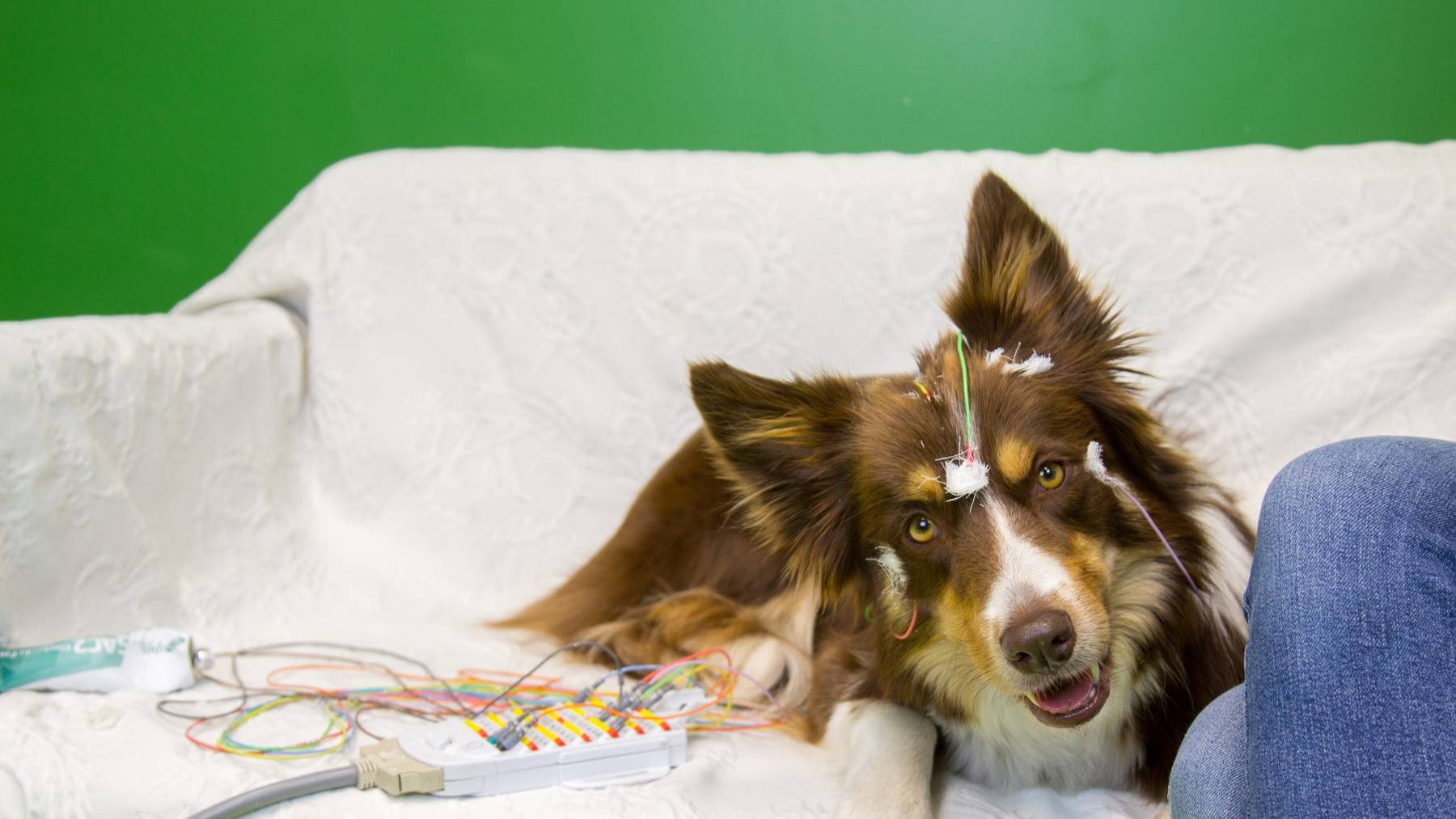
Twenty family dogs heard long strings of nonsense syllables in a Budapest lab while electrodes on their scalps tracked their brain activity. Those dog brains kept pace with the consonant patterns hidden in those strings, much as human brains do.
Researchers at Eötvös Loránd University (ELTE) ran the same test on 20 adults and reported both sets of results in Science on September 24, 2026. The co-first authors, biologist Boglárka Morvai and psychologist Kinga G. Tóth, work in the Neuroethology of Communication Lab headed by cognitive neuroscientist Attila Andics.
None of this means your dog follows your sentences. The team measured brain rhythms, so the result is about how dogs and humans carve up the talk around them, and nobody tested obedience or vocabulary.
Consonants hold words together
Written sentences come with handy spaces between the words, but spoken language does not. A listener has to find where each word starts and ends.
In many human languages, consonants tell you more about which word you are hearing than vowels do, the study’s abstract notes. Linguists call our habit of leaning on them the consonant bias, and the lab says the human brain shows it from infancy onward.
“Although vowels are louder and more noticeable, consonants usually form the skeleton of words,” Andics said in the lab’s announcement. Other primates are far closer relatives of ours, yet the study’s abstract says nonhuman primates do not rely on consonants this way.
Three streams of invented syllables
Morvai, a postdoctoral researcher in the lab, explained the logic behind the test. If the bias needs language skills that only humans have, no other species should show it, “not even dogs, despite spending much of their lives surrounded by human speech.”
Both groups heard nonstop strings of syllables with no pauses between them. In one version, repeating consonant patterns formed three-syllable word skeletons. The vowels in between changed freely.
A second version used repeating vowel patterns to build the words instead. A third, the control, put the syllables in random order.
The team recorded the brain signals with electroencephalography, or EEG. This noninvasive method picks up the brain’s electrical activity through electrodes on the scalp. The researchers looked for neural synchronization, when brain activity takes on a rhythm it detects in a sound.
The 400-millisecond signal
In the consonant streams, dog brains locked onto the rhythm of the words, just as human brains did. The press release says this tracking was stronger in both species than in the vowel or random streams.
“This is the first evidence that a consonant bias can also emerge in the brain of a species other than humans,” said Tóth, a doctoral researcher in the group.
The timing of the brain responses told the same story. About 400 milliseconds after each word began, the brain’s electrical activity changed in both humans and dogs. That happened only for consonant-structured words, and this time window is linked to splitting speech into words.
Dogs from streets and shelters
Puppies are very sensitive to social experience in their first months. So the team checked whether a talkative home in that window was what built the bias.
That early start turned out not to be required. Some dogs had spent their first three months on the street or in a shelter, rather than as family pets, and Tóth said they “showed a similarly strong consonant bias.”
For the team, that points to fairly simple pattern learning, with no need for built-in language wiring tied to an early life stage. “Regular exposure to speech may be enough to change how the brain functions,” Andics said.
Vowel words stumped the dogs
Humans could also pick out words built from vowel patterns, though less well. The dogs could not. The lab suggests people may cope better with patterns the brain does not prefer.
Both species tracked the rhythm of the syllables in each stream. Only human brains also followed the rhythm of single speech sounds, so each sound may be its own unit for us. For dogs, the syllable seems to be the smallest unit.
Hungarian researchers have used scalp recordings in other dog studies, too. One followed the brain waves of 14 dogs told to wait beside a treat.
No dog names were compared
The Budapest work measured brain rhythms in 20 dogs and 20 people. It did not test whether dogs learn consonant-heavy names faster or come more reliably when called.
It also clashes with a University of Maryland study, published online in Animal Cognition in 2020. There, dogs preferred their own name over a version with a changed vowel, but not over one with a changed consonant. That team saw a vowel bias, as in young infants and rats.
Spotting a familiar name and slicing up a stream of strange syllables are different tasks, though. And all the Budapest dogs were companion animals when tested, so the study cannot show how a dog with no exposure to speech would respond. The press release gives no breakdown by breed, age or home language either.
The full study was published in Science.
The work adds to a growing line of research on animal perception. Its authors argue that everyday speech can shape how a dog’s brain sorts what it hears.
Photo: Sarolta Szilagyi / ELTE Neuroethology of Communication Lab