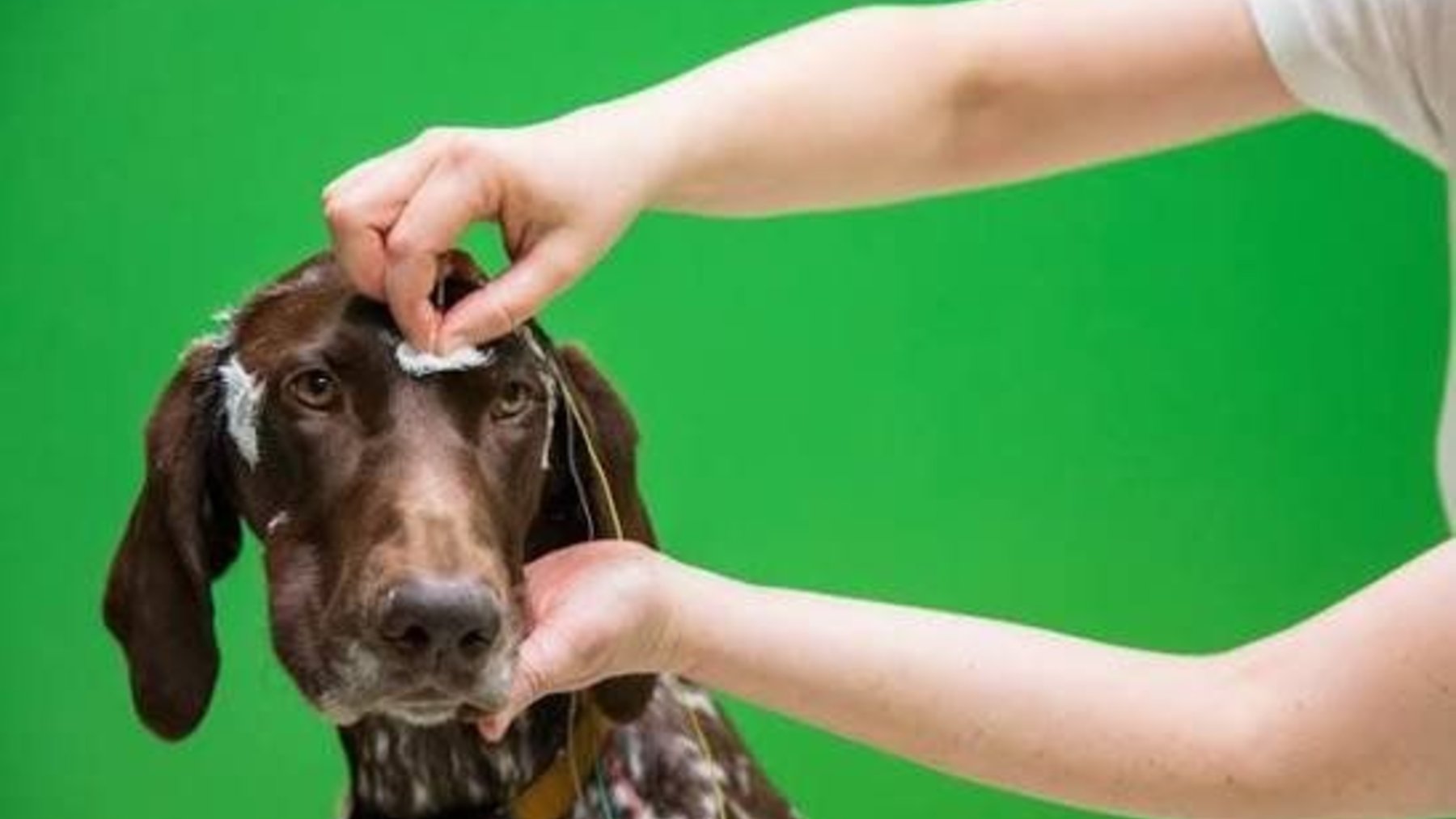
A dog that waits patiently beside a tempting treat may be doing more mental work than its still body suggests. Researchers in Hungary have recorded brain activity during canine restraint that resembles a signal associated with human self-control. The finding offers a closer look at what happens between hearing a command and resisting the urge to grab something appealing.
The team, from Eötvös Loránd University (ELTE) and the HUN-REN Research Centre for Natural Sciences, collected 226 brief recordings from 14 dogs. Their findings suggest that obeying a restraint command can involve cognitive effort, although the resemblance does not establish that dogs experience willpower the way people do.
Putting a familiar command to the test
For many owners, the situation needs little explanation. A dog wants something within reach, a person asks it to wait, and the animal holds back. Watching that pause reveals the behavior, but it leaves the underlying brain processes hidden.
The researchers used noninvasive electroencephalography, or EEG, to record electrical activity while the dogs remained awake. Each recording lasted roughly half a minute, capturing either a restraint task or a period of passive wakefulness. Comparing those conditions allowed the team to look for changes associated with the added demand of waiting.
The dogs already knew how to leave a treat or toy alone when instructed. During the challenge, a reward was placed within reach, and the owner told the dog to wait before eventually allowing access. The published methods describe randomly ordered task and baseline recordings within the same session.
A brain rhythm that looks familiar
The researchers focused on a rhythm called theta, which has been linked to cognitive control in humans. Activity measured over the frontal midline of the scalp can provide evidence that frontal brain systems are involved. These systems help people regulate actions when an immediate impulse conflicts with what they are trying to do.
In the dogs, the restraint condition produced an increase in theta activity that resembled the human pattern in both frequency and scalp location. The published paper reports a frequency range of 4 to 8 cycles per second. The effect was more pronounced toward the front of the head.
“We instead observed EEG activity that resembles human theta,” researcher Ivaylo Borislavov Iotchev said in the university’s announcement. That similarity gives researchers a measurable clue about the effort behind an apparently simple act of obedience.
What the recordings cannot tell us
Does that mean a dog debates whether to take a snack just as a person does? The study cannot answer that question. The authors explain that these EEG markers cannot separate different aspects of cognitive control, including attention, anticipation, and inhibition.
The sample also consisted of 14 trained dogs, with repeated recordings from each animal. That limits how broadly the findings can be applied, and the research did not establish how age or breed affects the signal. The cautious interpretation is that waiting engaged cognitive processes, while the precise mental experience remains uncertain.
Why researchers are looking beyond obedience
Study supervisors Anna Kis and Márta Gácsi are interested in whether dogs can help researchers understand conditions involving difficulties with behavioral control, including ADHD and obesity. This study offers a possible measurement tool for that work. It does not provide a diagnostic test or establish that these conditions operate identically across species.
The appeal of studying companion dogs comes partly from their everyday surroundings. As Gácsi explained in the university’s announcement, dogs share human environments and encounter many of the same social and physical challenges. They also develop and age faster, potentially allowing researchers to investigate changes over shorter periods.
Kis suggested that measuring signals associated with frontal brain activity could help scientists examine how closely canine conditions resemble human ones. Such comparisons would require further research. For now, the immediate advance is the ability to observe a potential neural marker during a manageable task.
A closer look at the animal beside us
The method could make future studies easier to undertake. Iotchev described noninvasive EEG as cheaper and easier to implement than functional MRI, potentially widening opportunities to investigate dogs’ mental processes. A familiar waiting task also connects laboratory measurements with behavior owners recognize at home.
For readers, the finding adds depth to an ordinary moment. A dog standing still beside a desired reward may be actively managing competing demands, even when very little seems to be happening. Understanding that process will take more than watching whether the treat disappears.
The researchers now have a way to investigate that pause in greater detail. The study was published online on August 11, 2026, in Animal Cognition.
Photo: Gáti Oszkár Dániel / ELTE