Have you ever heard the made-up words “bouba” and “kiki” and somehow felt that one sounds soft while the other sounds sharp? It may seem like a tiny party trick, but scientists have long treated this strange instinct as a clue to how brains connect sound, sight, and eventually language.
Now, newly hatched chicks have entered the debate. In a study by researchers at the University of Padova, 1-day-old and 3-day-old domestic chicks matched “bouba” with round shapes and “kiki” with spiky ones, much like humans do. The finding suggests that this sound-shape link may not depend only on culture, speech, or years of learning. It may be rooted much deeper in the animal brain.
A small sound test with big questions
The Bouba-Kiki effect is one of those experiments that feels almost too simple. Show someone a rounded blob and a jagged shape, then ask which one is “bouba” and which one is “kiki.”
Most people choose the rounded shape for “bouba” and the pointed one for “kiki.” Why? For the most part, the sounds seem to carry a feeling. “Bouba” rolls gently in the mouth, while “kiki” lands with sharper edges.
That matters because language is often described as arbitrary. A dog is called a dog because English speakers agreed on it, not because the word naturally looks or sounds like the animal. But this effect hints that some sound meanings may be less random than we thought.
Why chicks were the right test
Human babies already show signs of the Bouba-Kiki effect, but babies are fast learners. By the time researchers can test them, they have already heard months of voices, names, songs, and everyday household sounds.
Chicks offer a cleaner window. They are precocial animals, meaning they hatch with fairly developed senses and motor skills. In practical terms, that means they can be tested very early, before life has had much time to teach them patterns.
The Padova team carefully controlled the chicks’ surroundings. Before testing, the animals had not been exposed to the specific sounds or shapes used in the experiment, which helped reduce the chance that the results came from training or habit.
What the chicks actually did
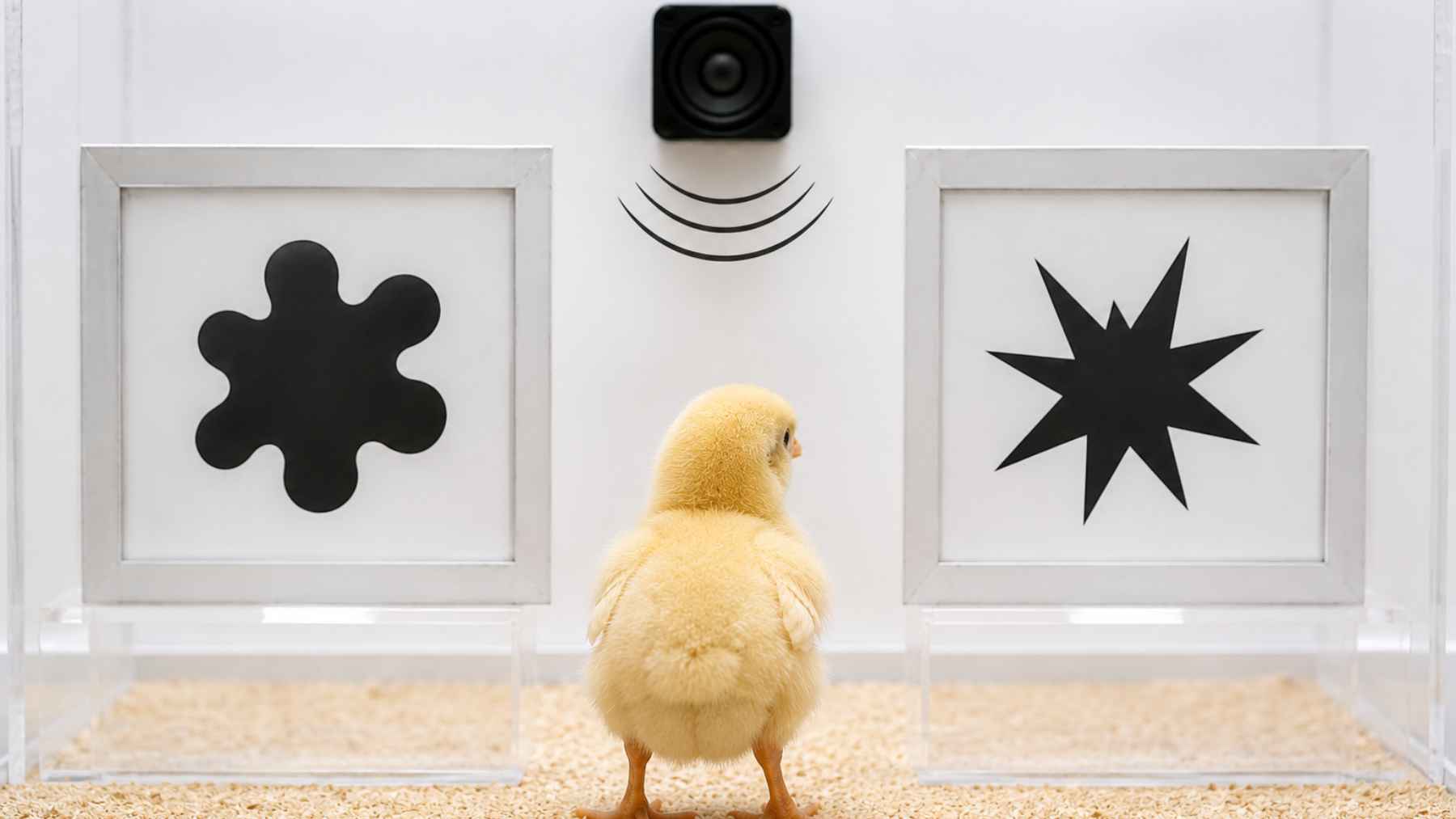
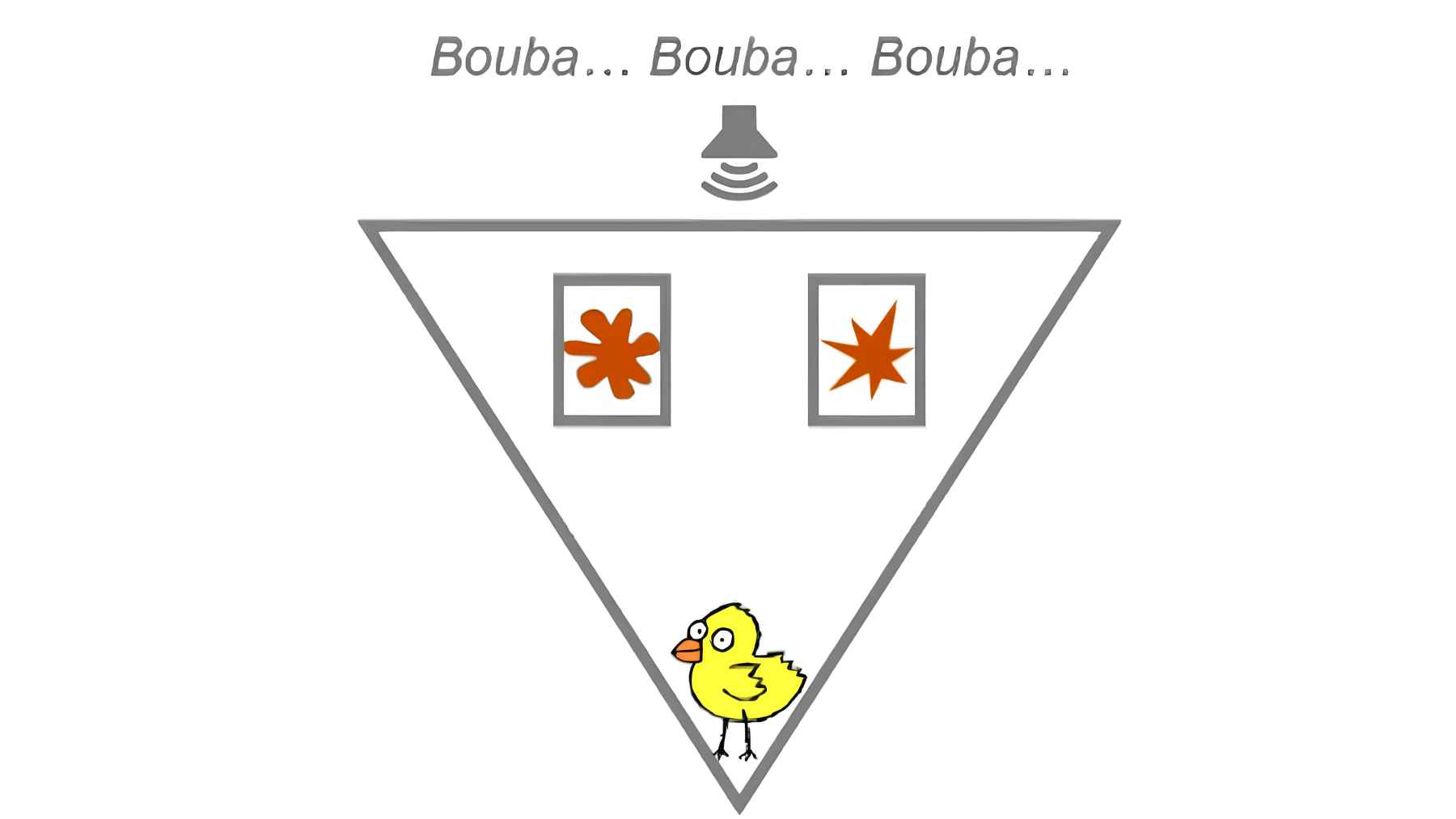
In one experiment, 3-day-old chicks first learned to walk around a panel to reach a food reward. The training panel showed an ambiguous shape that mixed rounded and pointed features, so it did not clearly favor either side.
Then came the real test. The chicks saw two new panels, one with a round shape and one with a spiky shape, while a hidden speaker repeated either “bouba” or “kiki.” No reward was waiting behind the test panels.
The result was surprisingly familiar. When the chicks heard “kiki,” they tended to approach the spiky shape. When they heard “bouba,” they tended to choose the round one. A second experiment with 1-day-old chicks, done without the same training and reward setup, found the same basic pattern.
Not language, but something older
No, the chicks were not “speaking.” That part is important. The study does not show that chickens have human language or that they understand words the way people do.
What it does suggest is more subtle, and maybe more fascinating. Their brains appeared able to link certain sound qualities with certain visual qualities without being taught to do so. The official abstract says results from young naive animals suggest a “predisposed mechanism” for matching sound and shape.
That pushes the question backward in evolutionary time. Birds and mammals split from a common ancestor more than 300 million years ago, so a shared sound-shape bias could point to an ancient way brains organize sensory information.
A clue to how meaning begins
Why would this kind of match exist at all? One possibility is that the natural world already contains patterns between sounds and shapes, or between sounds and bodies.
Small animals often make higher-pitched sounds than large animals. Sharp, sudden noises can signal quick movement or danger. Smooth, lower sounds may feel less threatening. The brain, to a large extent, may use these patterns as shortcuts.
For humans, those shortcuts might have helped build the earliest bridges between sound and meaning. They would not create language by themselves, but they could provide a small starting point, like a sketch before the full picture is drawn.
The debate is not over
The study does not close the book on the origin of language. Instead, it changes the shape of the conversation. If baby chicks can show a Bouba-Kiki-like response, then at least part of this effect may come from basic perception rather than human culture alone.
Still, scientists will need to test more species and more kinds of sounds before making broader claims. Chicks are one model, not the whole animal kingdom. The trouble is, one clear result in a carefully controlled young animal is hard to ignore.
At the end of the day, this tiny experiment asks a big question. Where does meaning begin? Maybe not with words. Maybe it starts earlier, with the brain quietly deciding that some sounds feel round, and others feel sharp.
The study was published in Science.