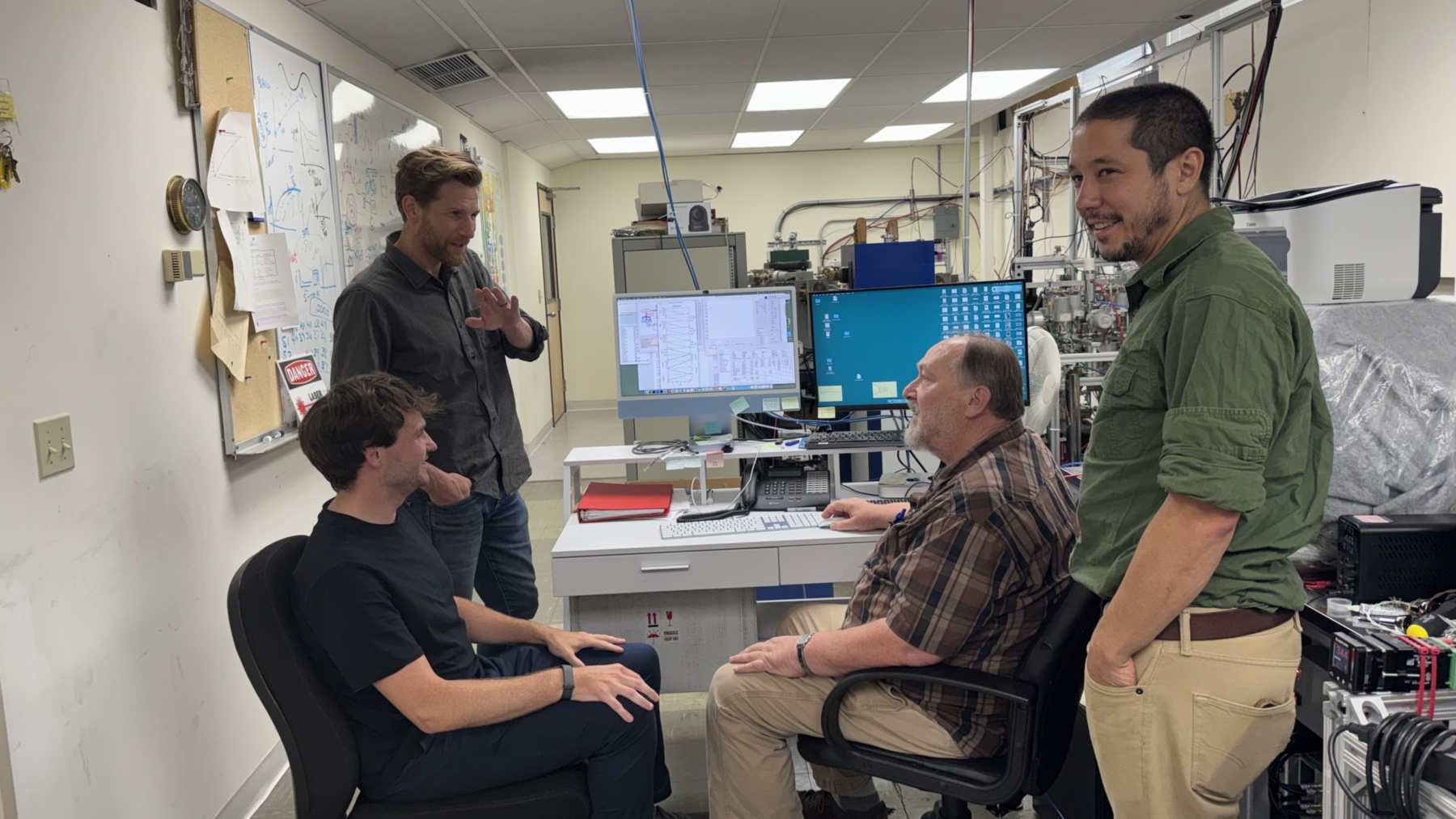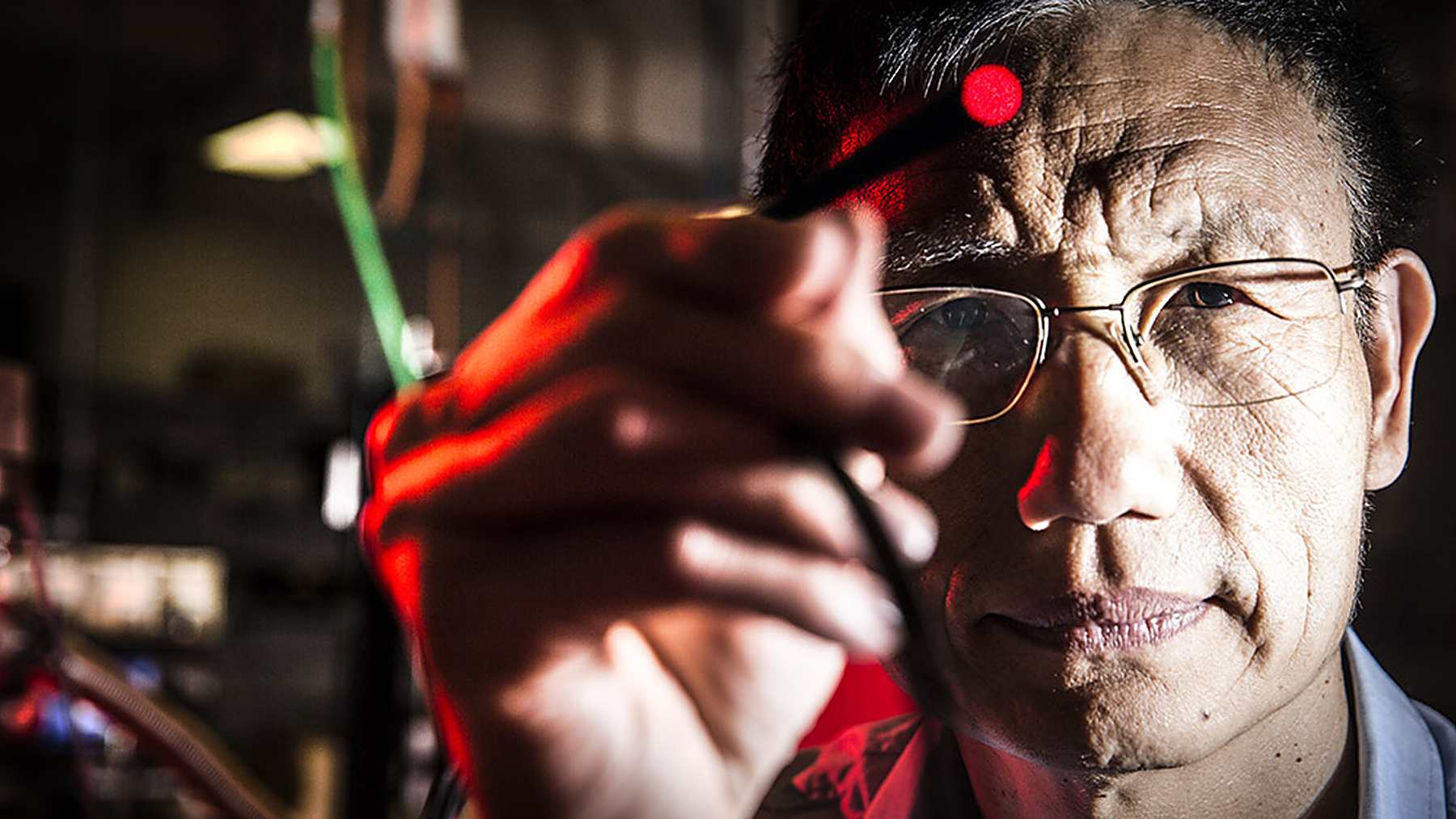
A physicist in Australia says gravity changes how fast laser pulses move through optical fiber, a claim that touches the speed of light itself. Enbang Li, of the University of Wollongong, timed pulses over a 12.4-mile (20-kilometer) round trip inside campus elevators. He then built a lab sensor that he says detects a 159-pound (72-kilogram) steel block moving beneath it.
The university announced the work on April 24, 2026, as a way to track groundwater, melting glaciers and magma. The release calls it an early proof of concept. Its headline number also sits badly with tests of Newton and Einstein on cosmic scales.
Elevators on a Wollongong campus
The first round of tests came out on July 3, 2025, in Annals of Mathematics and Physics. It used a coiled spool holding 6.2 miles (10 kilometers) of standard optical fiber, the glass strands that carry photon signals. A mirror at the far end sent each pulse back to a fast detector.
Li loaded the rig into lifts in campus buildings. He compared ground-floor readings with readings 18.4 feet (5.62 meters), 23 feet (7.0 meters) and 32.4 feet (9.87 meters) higher. Each pair came two minutes apart.
For every level, Li collected more than 1,000 data points. His timing resolution was 0.1 picosecond, a tenth of a trillionth of a second.
According to the paper, pulses took longer on the upper floors, where gravity is slightly weaker. Li concluded that “the speed of light in the optical fibre would increase with the gravitational field.” The delay grew almost in a straight line with height.
A 159-pound steel block
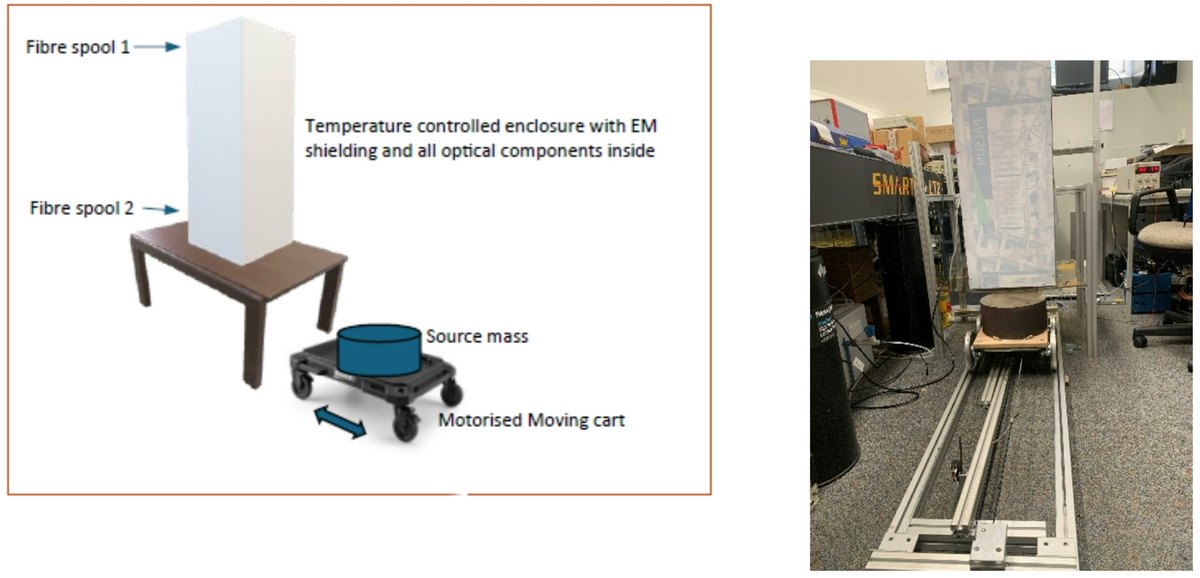
The follow-up study moved the idea onto a lab bench. It was published March 15, 2026, in Scientific Reports. Two identical 6.2-mile spools sat one above the other, 3.3 feet (1 meter) apart.
Each spool rested in a copper box held at 86°F (30°C). A single laser pulse was split between them. An oscilloscope then measured the gap between the two returning echoes.
A motorized cart rolled the steel block under the lower spool and pulled it back about 4.9 feet (1.5 meters), once every 16.5 seconds. Plotted raw, the delays bounced around by a few picoseconds. Li writes that it was “unclear” whether the moving block left any mark on the raw trace.
Only a frequency analysis pulled out a peak. Over repeated runs it averaged 0.062 hertz, close to the block’s rhythm of 0.061 hertz. For Li, that match shows the sensor picks up the block’s gravity.
Li’s data clash with Einstein by 85 million
Einstein worked on gravity and light speed in 1911, on his way to general relativity. Li’s 2025 paper uses that relation as its benchmark. His elevator data give a constant of 1.37 × 10⁻², while Einstein’s version gives 1.6 × 10⁻¹⁰.
By his own numbers, that gap is roughly 85 million times, or eight orders of magnitude. His explanation is that light responds to the strength of gravity’s pull, not to gravitational potential.
There is a textbook answer, too. A Gravity Probe B explainer hosted by Stanford University says a local clock and ruler always give the same light speed. Asking for one value across a whole gravitational field is “an ill-defined question” in special relativity, it adds.
Glass fiber is not empty space
General relativity already predicts that gravity bends light and slows its journey. Astronomers see this near the sun and in gravitational lensing around galaxies and black holes. Those results match Einstein’s numbers, with no sign of an effect millions of times stronger.
Li’s pulses never crossed a vacuum either. They ran through glass, where heat, strain and pressure all change light’s pace. In the elevators, air pressure shifted by 1.3 hectopascals between floors, although the fiber sat in a sealed box.
A timing change inside fiber says little, by itself, about the universal speed limit.
Groundwater, magma and submarines
Gravity changes slightly whenever mass moves, as when aquifers drain or ice thins. NASA’s GRACE twin satellites tracked those shifts for more than 15 years. The same approach later measured trillions of gallons lost from the Upper Colorado River Basin.
Most gravimeters, the tools that measure this pull, rely on a falling or spring-mounted test mass. Vibration disturbs them. Li argues that a sensor with no moving parts could work on planes or submarines and sample thousands of times per second.
In the university release, Li said that “tiny shifts in gravity can reveal critical changes beneath or around us, from underground water levels to magma build-ups below volcanos that could indicate future eruptions.” Think of the magma movement behind eruptions like Tajogaite. Spotting a shift and explaining it are still separate jobs.
One author, one campus so far
Every result so far comes from Li’s own lab at Wollongong. In the 2026 paper, Li writes that the signals also carry contributions “from other unknown sources which should be further investigated.” Quantitative measurements are still under way.
An independent team would need to reproduce the elevator delays and the 16.5-second signal. Tighter temperature control and full calibration would help. Until then, the light-based gravity sensor stays a lab proposal, and the speed of light in a vacuum stays where relativity puts it.
The full study was published in Scientific Reports.
Photo: University of Wollongong