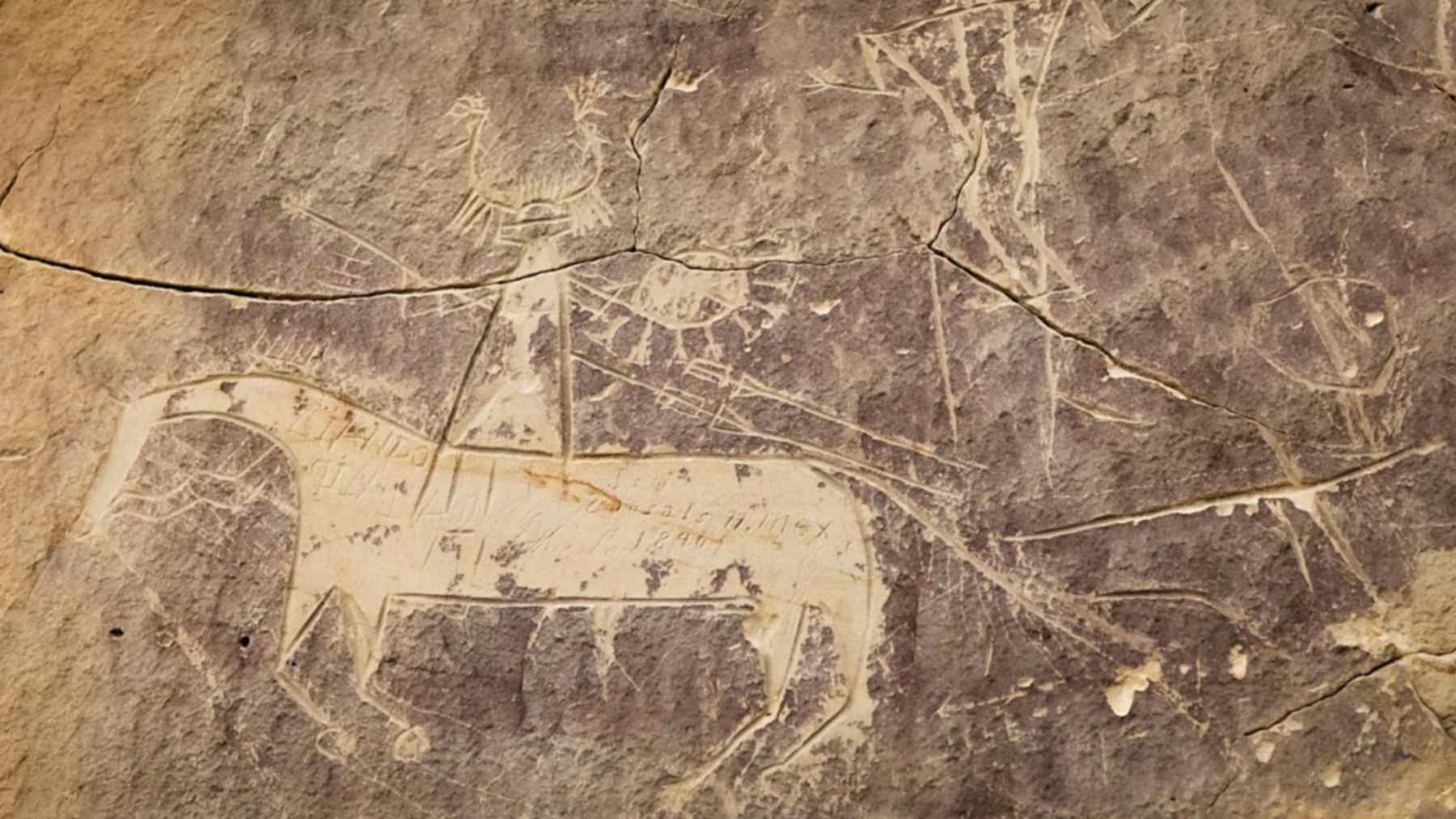
Indigenous peoples were raising horses on the Great Plains and in the northern Rockies by the early 1600s. That puts them decades ahead of the Pueblo Revolt of 1680, long treated as the starting point. The evidence comes from a 2023 study in the journal Science that examined 33 early horse-family specimens from New Mexico to Idaho.
According to the French National Centre for Scientific Research (CNRS), 87 scientists from 66 institutions did the work. Lakota, Comanche, Pawnee and Pueblo collaborators took part, and several of them signed the paper.
A timeline written by outsiders
For decades, textbooks tied the spread of horses to a single uprising. In 1680, Pueblo people in today’s New Mexico drove out Spanish colonists for a time. Their livestock then passed into Indigenous hands.
That account rests almost entirely on texts by European observers from the 18th and 19th centuries. Most of the land north of New Mexico was unknown to those writers, the authors note. A first written mention of horses in a region says little about when they really arrived.
Lakota scholar Yvette Running Horse Collin started the partnership in 2018 by contacting CNRS geneticist Ludovic Orlando. William Taylor, curator of archaeology at the University of Colorado Museum of Natural History, became a corresponding author.
In the University of Colorado Boulder announcement, Taylor summed up the problem. “Focusing only on the historical record has underestimated the antiquity and the complexity of Indigenous relationships with horses across a huge swath of the American West,” he said.
Four horses older than 1680
Of the 33 specimens, the team got radiocarbon dates for 29 and genetic data for 27. Radiocarbon dating measures how much carbon-14, a slowly decaying form of carbon, is left in bone.
Three animals from Indigenous sites clearly predate the revolt. One is a young horse buried at Blacks Fork, in southwestern Wyoming. The others are an adult skull from the Kaw River in Kansas and bones from Paa’ko Pueblo in New Mexico.
A fourth bone, from American Falls Reservoir in Idaho, had already been dated to between 1597 and 1657. When the researchers modeled all the dates together, Indigenous horse keeping in the West most likely began between 1516 and 1599.
Coyotes beside the Blacks Fork foal
The Wyoming animal was a foal about 5 or 6 months old. It was excavated at the Blacks Fork of the Green River in the 1990s. Its skull carries a severe fracture that had partly healed, possibly after a kick from another horse.
According to the paper, bone growth at the back of the skull appears only in horses used for transport or kept confined. When the foal died, people buried it in a ceremonial setting. Three coyotes lay alongside it.
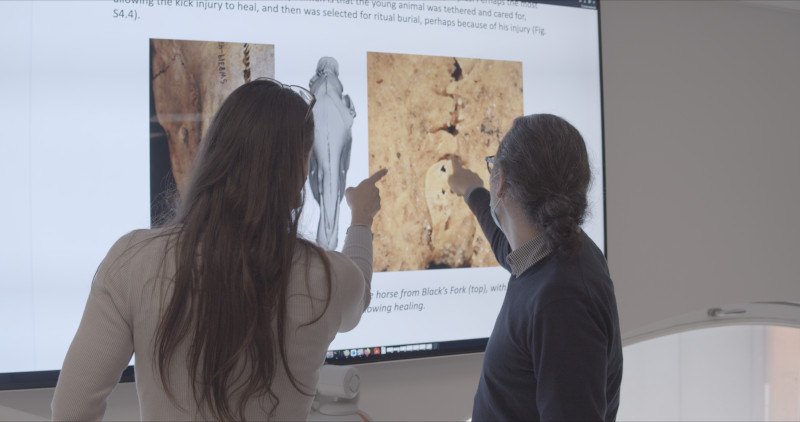
Teeth absorb strontium, a chemical element, from local food and water. The foal’s readings matched the Green River Basin, so it was born and raised there. As Taylor put it, “It was cared for, and when that animal passed, there was extraordinary significance to that event.”
Southwestern Wyoming is considered a homeland of the ancestral Comanche. The study suggests they raised horses for at least half a century before moving to the southern Plains.
Jimmy Arterberry is tribal historian of the Comanche Nation in Oklahoma and a co-author. “These findings support and concur with Comanche oral tradition,” he said in the CNRS release.
Maize and a metal bit
On the Kaw River horse, wear on a lower premolar matches a European-style metal curb bit. In other words, it was bridled and ridden. Carbon in one molar spikes near the end, and the authors link that to winter feeding with maize, a custom of Plains nations such as the Pawnee.
How did horses get so far from Spanish towns? The team points to Indigenous exchange networks at the edges of New Mexico. From there, old trade routes ran across the Plains and the Rockies.
Puebloan groups moving from Spanish New Mexico into western Kansas offer a second route. The U.S. National Science Foundation, which funded the project, lists both options.
Hispaniola, November 28, 1493
Horses first evolved in North America and later vanished from it. Domestic horses came back with Christopher Columbus on his second voyage. They reached La Isabela, on Hispaniola, on November 28, 1493, says a 2022 paper in PLOS ONE.
Within a decade, the island’s horses grew from a few dozen into large herds. In 1519, Hernán Cortés landed 16 horses on Mexico’s Gulf coast.
That 2022 study was led from the Florida Museum of Natural History. Its team read the mitochondrial DNA of a late 16th-century horse from Puerto Real, in today’s northern Haiti. The maternal line pointed to Iberia, and the closest modern match was a Chincoteague pony.
The 2023 genomes fit that picture. Plains horses carried mostly Iberian ancestry, with more British blood over time. None descended from horses the Vikings might have brought.
A radiocarbon plateau after 1670
Radiocarbon has a blind spot here. A flat stretch in the calibration curve blurs horses that lived between 1670 and the early 20th century, the authors write. Many later specimens cannot be dated precisely.
The body of archaeological data is also small, the paper acknowledges. The routes north are still a hypothesis. The CNRS expects new digs at sites from the 16th century or earlier to fill in more of the story.
For the Lakota co-authors, dates were never the whole point. “Horses have been part of us since long before other cultures came to our lands, and we are a part of them,” said Chief Joe American Horse, an Oglala Lakota leader.
Projects that pair Indigenous knowledge with archaeology are growing elsewhere too. In this one, a board of 10 Lakota elder knowledge keepers endorsed the research and its results.
The full study was published in Science.
Photo: Pat Doak / University of Colorado Boulder