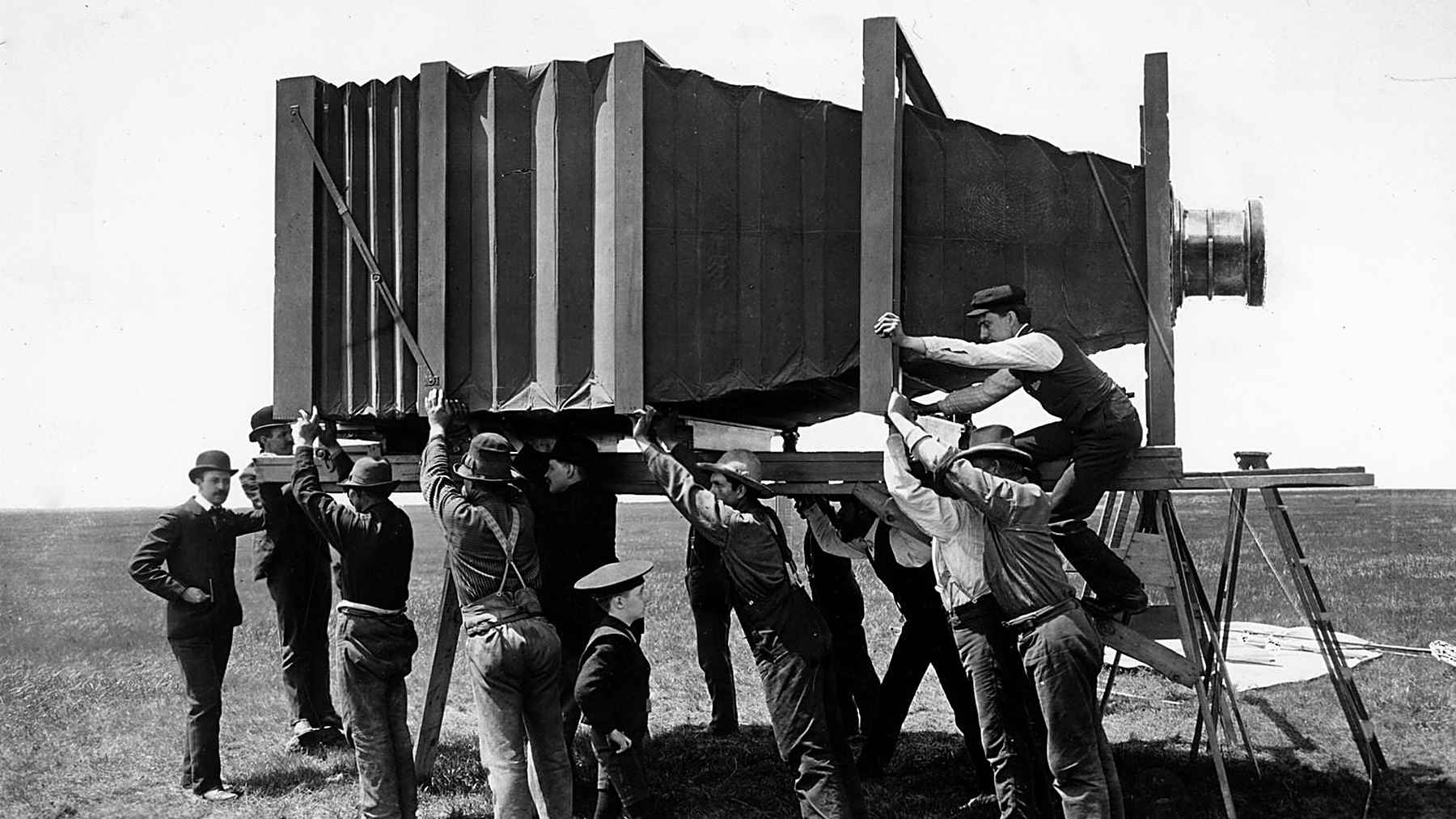
On a spring morning in 1900, Chicago photographer George R. Lawrence pointed the world’s largest camera at a passenger train parked in a field and kept the lens open for two and a half minutes. Camera and loaded plate holder came to 1,400 pounds (635 kilograms), and nobody had built the thing for any other job.
The order came from the Chicago & Alton Railway, which wanted a single photo of its new Alton Limited at least eight feet (2.4 meters) long. Extra copies of the company’s brochure about the job cost two cents in postage stamps. One now sits in the Indiana Historical Society’s digital collections as “The Largest Photograph in the World of the Handsomest Train in the World.”
Six matching cars from Pullman
Workers at the Pullman plant in Illinois built two six-car trains in 1899 for daytime runs to Saint Louis. According to the brochure, every car had windows of the same size and shape. All of them matched in length and height, too.
Even the locomotive’s tender rose to the exact height of the cars behind it. The whole train measured 324 feet (99 meters) and weighed 472 tons.
The brochure praised the train’s “absolute unity of detail from cow-catcher to observation platform,” and the railroad wanted the public to see every bit of it. American railroads have long sold themselves through their machines, a habit that later made locomotives like Union Pacific’s Big Boy famous.
A glass plate eight feet wide
Lawrence was the railroad’s own photographer, and he had already made very large pictures of its locomotives. His first idea was to shoot the train in pieces and stitch the prints together. The railroad turned that down, since the seams always show, however carefully the pieces get blended.
The railroad “demanded a faultless photograph,” in the brochure’s words. Lawrence came back with plans for a camera that could fit the whole train on one plate. That plate measured 8 by 4.5 feet (2.4 by 1.4 meters), three times the largest ever exposed, according to the company.
Glass plates were the film of the era. They were sheets of glass coated with light-sensitive chemicals that became negatives once developed. The National Science and Media Museum notes that the gelatin dry plate stayed in use until the 1970s.
Cherry wood, rubber and Zeiss lenses
According to the Chicago History Museum, Lawrence built the camera with J.A. Anderson, and it needed 15 operators. The brochure adds that it took two and a half months to build, all of it in natural cherry.
Fully extended, its bed of four cherry beams stretched about 20 feet (6 meters). The bellows is the folding, lightproof tunnel between lens and plate. On this camera it used more than 40 gallons of cement and rolled on small wheels along a steel track.
The lenses came from Carl Zeiss. In the railroad’s telling, they were the largest photographic lenses ever made. For the train, Lawrence chose a telescopic lens with a 10-foot (3-meter) focal length.
To dust the plate, an operator opened the big front board and walked inside with a camel’s hair brush. A ruby glass cap over the lens turned the camera into a darkroom. The camera alone weighed 900 pounds, and the plate holder added 500.
Fifteen men at Brighton Park
Early one morning, a padded van hauled the camera to the railroad’s Chicago station. Crews moved it onto a flatcar bound for Brighton Park, about six miles (10 kilometers) away. Setting it up and taking the picture took at least 15 men, the brochure says.
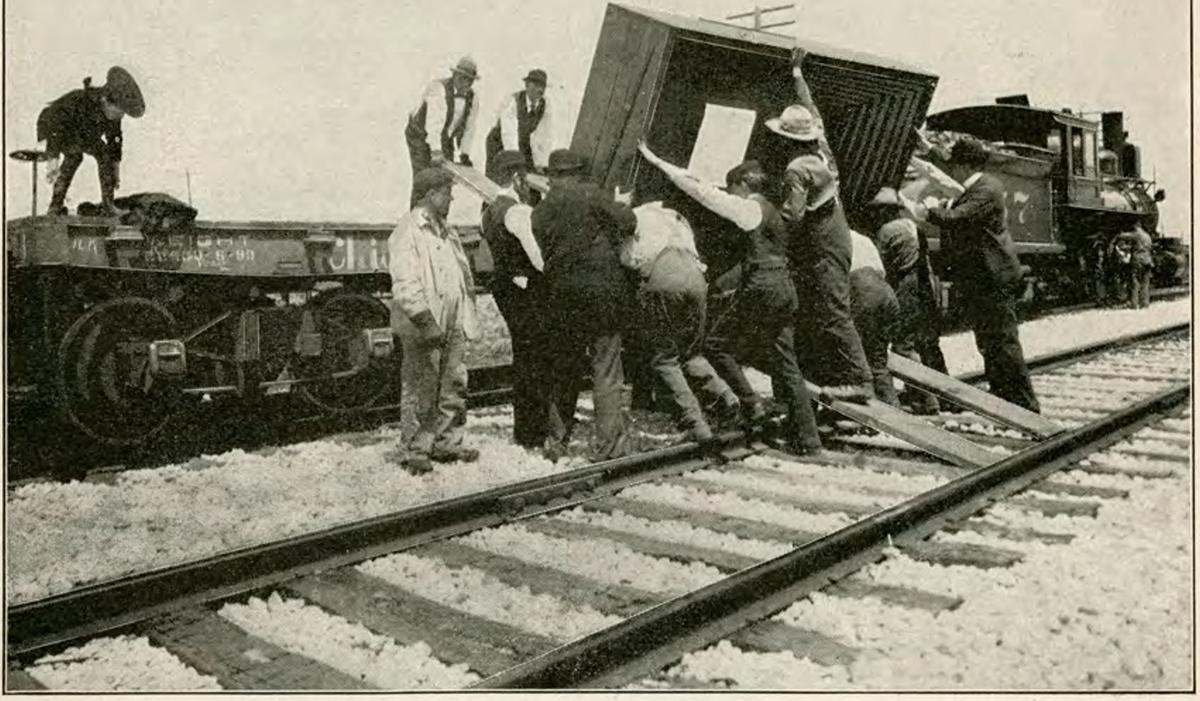
A strong wind blew across the field that day. Even so, the two-and-a-half-minute exposure produced what the railroad called a perfect negative.
The company printed the picture in its brochure from a platinum print. It stressed that the engraver had not retouched it at all.
Sworn statements in Paris
The first three prints went to the Paris Exposition of 1900. One hung in the railway section and one in the photography section. The third went to the United States Government Building.
Officials there asked for affidavits before they would label it “The largest photograph ever made on one plate,” the brochure says. American builders had sent no passenger trains to Paris, so visitors met the Alton Limited only through the print.
Lawrence kept chasing hard pictures after that, and the Chicago History Museum calls him “relatively fearless.” He shot Chicago from balloons until one broke loose and dropped him from 200 feet. Telephone wires caught him 50 feet up, and after a second mishap in Minnesota he switched to unmanned kites.
Most details come from the railroad
Almost all of the technical numbers in this story trace back to one advertisement, the two-cent brochure. Boasts about the biggest lenses ever ground came from the railroad itself, and no outside check from 1900 appears in either source.
The Chicago History Museum does agree on the big numbers, 1,400 pounds and 15 operators. Oddly, one of its captions dates a photo of the camera to 1911. Neither source gives the exact day of the exposure or says what became of the glass negative.
The record has long since moved on, and the largest digital camera ever built now works at Chile’s Rubin Observatory. The railroad’s 1900 brochure, with photos of the crew at work, is in the Indiana Historical Society’s collection.
Photo: Chicago History Museum, ICHi-022529