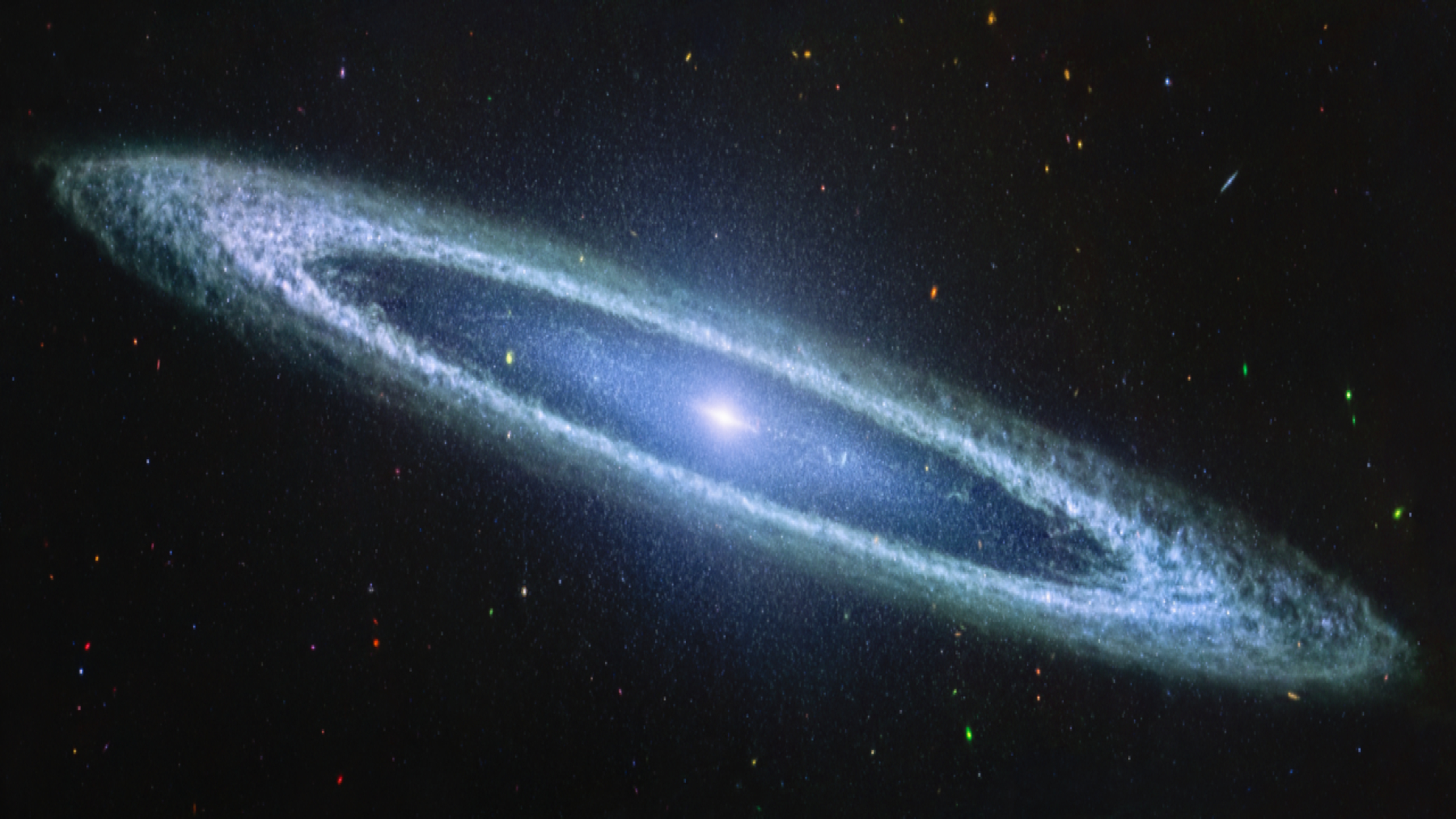
The James Webb Space Telescope has opened an entirely new layer of investigation into the Sombrero galaxy (Messier 104) with the brand-new Mid-Infrared Instrument. It is a galaxy that looks very similar to a sombrero: Mexican hat and now looks very detailed showing how dust and star formation and the quiet supermassive black hole at its center would further penetrate understanding than images received before in visible light.
Sombrero galaxy seen in a new light: Webb offers proof striking models of dust clumps
At first sight, Sombrero appears less like a Mexican hat and more like an archery target in Webb’s mid-infrared image. The once bright core, which was pronounced and visible with traditional photography, has no shine at all in Webb’s infrared view. What is visible is a smooth inner disk-for reading the inner structure of a galaxy.
But the most striking feature is the sharp, intricate clumps of dust that decorate the galaxy’s outer ring. These clumps were previously hidden in older images from the Spitzer Space Telescope; thus, they have now come into focus thanks to the high-definition capabilities of MIRI.
Dust clumps are significant because they suggest the possible presence of an important class of carbon-based molecules called polycyclic aromatic hydrocarbons (PAHs) typically found in star-forming regions. The Sombrero galaxy certainly does not undergo brisk stellar formation, but there is still some evidence for ongoing stellar activity.
The galaxy forms only about one-tenth of the star formation seen in our own Milky Way. Even though the galaxy is far from being a hotbed of star production, the dust observed by Webb is an important part of the puzzle for understanding what happens in the outer regions of the galaxy.
The Sombrero Galaxy: Supermassive black hole remains silent but stormy
Perhaps the most compelling thing about the Sombrero galaxy is the supermassive black hole right in the center. It measures a whopping 9 billion times the mass of our Sun, but it has been very quiet. This black hole, classified as a low luminosity active galactic nucleus, is a very slow eater, consuming infalling materials from the surrounding galaxy steadily over time.
Instead of a huge explosion of radiation, this black hole quite quietly sends out a relatively faint, narrow jet, all contributing to the calm nature of this black hole even in the galaxy’s center. The supermassive black hole of Sombrero starkly contrasts with Messier 82, which does house some of the most active black holes that radiate copiously. It reminds the viewer that even the most monolithic objects in the universe can be quite quiet and introverted: their silence sustains and holds up entire galaxies in subtle, meaningful ways.
Those thousands of far-away galaxies are recently unveiled in the latest image by JWST, unfolding the cosmic depth
The most recent picture taken by the JWST also captures, along with this, the thousands of other galaxies in the background. Each of these distant galaxies, having its own unique shape and color, contributes to the apparent depth and richness of the overall picture.
By examining these background galaxies, astronomers can reap precious insights into distances, structure, and properties concerning these galaxies. This in turn, is fundamental to the understanding of the cosmic context in which the Sombrero exists.
Furthermore, this fact presents astronomers with a great opportunity to study stellar population patterns as it has about 2000 globular clusters. These globular clusters contain several hundred thousand old stars and provide Nature’s natural setting.
The newest view of the Sombrero galaxy reveals the capabilities of the James Webb Space Telescope in unveiling hidden aspects of galaxies. By infra-red observing Webb gives a deeper understanding of their composition and history. That’s just the part of the discoveries. It gets us closer to answering some of the essential questions about the cosmos and enhances the mythical story of the Sombrero galaxy.