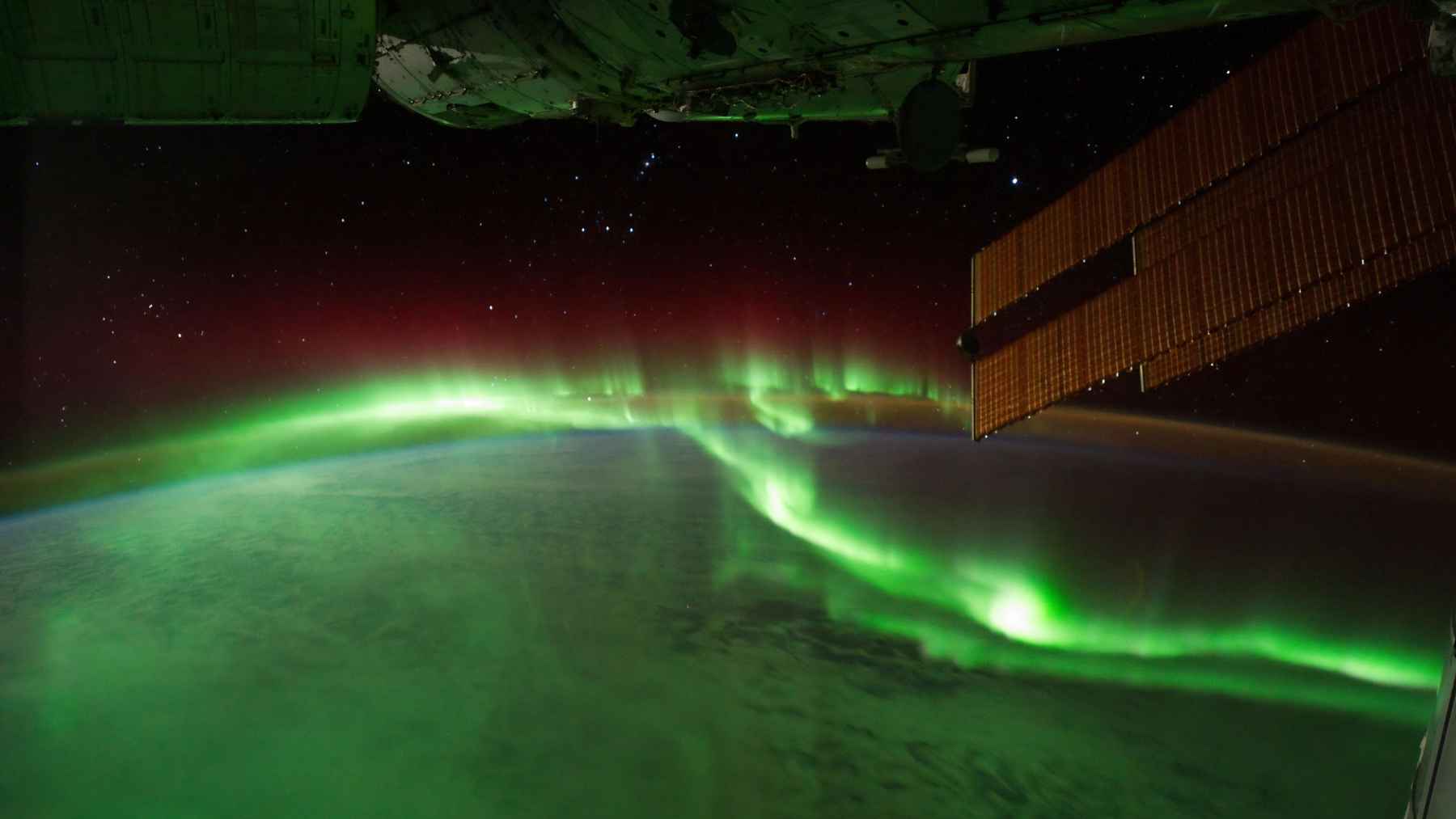
A glowing green ribbon curled across Earth on June 5, and only a handful of people were in the right place to see it from above. One of them was NASA astronaut Jessica Meir, who photographed and filmed the southern lights while temporarily sheltering inside a SpaceX Dragon spacecraft near the International Space Station.
The view was beautiful, but the moment around it was tense. The crew had moved into the capsule as a precaution while Russia’s space agency prepared work on a leak in the station’s Russian segment, a reminder that life in orbit can swing quickly from routine science to careful safety checks.
A rare view from orbit
The aurora spread below the spacecraft in bright green waves, almost like a glowing river running along the edge of the planet. From the ground, auroras can fill the sky overhead. From orbit, astronauts can watch the lights curve with Earth itself.
Meir later described the display as one that “danced and snaked” below the crew. That short phrase says a lot. Auroras are not still lights, but shifting curtains shaped by energy from the Sun and Earth’s magnetic field.
What made this sight stand out was the setting. The astronauts were not floating by a station window during a quiet break. They were inside their return spacecraft, following a safety plan while teams on the ground watched a technical issue closely.
Why the lights turned green
The southern lights, also called the aurora australis, are the Southern Hemisphere’s version of the northern lights. Both happen when charged particles from the Sun reach Earth and interact with the magnetic field that surrounds our planet.
That magnetic field acts a bit like a shield and a guide. It channels many of those particles toward the polar regions, where they crash into gases high in the atmosphere and make them glow. NASA explains that solar flares and coronal mass ejections can help trigger the magnetic storms behind these displays.
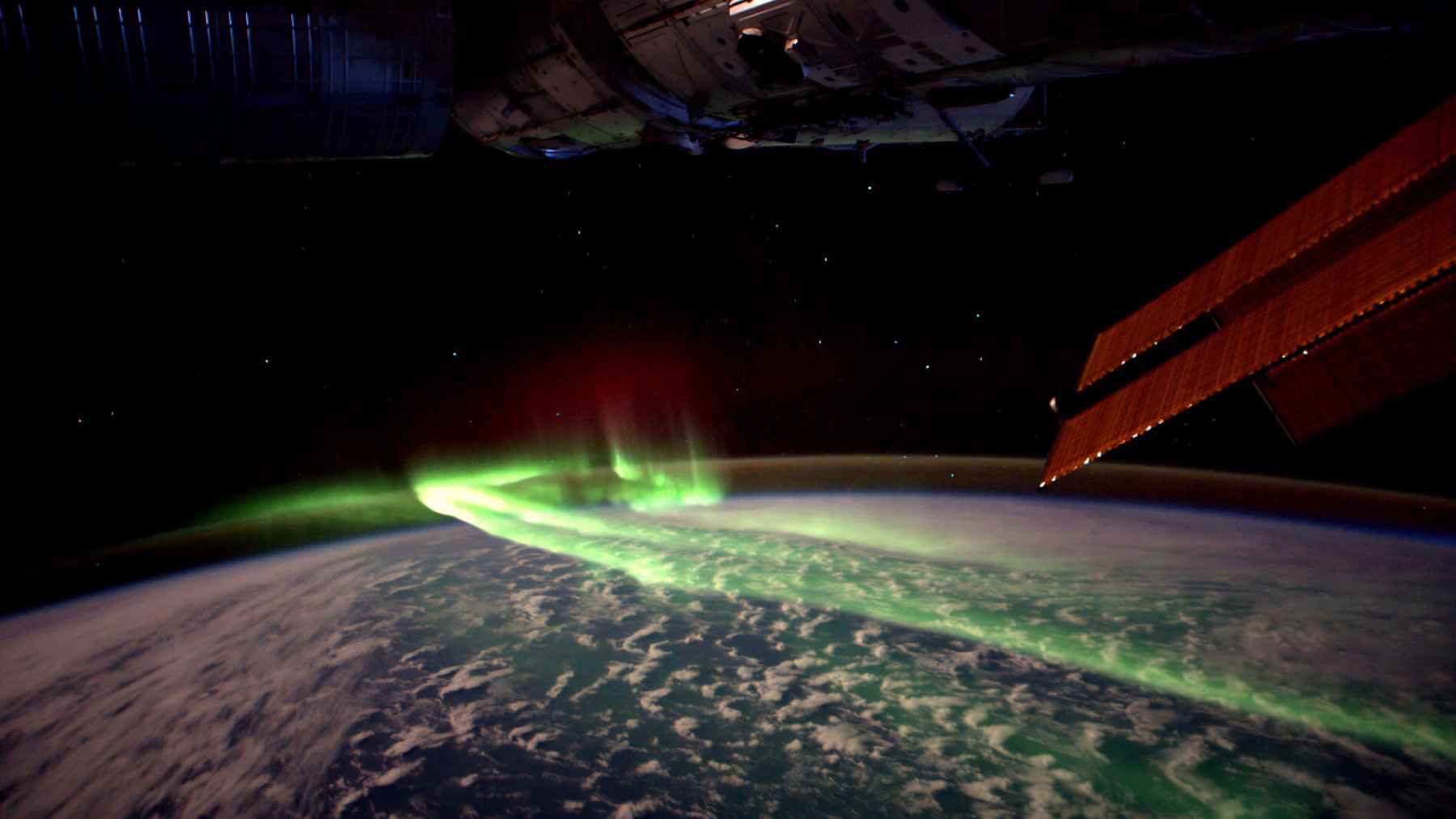
The green color offers a clue about what was happening. According to NASA, green auroras usually come from oxygen high above Earth, roughly 60 to 120 miles over the surface. Red auroras tend to form higher up, while nitrogen can create blue, pink, or purplish light.
The safety issue behind the scene
On June 5, the station’s Perekhodnaya Kamera (PrK) transfer tunnel was at the center of the concern. NASA said the area, connected to the Russian Zvezda service module, has had cracks since 2019 and has been monitored and repaired by Roscosmos.
During cargo operations that week, Roscosmos noted that the leak rate had increased to about 2 lbs. of air per day. The agency also found new suspected leak areas, which led to plans for a more involved inspection and repair effort.
NASA directed the four Crew-12 members and astronaut Chris Williams to take a “safe haven” posture inside the SpaceX Dragon during the planned work. Later that morning, Roscosmos paused the structural repair work to gather more data, and the astronauts returned to normal operations aboard the orbiting laboratory.
Why Crew-12 was there
Crew-12 launched on February 13, 2026, with Meir as commander, Jack Hathaway as pilot, Sophie Adenot as a European Space Agency mission specialist, and Andrey Fedyaev as a Roscosmos mission specialist. Their Dragon spacecraft was scheduled to dock with the station the next day.
The mission is not only about keeping people aboard the station. Over about eight months, the crew is working on research meant to help people on Earth and support future trips to the Moon and Mars.
Some of that science sounds surprisingly close to everyday medicine. NASA says Crew-12 studies include pneumonia-causing bacteria and possible heart damage, how spaceflight affects blood flow, and a system that could make IV fluid from drinkable water during missions.
Auroras are not just Earth’s show
Earth is not the only world with these glowing displays. Auroras can form on planets with atmospheres and magnetic fields, and some are far more powerful than what we usually see from Alaska, Canada, or Antarctica.
Jupiter is the heavyweight example. NASA’s James Webb Space Telescope has observed auroras there that are hundreds of times brighter than Earth’s, giving scientists a better look at the giant planet’s magnetic environment.
Still, Earth’s auroras have a special pull because they connect space weather to something people can see. A solar event millions of miles away can end up as green light above a frozen landscape, or in this case, beneath a crew waiting inside a spacecraft.
A brief pause with a lasting view
The Crew-12 sheltering order did not become an evacuation. That matters. It shows how space agencies plan for risk, even when the preferred outcome is simply to pause, check the data, and return to work.
However, the image Meir captured gave the moment another layer. While engineers and mission controllers focused on a leak, Earth offered a reminder of why humans keep looking out the window in the first place.
For most of us, auroras are something we chase on cold nights, hoping clouds will clear and the sky will cooperate. For Meir and her crewmates, the lights arrived during a safety procedure in orbit. Strange timing, stunning view.
The main official update on the station leak has been published on NASA’s website.