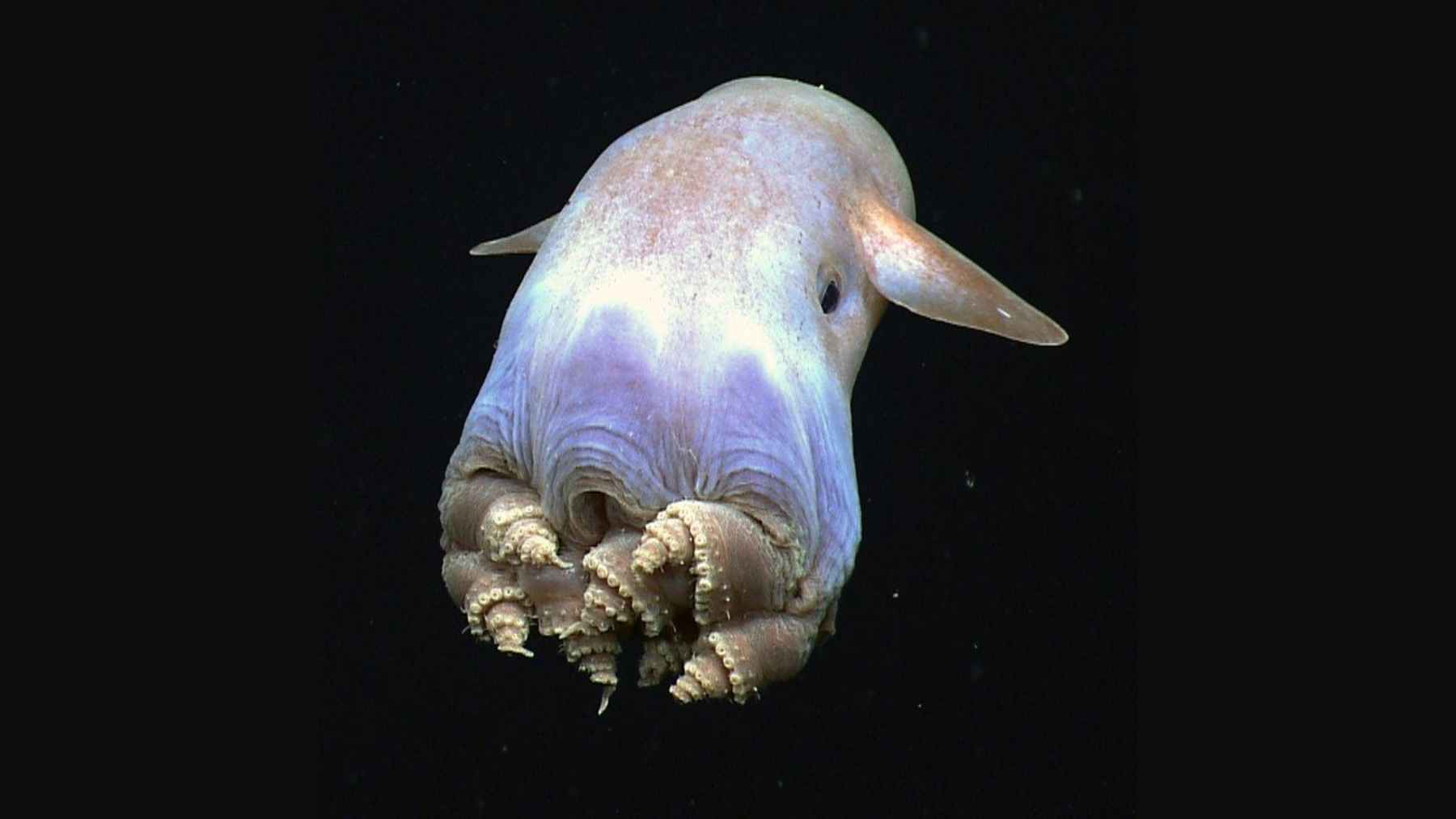
A new Dumbo octopus has been identified in one of science’s harder-to-reach neighborhoods, the dark slopes of the Western Pacific. The species, named Grimpoteuthis feitiana, was collected on Caroline Seamount during a 2017 expedition at about 4,070 feet below the surface, a depth where daylight is long gone.
The find is small in size, but it matters for a big reason. Deep-sea life is still poorly mapped, and a single confirmed species can change what researchers know about where animals live, how they move, and how they survive. Its name also carries an unusual twist, linking a modern marine discovery to flying figures painted in China’s Dunhuang cave murals.
A discovery in the deep
The study was written by Yan Tang, Xiaodong Zheng, and Junlong Zhang, with affiliations including the Institute of Oceanology at the Chinese Academy of Sciences and Ocean University of China. Their team used integrative taxonomy, a careful approach that compares body structure with DNA instead of relying on appearance alone.
That matters because deep-sea animals often arrive damaged after collection. Soft bodies do not always preserve well, and tiny differences can be hard to judge. DNA gives scientists another way to check whether they are looking at a known animal or a species new to science.
What the octopus looks like
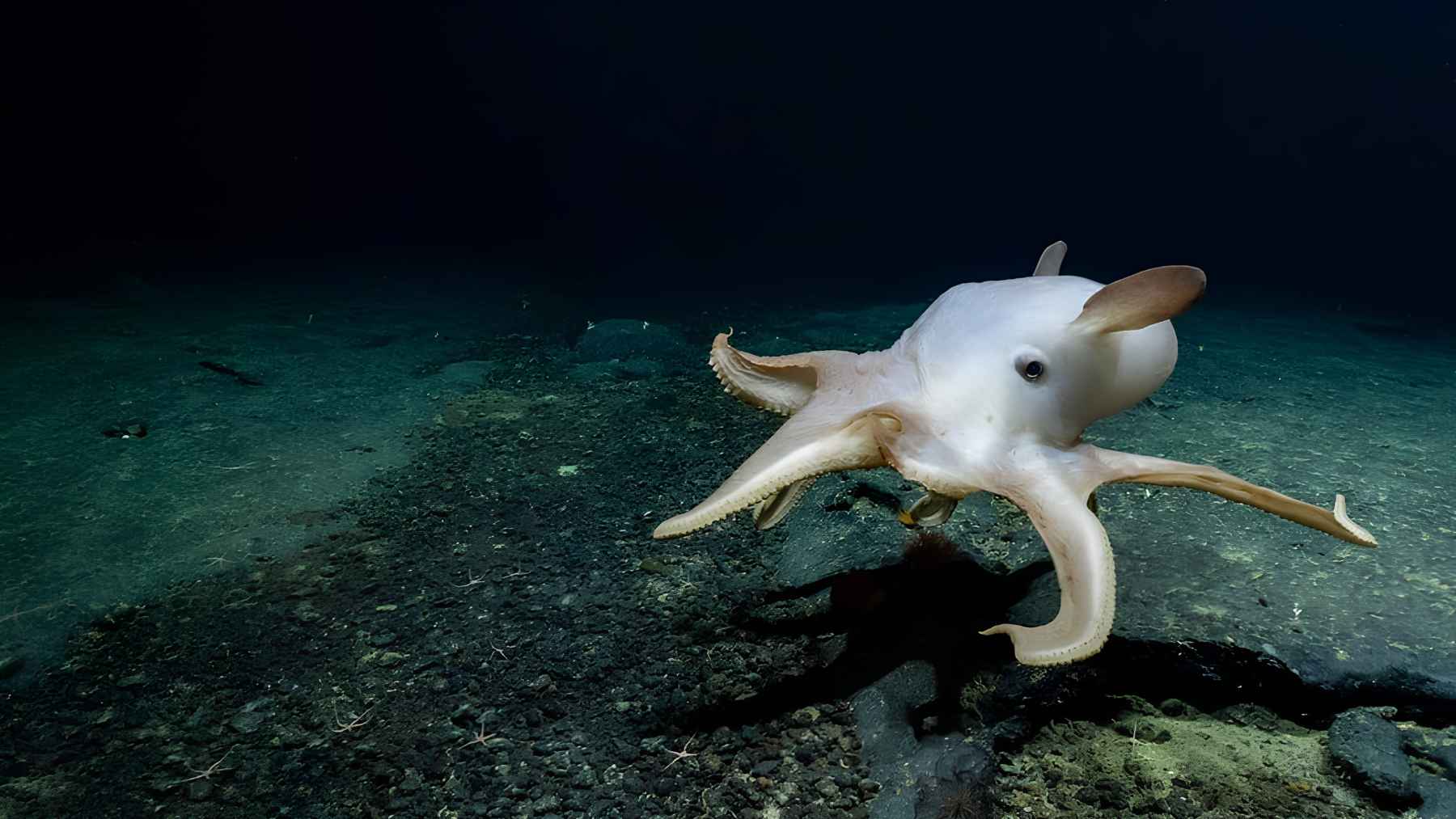
The official release says the octopus is about 7.9 inches long, with a translucent orange-red body and a soft, gelatinous texture. It is not the bulky, reef-hunting octopus many people picture from aquariums or nature shows.
Instead, it looks built for a slower world. The body has a delicate, almost floating shape, and its large fins sit like little ears on either side. That is where the nickname “Dumbo octopus” comes from.
How Dumbo octopuses move
Dumbo octopuses are part of the cirrate group, which includes finned octopods that live mostly in the deep ocean. National Oceanic and Atmospheric Administration (NOAA) notes that these animals have largely moved away from jet propulsion, the fast water-squirting movement used by many shallow-water octopuses, and rely on their fins as their main way to travel.
The Natural History Museum in London says Dumbo octopuses can live from about 3,300 to nearly 23,000 feet below the surface. It also describes them as neutrally buoyant, meaning they can hover and drift with little effort.
At those depths, why rush? There is little food, cold water, and no sunlight. That means, saving energy can be as important as finding the next meal.
A name from flying art
The name feitiana comes from Feitian, the flying apsaras shown in Dunhuang murals. These graceful figures are tied to music, dance, and floating motion, which makes the name feel unusually fitting for an octopus that appears to flap through darkness.
There is a practical reason for that poetic touch. Scientific names can preserve a place, a person, or a cultural memory. In this case, the name gives readers a quick mental picture of how the animal moves, almost like a tiny dancer above the seafloor.
DNA tells another story
The team also sequenced complete mitochondrial genomes from the new species and another Dumbo octopus from a different seamount. Mitochondria are the energy centers of cells, so their genes can offer clues about how animals cope with demanding environments.
One line in the study is technical but important. The authors wrote that “certain residues in the mitochondrial genes of deep-sea octopods have undergone positive selection.” In plain English, some parts of the animal’s energy machinery may have changed over time in ways that help it handle deep-sea life.
The researchers were careful, though. They also said more samples are needed to strengthen the picture, especially because one animal can tell a useful story but not the whole story. That is the trouble with the deep sea. The evidence is precious because it is so hard to reach.
Why one animal matters
What do you do with a creature found only once? You treat it as a clue. One confirmed specimen helps sharpen the tree of life, the branching record scientists use to understand how living things are related.
The discovery also fits a broader pattern. A 2020 Marine Biology study by Alan J. Jamieson and Michael Vecchione documented Grimpoteuthis observations at about 22,825 feet in the Java Trench, extending the confirmed depth range for cephalopods and showing that finned octopods may reach deeper habitats than once expected.
That context matters for Grimpoteuthis feitiana. It was not found as deep as the Java Trench animals, yet it belongs to a group that keeps turning up in places where human knowledge is thin. The more scientists look, the larger the map becomes.
A fragile seamount habitat
Caroline Seamount is far from the coastline, but remote does not mean untouched. NOAA has reported that microplastics have been found across the world’s oceans, from the surface down to the ocean floor.
There is also growing attention around mineral exploration on the seabed. The International Seabed Authority lists exploration contracts, environmental impact work, and regional environmental management plans among its core topics, a reminder that deep habitats are becoming policy questions as well as scientific ones.
For conservation, the first question is basic. What lives there? Discoveries like this one do not answer everything, although they give future decisions a firmer starting point.
What comes next?
Researchers can now search nearby seamounts for more individuals and compare their DNA. Remotely operated vehicles could also watch these octopuses without disturbing them, helping scientists learn how they feed, rest, and move through the dark.
At the end of the day, Grimpoteuthis feitiana is more than a curious name and a soft orange body. It is a reminder that the deep Pacific still holds animals we have barely begun to notice.
The official study has been published in Organisms Diversity & Evolution.