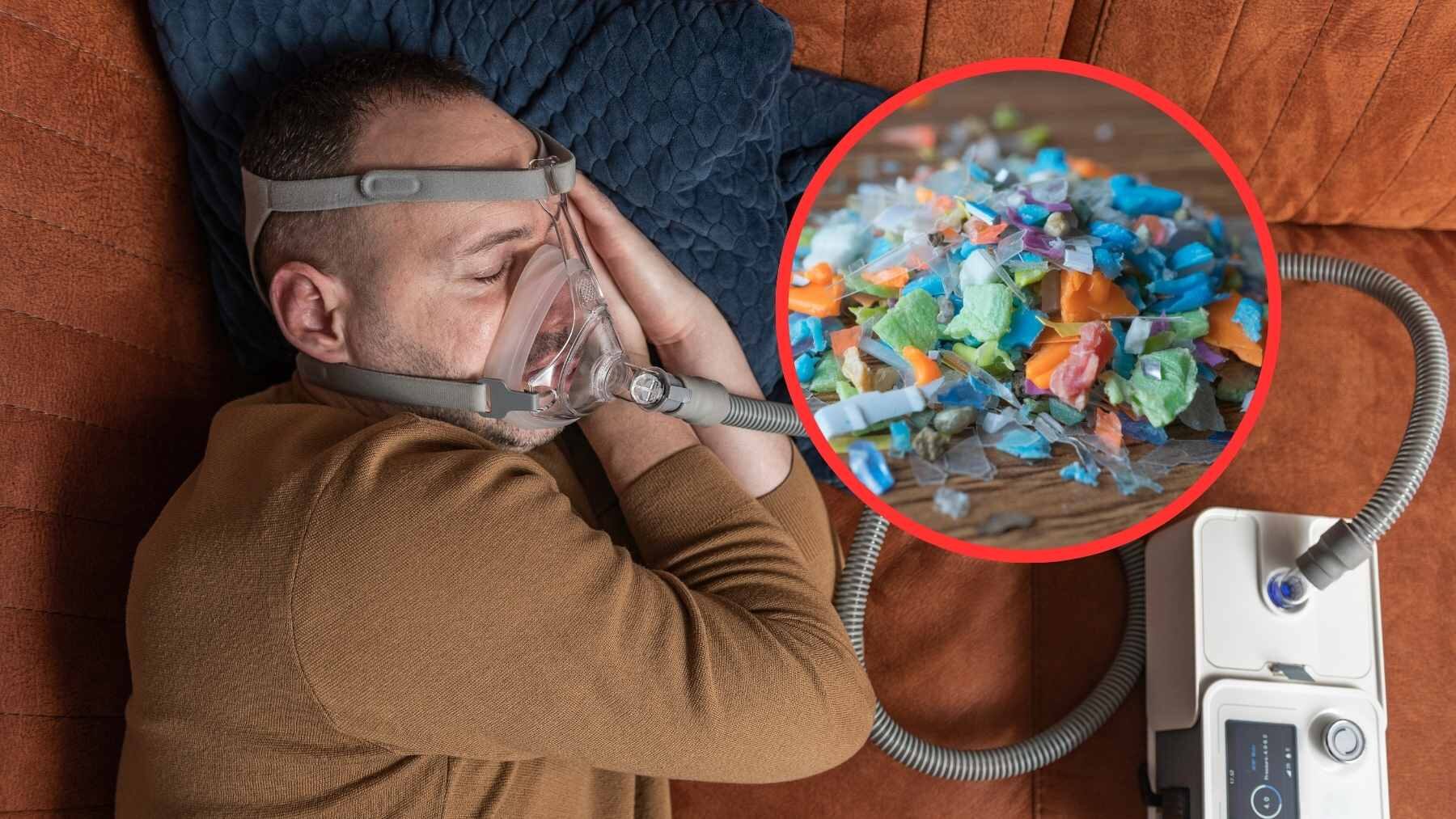
Microplastics were detected in the upper airways of every sleep apnea patient examined in a new pilot study conducted by researchers at the University of São Paulo. The reassuring part for people who sleep beside a humming continuous positive airway pressure (CPAP) machine is that regular use was not linked to a higher overall particle count.
The more troubling signal appeared elsewhere. Patients with more microplastics in nasal rinse samples also tended to have higher levels of inflammation-related proteins, but the research cannot show that the particles caused the inflammation or that they play any role in causing sleep apnea.
What the researchers tested
Obstructive sleep apnea repeatedly narrows or blocks the upper airway during sleep, interrupting breathing and disturbing rest. CPAP treatment pushes a continuous flow of pressurized air through a mask to help keep that airway open, which is why many patients rely on the device every night.
The study included 42 people with obstructive sleep apnea. Researchers compared 21 regular CPAP users with 21 people who had not started CPAP, and all participants were selected without signs or symptoms of nasal inflammation. Nasal lavage fluid was then checked for plastic particles and inflammatory markers.
Why the CPAP question mattered
The investigation grew out of concern surrounding Philips Respironics’ 2021 recall of certain CPAP, BiPAP, and ventilator models. The sound-reducing polyurethane foam in affected devices could break down, allowing particles or chemicals to enter the airflow, and the recall ultimately involved about 15 million devices worldwide.
That history raised an obvious question. Could a device designed to help people breathe all night also add plastic debris to the air reaching their nose and throat? The new study tested that broader possibility, though it was not a safety review of every machine or a substitute for model-specific recall guidance.
CPAP did not raise the overall count
Microplastics appeared in all 42 nasal samples, yet the total counts were not significantly different between the two groups. The reported p-value was 0.68, well above the conventional 0.05 threshold for statistical significance, and the authors concluded that regular CPAP use “does not appear to associate with an increase in inhaled microplastic levels.”
Together, polyethylene and polyamide accounted for roughly 80% or more of the polymers recovered in both groups. Of 15 polymer types identified, ethylene vinyl acetate was the only one found at a higher concentration among CPAP users, but total particle levels still did not rise and they were not linked to treatment pressure, years of use, or adherence. That isolated finding also does not establish where the material came from.
The inflammation finding needs attention
The average inflammatory profile did not differ between CPAP users and non-users. Across all participants, however, higher particle counts tracked most clearly with interleukin-1 beta and interleukin-6, while an accompanying scientific commentary described correlations with two of the 17 cytokines tested.
Cytokines are chemical messengers that help coordinate immune responses, so higher levels can be a sign that tissue is reacting to irritation or another stressor. Still, correlation is not proof of cause. Sleep apnea, other environmental exposures, and individual health differences could influence inflammation, and the commentators warned that the “reassuring results” should not be treated as definitive.
Plastic pollution is already in the air we share
Microplastics are fragments or fibers generally smaller than about 0.2 inches, and scientists have detected them across air, water, soil, and human biological samples. In practical terms, exposure can happen during ordinary life, including the hours spent indoors while sleeping, not only near an obvious pile of plastic waste.
The study did not trace each particle back to a product, room, street, or machine. That matters because polyethylene and polyamide are widespread materials, and the same polymer can come from many sources. The nose is the respiratory system’s front door, but a nasal rinse offers only one snapshot of a much larger exposure picture.
What CPAP users should keep in mind
Nothing in the findings supports abandoning prescribed CPAP therapy. For people using a recalled Philips model, the FDA advises checking the device, discussing individual risks and benefits with a health care provider, and not making treatment changes alone because stopping therapy may carry greater risks for some patients.
Routine care matters, too. The FDA says users should follow the manufacturer’s cleaning instructions and avoid ozone or ultraviolet cleaners for affected CPAP and BiPAP machines, since ozone may worsen foam breakdown and added filters can change how a device works.
The next studies must go deeper
This was a pilot study with a small group, no healthy control population, and samples taken only from the nose. Researchers now need larger studies that follow patients over time, examine different devices and mask interfaces, measure everyday environmental exposure, and look farther down the respiratory tract.
For now, the result cuts in two directions. CPAP was not linked to more overall microplastics, which is reassuring, but finding particles in every sample shows how thoroughly plastic pollution has entered daily life.
The study was published on Springer Nature.