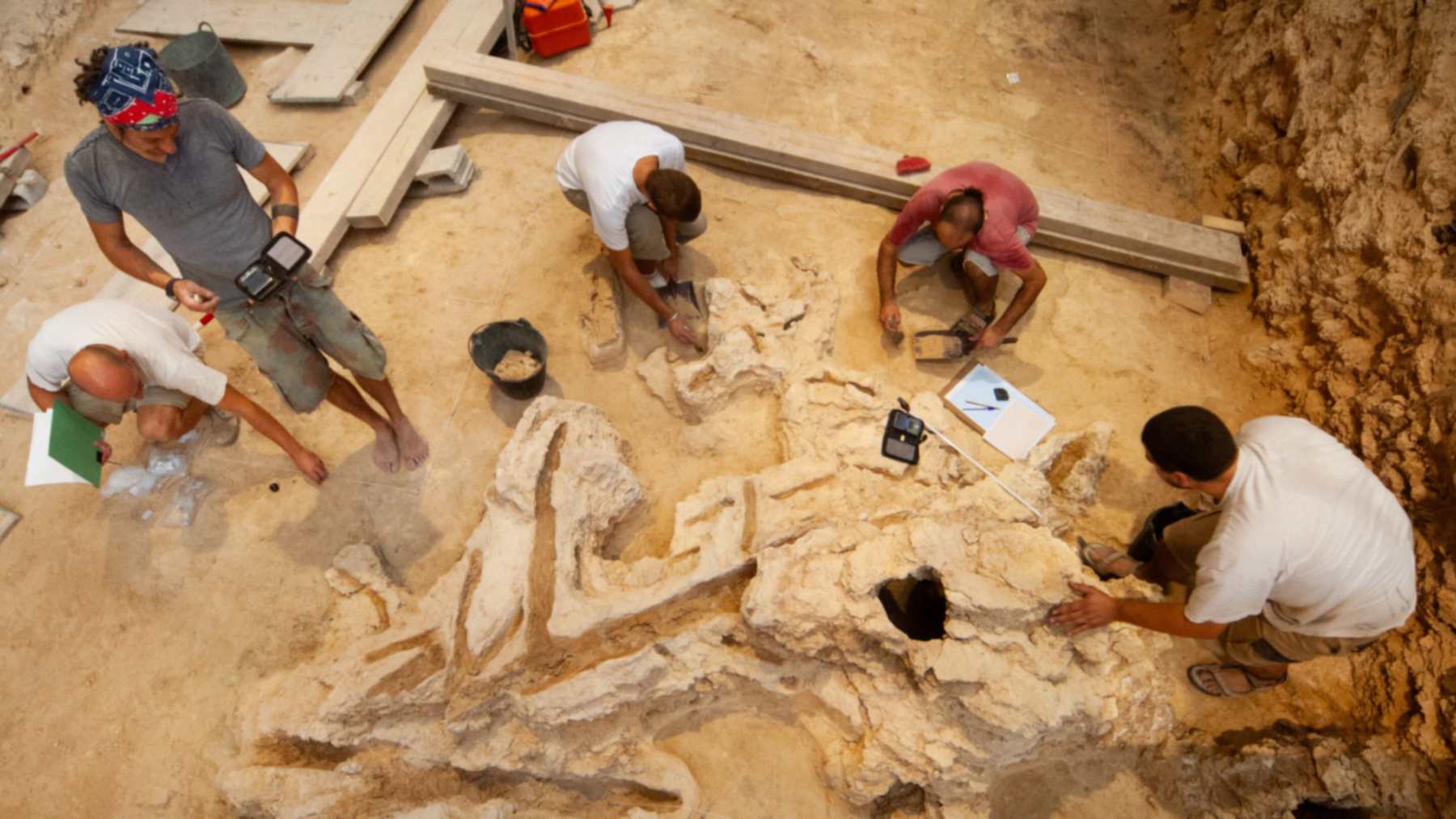
A landowner in rural Río Negro, Argentina, noticed unusual remains scattered across a low-production ranch near Pilcaniyeu. Provincial authorities later confirmed that the site holds three petrified forests estimated to be about 50 million years old.
The discovery is more than a fossil find. It points to a Patagonia that was greener, warmer, and more wooded than the dry steppe many people picture today. For anyone who has crossed that windy landscape, the idea of old forests beneath the dust feels almost unreal.
A ranch tip changed the search
The procedure began when the owner of the rural property alerted authorities to possible fossil remains. That small decision mattered, because fossils lose scientific value when they are moved, broken, or sold without their original location.
Officials said the Secretariat of Culture and the Directorate of Heritage and Museums activated a protection process under the province’s conservation and research plan. The fieldwork also included the Asociación Paleontológica de Bariloche, the Center for Specific Improvement Education Bariloche, and the Environmental Patrol of Squadron 34 Bariloche of Argentina’s National Gendarmerie.
During the survey, specialists identified more than 13 fossilized tree specimens across three paleontological sites. Preliminary work links the trunks to conifers and angiosperms, the broad group that includes flowering plants.
Trees turned into stone
So, what is a petrified forest? In simple terms, it is an ancient forest where wood was buried and slowly changed into stone while keeping the shape of the original tree.
This can happen when water carrying minerals seeps through buried wood. The National Park Service explains that silica, often linked to volcanic ash, can fill pores in wood or replace woody material during fossilization, preserving details that can still look like bark, grain, or rings.
That is why a fossil trunk is not just a heavy rock, it is a time capsule. Like an old photo saved in stone, it can help researchers read clues about climate, plant life, and the landscape that surrounded it.
The Eocene clue
The Río Negro fossils are preliminarily placed in the Eocene, a period that lasted from about 56 million to 34 million years ago. The U.S. Geological Survey describes the Eocene as including some of the warmest climates of the last 66 million years, with plant and animal communities shifting as conditions changed.
In other words, these stone trees grew during a very different world. Patagonia was not always the open, dry country of dust, sheep fences, and cold winds that travelers often meet today.
The mix of conifers and flowering plants is especially interesting. Conifers include trees related to pines and araucarias, while angiosperms include the flowering plants that now dominate many forests and gardens.
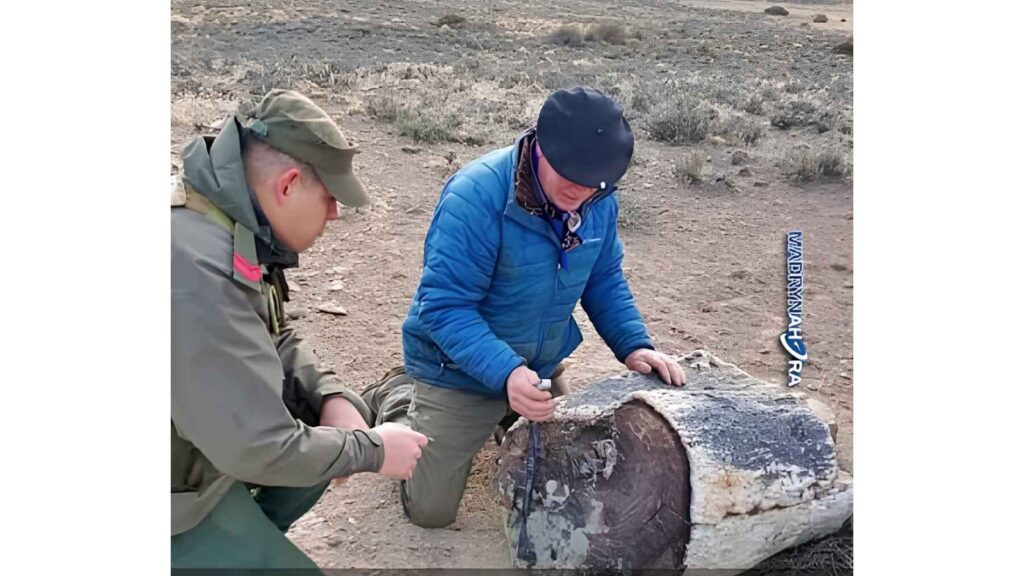
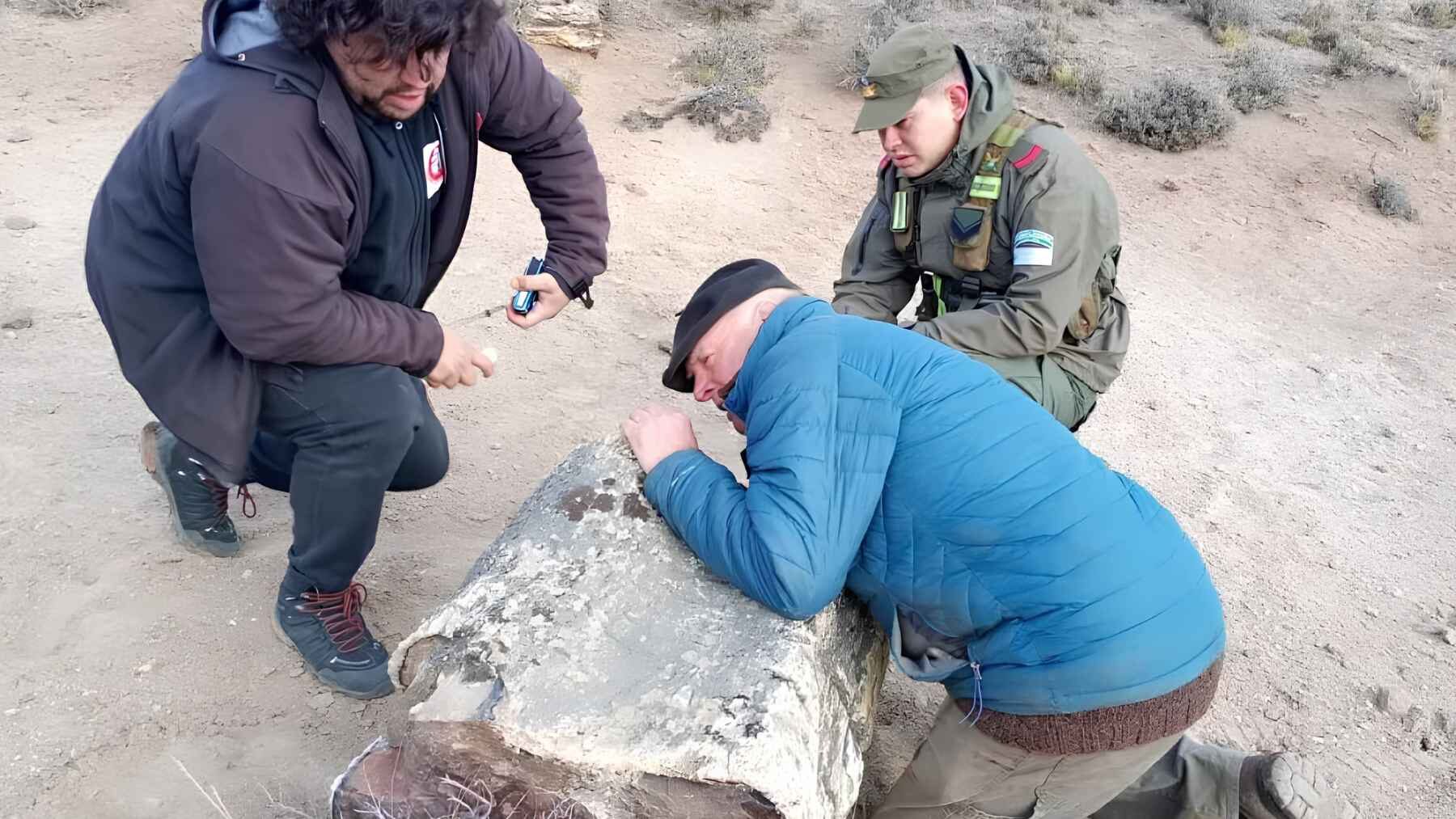
Researchers inspect a fossilized tree trunk in Río Negro, Argentina, where three petrified forests dating back about 50 million years were recently identified.
A greener Patagonia
Other fossil studies have already hinted at this lost version of the region. Research on Eocene Laurales from Patagonia reported that much of the modern land east of the Andes is dry steppe, but fossil floras show that Eocene Patagonia had wet, diverse forests with tall canopies dominated by flowering plants and conifers.
A 2024 reassessment by Gabriella Rossetto-Harris and Peter Wilf focused on Río Pichileufú, one of Patagonia’s well-dated middle Eocene plant localities in Río Negro. Their work reviewed fossil leaves from about 47.7 million years ago, adding another piece to the puzzle of how plants spread across the region.
Also, a Communications Biology study on southern Patagonia found that plant diversity rose during a middle-Eocene warming event. The new Pilcaniyeu sites may help researchers compare northern Patagonia with those better-known southern records.
Why the exact location matters
Finding fossil wood is exciting, but finding it in place is far more useful. A trunk’s position can tell scientists whether the tree grew there, was carried by water, or was buried after a storm, flood, or volcanic event.
That is why the team documented the sites before moving samples. The official process included field verification, photography, geolocation, controlled extraction, and careful transport to protect the fossils from damage.
“This discovery represents an important opportunity to expand knowledge about Río Negro’s natural history,” said Pablo Chafrat, the provincial director of Heritage and Museums. He also stressed that community reports are key because local people are often the first to notice something unusual in remote areas.
From the steppe to the museum
The recovered material was moved to the Museo Paleontológico de Bariloche for safekeeping and study. There, specialists can examine the wood anatomy, identify plant groups more precisely, and test whether the preliminary age estimate holds.
That work may sound slow, but it is how a fossil stops being a curiosity and becomes evidence. Tiny structures inside petrified wood can separate one plant group from another, while nearby rocks can help reconstruct the environment that buried the forest.
The researchers’ next steps are expected to focus on dating, taxonomy, and the geology of preservation. In plain English, they will try to answer three questions: how old are the trunks, what trees were they, and what natural process turned that forest into stone?
What comes next
For now, officials are treating the three sites as protected heritage. That keeps the focus on study rather than tourism, collecting, or quick headlines.
Future analysis could reveal whether these trunks represent one ancient landscape or several moments preserved in nearby rocks. Either way, they offer a rare view of a Patagonia that no human ever saw, a place where forests stood where steppe now stretches toward the horizon.
The full meaning of the find will depend on the museum work still ahead. The first message is already clear, though: Patagonia’s past was not one landscape, but many.
The official press release has been published by the Government of Río Negro.