Mars looks dry, cold, and almost empty today, but two recent studies suggest the Red Planet may not have lost everything that once made it look more like Earth. Instead, much of its ancient water and carbon-rich air may have slipped underground, hiding in deep fractured rock and clay minerals for billions of years.
The finding does not mean astronauts are about to drill a Martian well or breathe ancient Martian air. It does mean that one of the planet’s biggest mysteries may have a more grounded answer than scientists once thought. So where did it all go?
Mars once looked different
Long before spacecraft arrived, people imagined Mars as a place of canals, forests, or even alien civilizations. That picture changed sharply when NASA’s Mariner 4 flew past the planet in 1965 and returned close-up images of a barren, heavily cratered world.
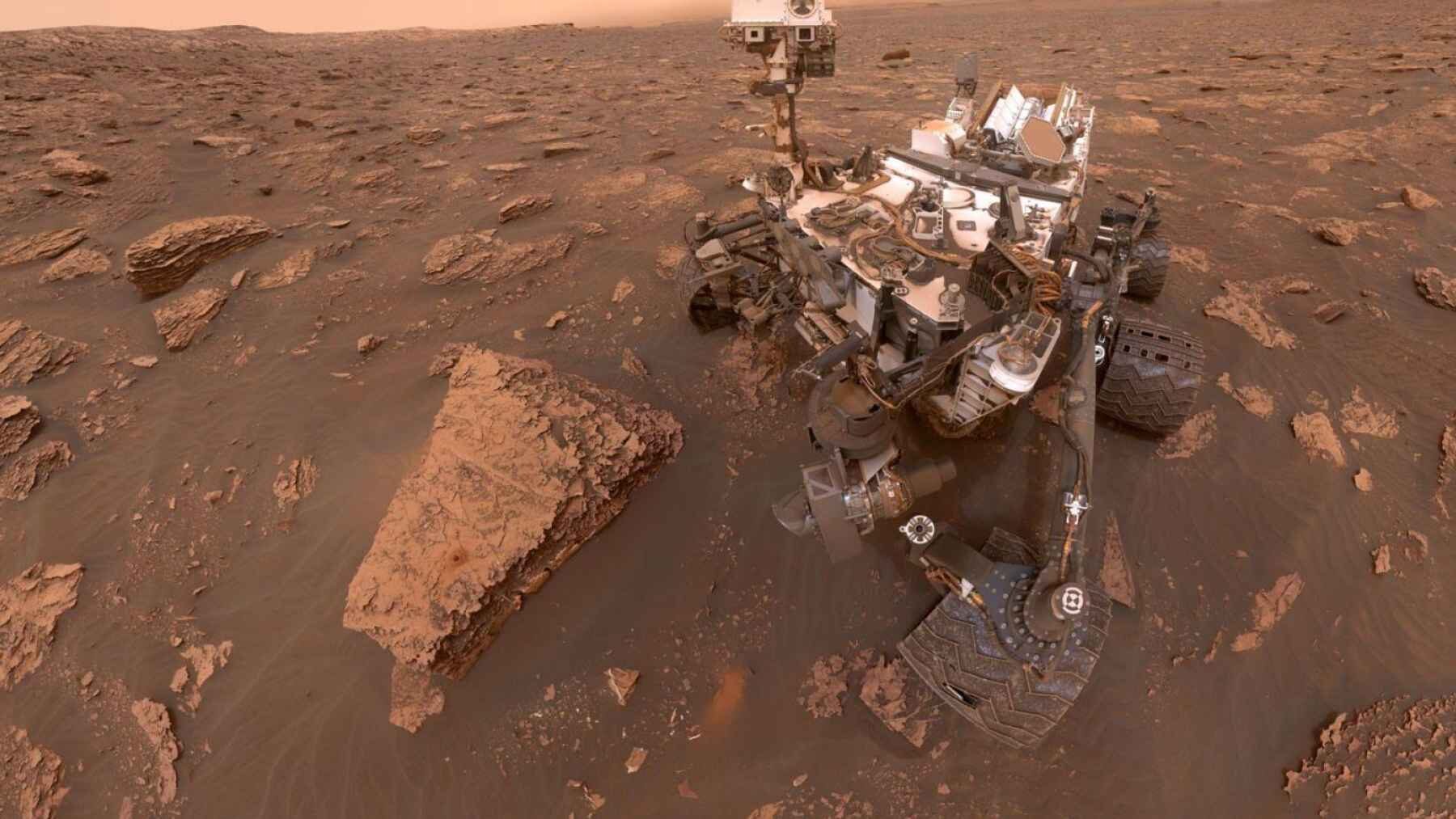
Later missions added a twist. Mars Pathfinder landed in 1997 on an ancient floodplain, where rounded rocks and cobbles pointed to powerful flows of water in the distant past. Opportunity later found chemical evidence that part of Mars had once been wet enough to alter rocks, leaving behind minerals that form in water.
How Mars lost its air
Today, liquid water cannot last on the Martian surface for long because the air is too thin and cold. The old explanation was simple enough. Without a strong global magnetic field, the solar wind could slowly strip the atmosphere away, like a steady breeze peeling dust from a porch.
The MAVEN spacecraft strengthened that idea by showing how solar wind and radiation helped remove atmospheric gas over time. However, that did not fully close the case. Chemical reactions can also lock gas into rocks, and that possibility has become much harder to ignore.
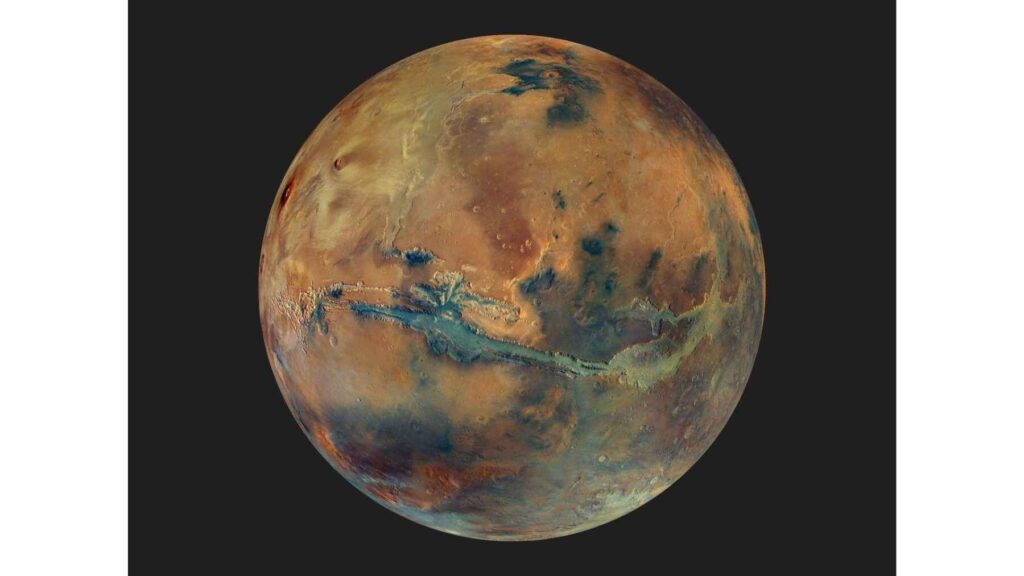
A global view of Mars. New research suggests the Red Planet may still hold ancient water deep underground while clay minerals could preserve part of its early carbon-rich atmosphere.
A hidden ocean beneath rock
For Vashan Wright of Scripps Institution of Oceanography, who worked with Michael Manga of the University of California, Berkeley, and Matthias Morzfeld, the starting point was the InSight lander. “Understanding the Martian water cycle is critical for understanding the evolution of the climate, surface, and interior,” he said.
The team used marsquakes, tiny vibrations moving through the planet, to infer what lies below the landing site. Their model found that the best fit was fractured igneous rock filled with liquid water, buried about 7 to 12 miles below the surface. If that region represents the wider planet, the water could cover Mars in a global layer about 0.6 to 1.2 miles deep.
That sounds like an ocean. In practical terms, though, it is more like water trapped inside stone, not a clean underground lake waiting for a pump.
The claim needs caution
The InSight result is an inference, not a direct sample. Scientists have not drilled into that layer, touched the water, or proved that the same structure exists across all of Mars.
That matters because the debate is still moving. A later letter in Proceedings of the National Academy of Sciences argued that the same data do not require a water saturated mid-crust, even if they do not rule it out. That is the trouble with a planet we can only probe from a few landing sites.
Still, the possibility is important. On Earth, life can survive deep underground and at the ocean floor, far from sunlight. Mars has not given up evidence of life, but deep water would give scientists a specific place to look.
Clay may hold the air
The second clue comes from smectite, a kind of clay with microscopic folds that can trap carbon bearing molecules for very long periods. Think of it like a tiny accordion with pockets inside each fold.
At MIT, Oliver Jagoutz, working with lead author Joshua Murray, connected that idea to Mars after looking at maps of the planet’s clay-rich surface. “We know this process happens, and it is well-documented on Earth,” he said. The team proposed that ancient water moving through iron-rich rock could have changed carbon dioxide into methane, which then became locked in clay.
Their estimate is striking. A clay layer about 3,600 ft. deep could hold carbon equal to roughly 25 pounds per square inch of pressure, or about 80% of Mars’ early atmosphere. In other words, the missing air may not be gone. It may be stored in plain sight.
What future explorers could use
The underground water would be a scientific prize, but it is probably not a practical resource for early crews. Drilling 7 to 12 miles deep is difficult on Earth, let alone on a cold planet with limited equipment and no hardware store down the road.
The clay trapped methane may be a different story. Researchers have suggested that future explorers could one day recover some of that carbon and turn it into propellant for missions between Mars and Earth. That is not a promise, yet it is the kind of resource question mission planners care about.
At the end of the day, these studies do not turn Mars back into a blue planet. They do something quieter and maybe more useful. They suggest Mars did not simply lose its water and atmosphere into space. Some of it may have moved underground, leaving clues that future missions can follow.
The main studies were published in Proceedings of the National Academy of Sciences and Science Advances.