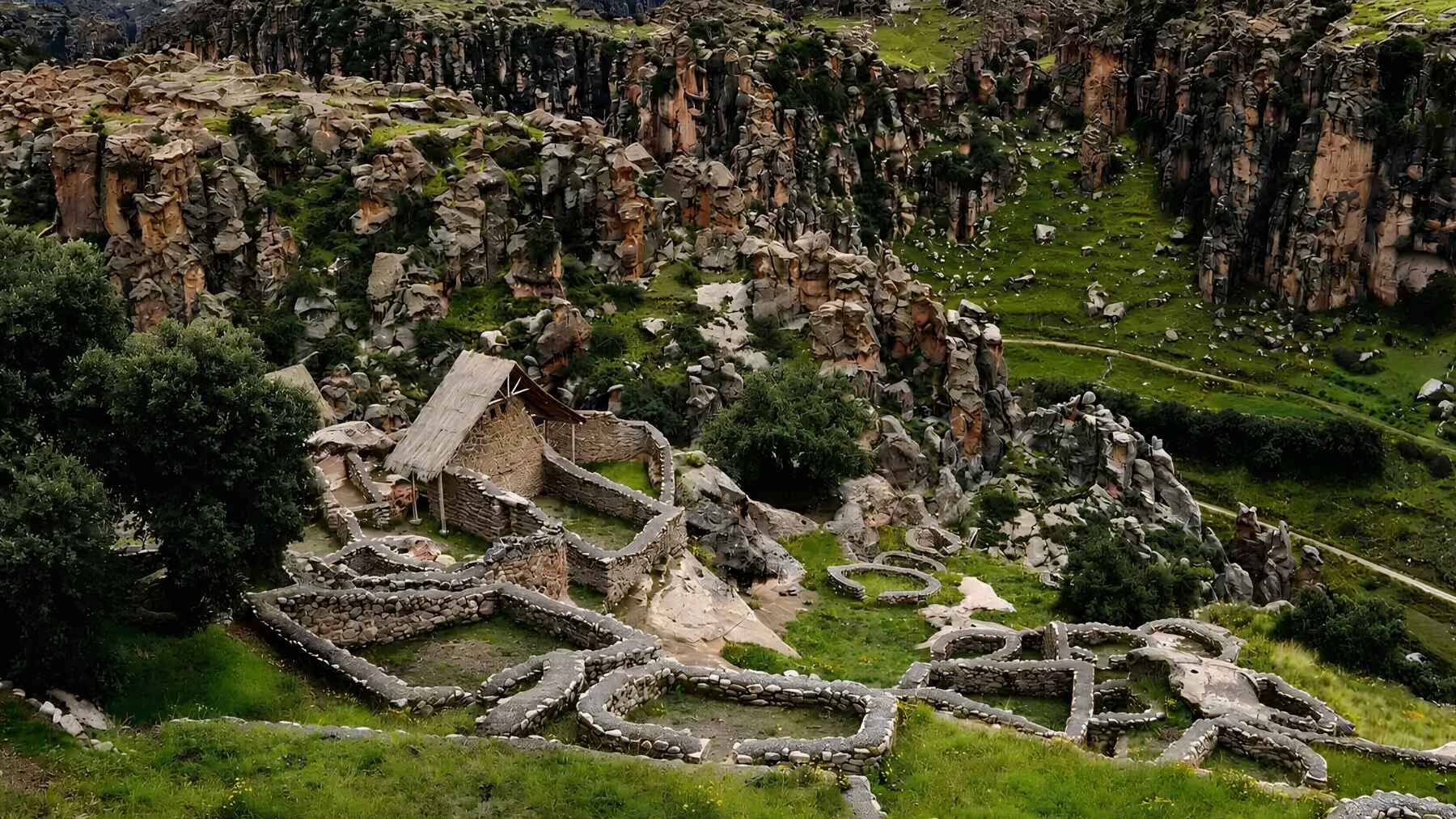
An overlooked fortress high in Peru’s southern Andes is suddenly changing the way archaeologists talk about the last chapters of the Inca Empire. T’aqrachullo, also known as María Fortaleza T’aqrachullo, sits above the Apurímac River canyon and has now been linked by some researchers to Ancocagua, a sacred citadel described in colonial chronicles but lost to history for centuries.
The attention-grabbing detail is easy to understand. Excavations have revealed nearly 3,000 tiny gold, silver, and copper sequins, along with hundreds of structures spread across a windswept plateau, but the bigger story is not just treasure. It is about a place that may help Peru reclaim a part of its own ancient past, stone by stone.
A city above the canyon
T’aqrachullo is located in Chaupimayo, in the district of Suykutambo, province of Espinar, about 140 miles from Machu Picchu. Peru’s Ministry of Culture says the site stands at 13,458 ft. above sea level, positioned on a rocky cliff in a high-mountain landscape.
National Geographic reported that the ruins cover about 43 acres and include an area along the base of the mesa. That has led to comparisons with Machu Picchu, though Peruvian specialists have been careful to add context.
Why the caution? Machu Picchu is not only its famous urban core; It also sits inside a vast historic sanctuary, which covers more than 79,000 acres, so the comparison depends on what exactly is being measured.
Treasure in an alpaca corral
For decades, T’aqrachullo did not look like the kind of place that would shake up Inca archaeology. Farmers grazed animals and grew potatoes among the ruins, and one stone enclosure was used as an alpaca corral. Then came the surprise.
In September 2022, archaeologist Dante Huallpayunca and his team uncovered nearly 3,000 metal sequins made of gold, silver, and copper. The small round pieces had been buried for hundreds of years and were later interpreted as decorations for ceremonial clothing used by the Inca elite.
Imagine finding a glittering clue in a place everyone had walked past for years. That is what makes the discovery so powerful. The sequins suggest that T’aqrachullo was not a remote backwater, but a ceremonial and political space with serious importance.
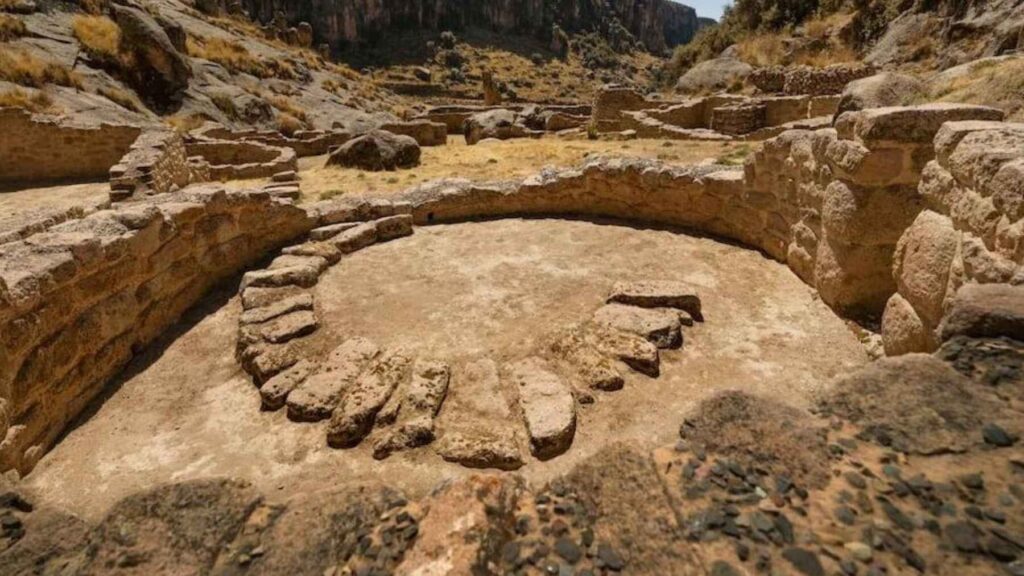
The T’aqrachullo archaeological complex rises above the Apurímac River canyon in southern Peru, where archaeologists have uncovered hundreds of structures and thousands of artifacts that are reshaping the history of the Inca Empire.
More than one culture
The site’s story reaches far beyond the Inca. Peru’s Ministry of Culture says evidence from T’aqrachullo points to three major periods of occupation, including the Middle Horizon from 700 to 1000, the Late Intermediate Period from 1000 to 1476, and the Late Horizon from 1476 to 1532.
That timeline matters because it places Wari, Qolla, and Inca layers in the same dramatic landscape. Effectively, T’aqrachullo was not built in one moment and then abandoned. It grew, changed, and was reused across centuries.
The official virtual library of the Cusco cultural authority lists research on architecture, ceramics, archaeobotany, funerary structures, war-related stone artifacts, ceremonial objects, metal objects, restoration, and recovered cultural material. That tells us something simple but important. This is a whole archaeological landscape, not just a single headline-making stash.
Could this be Ancocagua?
The most intriguing question is still open. Could T’aqrachullo really be Ancocagua, the sacred Inca stronghold mentioned by colonial chroniclers?
National Geographic reported that the theory has gained support among some experts because the geography, ceremonial evidence, and colonial descriptions appear to line up. The chronicles describe a sacred citadel high on a mesa south of Cusco, connected to rebellion and resistance after the Spanish conquest.
Still, archaeologists are being careful. No single discovery has closed the case. For now, the idea is a strong hypothesis, and the site still has plenty of untouched areas reserved for future researchers.
The Machu Picchu comparison
The phrase “bigger than Machu Picchu” is tempting. It grabs the eye right away. However, as often happens in archaeology, the truth is more interesting than the slogan.
Archaeologist Emerson Pereyra, cited by TVPerú, said that “at the level of magnitude, there is no comparison with Machu Picchu.” He added that this does not reduce T’aqrachullo’s importance, since the site remains highly relevant for understanding the region’s past.
That is the better way to read the discovery. T’aqrachullo does not need to defeat Machu Picchu in a size contest. It matters because it may explain how sacred geography, elite ritual, political control, and conflict came together in one high-Andean place.
Opening the site without losing it
The sudden attention has created a new challenge. More visitors are now interested in seeing T’aqrachullo, and this can bring opportunities for local communities. It can also bring risk.
In late May 2026, the Cusco cultural authority announced reinforced surveillance and monitoring at the archaeological site after a sharp increase in visitors. Officials said the measure was meant to prevent damage, illegal digging, and other threats to cultural heritage.
A few days later, authorities also announced interinstitutional work to promote sustainable tourism, improve visitor conditions, and protect the monument. In everyday terms, the question is simple. How do you let people experience a place like this without loving it to pieces?
T’aqrachullo and Peru’s memory
T’aqrachullo is more than stone walls and precious metal. It is a reminder that the Andes still hold stories that were partly hidden by conquest, neglect, and time.
The Ministry of Culture recently inaugurated a temporary exhibition titled T’aqrachullo: El tiempo superpuesto. La historia que se escribe,”which presents more than 1,000 years of high-Andean history through recovered objects, graphics, and infographics. The exhibition runs from June 15 to August 15 at the Museo Histórico Regional Casa Garcilaso.
For the most part, the message is clear. T’aqrachullo is not only a possible lost citadel. It is also a living test of how Peru protects, studies, and shares its ancient heritage.
The official statement was published on Peru’s Ministry of Culture.