A vast whale cemetery has been discovered in one of the least familiar places on Earth, deep beneath the southeastern Indian Ocean. In the Diamantina Zone, researchers documented what they describe as a massive whale necropolis stretching 746 miles along the seafloor, with five active whale-fall communities and 476 fossil cetaceans recorded.
The surprise is not just the age of the bones, it is the life around them. Whale bodies that sank millions of years ago, and some that arrived much more recently, appear to be feeding strange and specialized ecosystems in a dark world where every scrap of energy matters.
A graveyard at crushing depth
The site lies between 15,150 and 22,970 ft. below the ocean surface, far beyond sunlight and far beyond the reach of ordinary exploration. To picture that depth, imagine stacking more than 70 Statues of Liberty from the seafloor upward and still not reaching the waves above.
The discovery was made during 32 dives in 2023 using the human-occupied Fendouzhe submersible aboard the research vessel Tansuoyihao. The team first encountered whale fossils near the Dordrecht Deep at 22,970 ft., one of the deepest points in the region.
Until now, most known whale falls had been found above roughly 13,100 ft., and the deepest active example had been recorded at 13,793 ft. This new site pushes that boundary much lower, with one active whale-fall community found at 22,273 feet.
When death becomes dinner
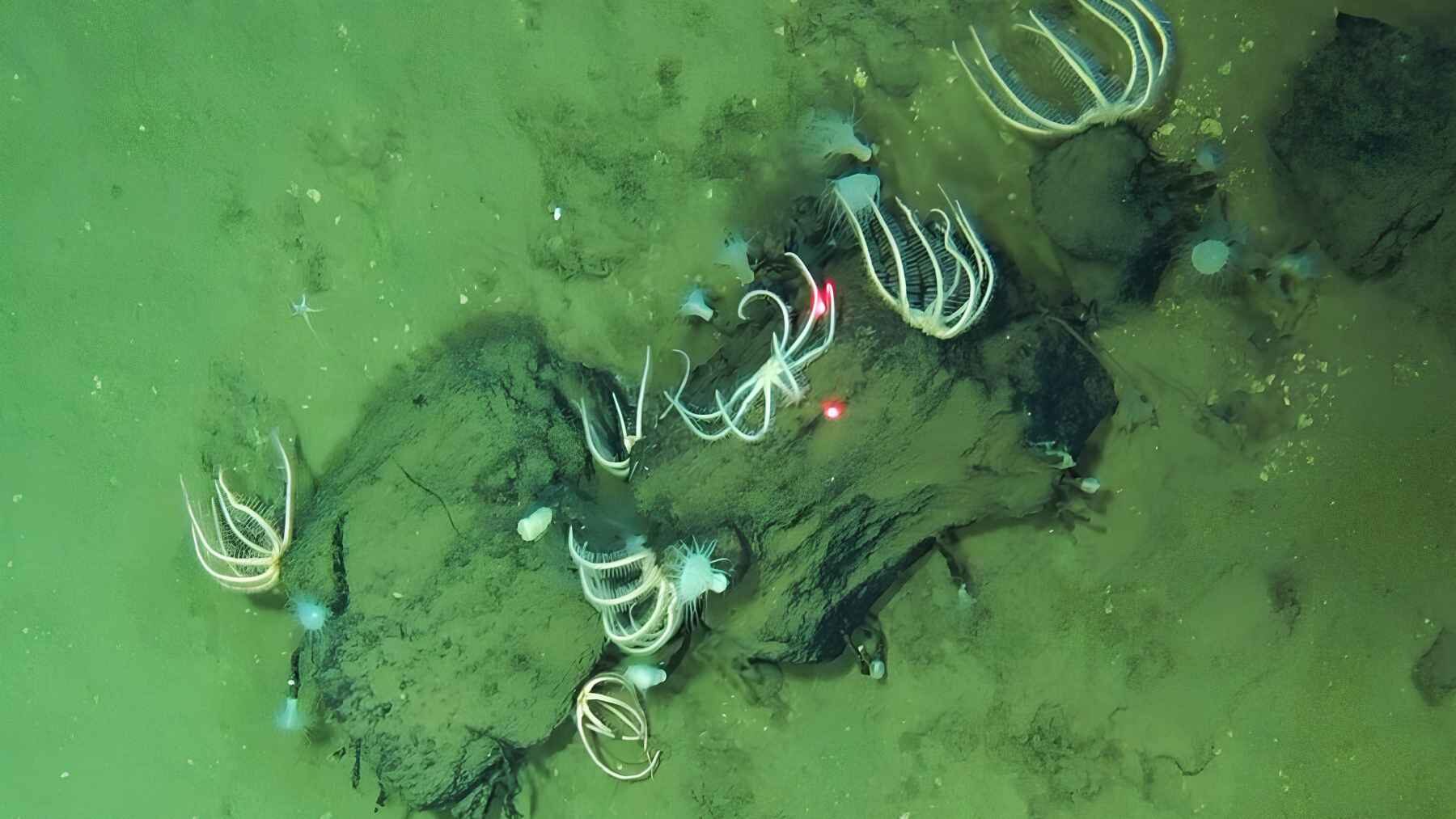
When a whale dies and sinks, its body can become a feast in a place where food is usually scarce. First come scavengers. Later, the bones themselves can support animals and microbes that live off the chemical energy released during decay.
At Diamantina, researchers found active whale falls in what scientists call the “sulfophilic stage,” when bones are covered by microbial mats and organisms that can use sulfur-rich chemistry. The communities included brittle stars, bone-boring Osedax worms, chemosynthetic bivalves, gastropods, crustaceans, and other small seafloor animals.
It sounds eerie, but it is also practical. In the deep sea, a whale carcass is a little like a pop-up neighborhood, bringing food, shelter, and chemical fuel to creatures that may never see sunlight.
Fossils from the Pliocene
Using strontium isotope dating, the researchers found that whale falls have been occurring in this region since at least 5.3 million years ago. That places the oldest evidence near the start of the Pliocene, long before modern humans appeared.
The remains include living beaked-whale species, such as Andrews’ beaked whale and the strap-toothed beaked whale, along with extinct species. Among the extinct forms, the team described a new species named Pterocetus diamantinae, a name tied directly to the Diamantina seafloor where it was found.
Not every bone tells a complete story by itself. But together, these fossils create a rare archive of deep-diving whales and the ecosystems that formed around them over millions of years.
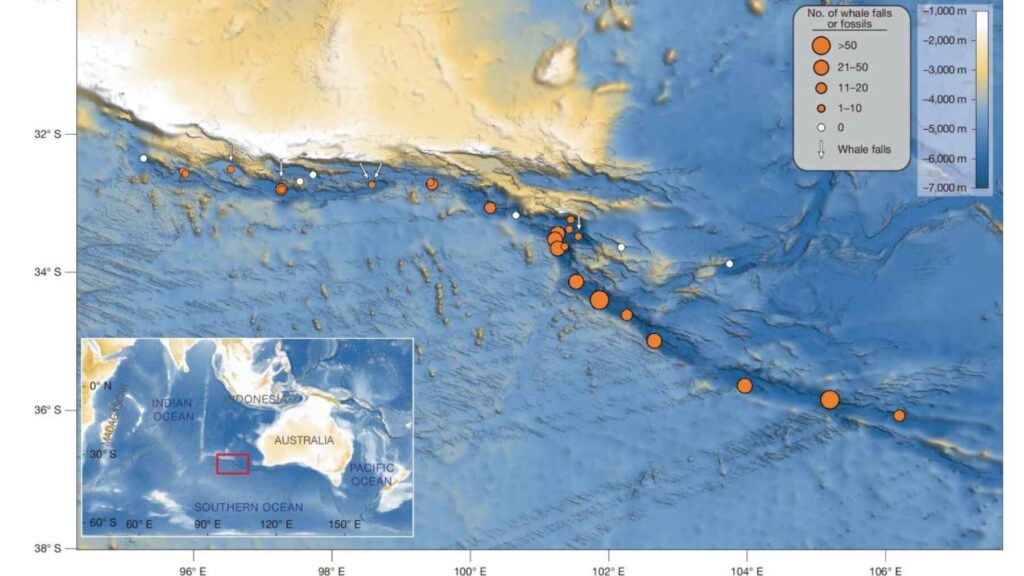
Map of the Diamantina Zone highlighting the locations of active whale falls and fossil whale remains discovered along a 746-mile stretch of the southeastern Indian Ocean.
Why so many whales here?
The study points to several likely reasons for the concentration. The Diamantina Zone has steep, complex topography, and its V-shaped seafloor may help funnel sinking carcasses into the same deep corridor.
The area may also sit near routes used by some whales, including migratory baleen whales such as Antarctic minke whales and sei whales. Beaked whales, on the other hand, are deep-diving hunters, and the region may offer the squid and fish that draw them into risky, high-pressure waters.
There is another quiet factor at work. Sediment builds up slowly in parts of this region, so bones can remain exposed for extraordinary lengths of time instead of being quickly buried.
A possible whale-fall supercorridor
The density of whale remains reached up to about 1,967 individuals per square mile in surveyed areas, by the researchers’ estimates. “If that number is extrapolated across the entire zone, it suggests there may be more than 10 million whale carcasses in the area,” said Peng Xiaotong, a professor at the Institute of Deep-sea Science and Engineering.
That figure should be read carefully. It is not a direct count of every whale skeleton across the whole region, but it does show how unusually packed some parts of the seafloor appear to be.
The authors also suggest the 746-mile stretch may function as a “whale-fall community supercorridor.” In practical terms, these carcasses could act like stepping stones, helping deep-sea animals spread and evolve across parts of the Southern Indian Ocean.
Why this matters now
For most of us, the deep ocean feels distant, almost imaginary. We notice beaches, storms, seafood, and maybe the price of fish at the grocery store, but not the slow work happening miles below the surface.
This discovery is a reminder that the deep sea is not empty. It holds living communities, ancient fossils, and ecological records that can reshape how scientists understand whale evolution, biodiversity, and the hidden movement of nutrients through the ocean.
At the end of the day, the Diamantina whale cemetery is both a graveyard and a library. The bones are old, but the story is still alive.
The study was published on Nature.