Astronomers tracked carbon monoxide around young stars and found a twist that shouldn’t be there
· 3 min read
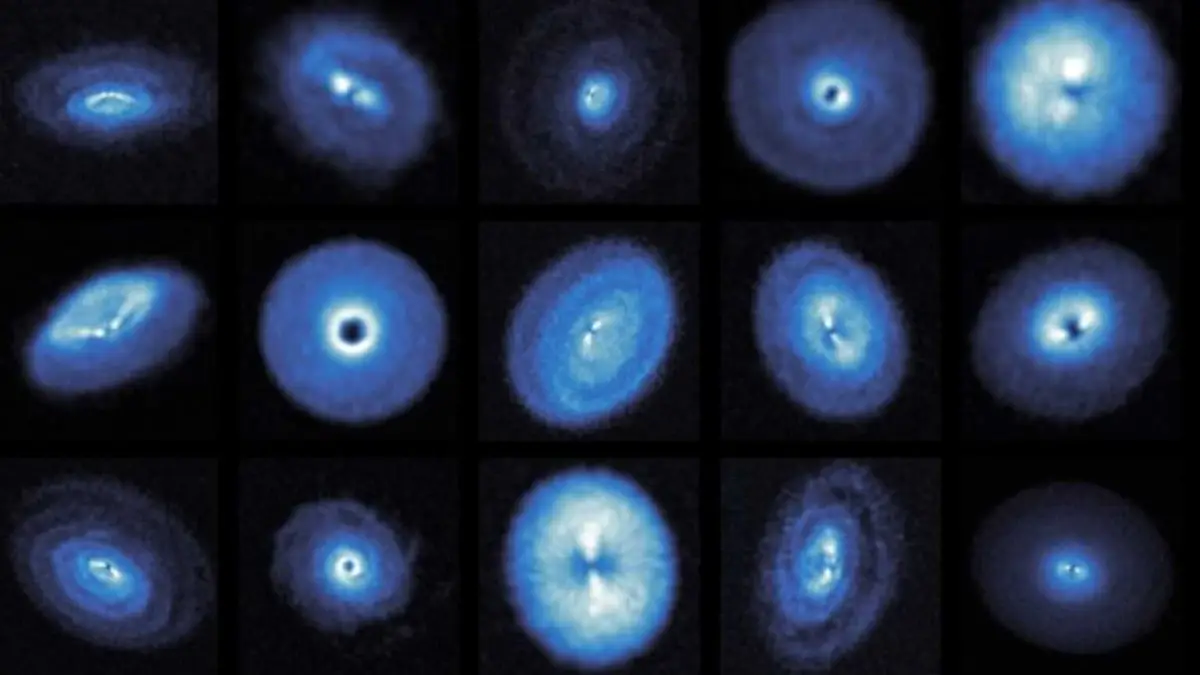
For decades, astronomy textbooks have shown planet forming discs as perfectly flat, like cosmic vinyl records. A new international study using the Atacama Large Millimeter submillimeter Array (ALMA) now paints a more complicated picture. Many of these planetary nurseries appear to be gently warped, with different parts of the disc tilted by a few degrees. Those tiny angles closely match the small differences in orbital tilt among the planets in our own Solar System.
The work comes from the exoALMA project, a large observing program that mapped the gas around dozens of young stars. The results appear in The Astrophysical Journal Letters. The team, led by Dr Andrew Winter of Queen Mary University of London, examined how carbon monoxide gas moves in the discs.
By measuring slight Doppler shifts in the radio emission, they could track the speed of the gas along our line of sight. When they compared the data with the smooth rotation expected from a flat disc, a pattern of subtle but persistent deviations appeared.
Instead of random turbulence, many discs showed a clear large-scale twist in their velocity maps. The best explanation is that the disc plane slowly changes orientation with distance from the star. In other words, the inner and outer regions of the disc do not sit in the same plane but are slightly misaligned. Typical tilts range from about half a degree to two degrees, enough to leave a long lasting imprint on the orbits of growing planets.
One striking example is the young star MWC 758, a well known system with dramatic spiral arms in scattered light images. When the exoALMA team applied their warp model to the gas motions in this disc, they found that a modest twist could reproduce the spiral pattern seen in the velocity data. The same warped geometry also creates spiral features and temperature variations of around ten Kelvin in computer simulations of how the disc reflects and reprocesses starlight.
These results challenge the idea of planet formation as a quiet and perfectly ordered process. A slightly warped disc changes how gas and dust move and mix. It can channel material along preferred paths, create shadows that cool some regions and heat others, and help shape spiral structures that guide pebbles and boulders into planet sized bodies. If small tilts are common, then the birthplaces of planets are more dynamic and three dimensional than the flat diagrams suggest.

The study also hints that warps are not just geometric curiosities. When the researchers compared different systems, they found that discs with stronger warps tend to feed gas into their central stars more efficiently. That link between warp strength and stellar accretion suggests a connection between the inner disc, where material falls onto the star, and the outer disc, where planets take shape.
What creates these warps is still an open question. Possible culprits include the gravity of unseen companion stars or massive planets, misaligned flows of gas falling in from the surrounding cloud, or magnetic fields that tug on different parts of the disc in slightly different directions. More than one mechanism may be at work, and the new data give theorists a clearer set of targets to test.
For our own Solar System, the findings offer an intriguing clue. The planets do not orbit in exactly the same plane. Their inclinations differ by a few degrees. The new results suggest that this gentle spread could be a fossil trace of a slightly warped disc that once surrounded the young Sun. The twisted planetary nurseries seen by ALMA today may be snapshots of how our own system began.
Future observations with ALMA and other telescopes will now focus on mapping these warps in more systems and at different heights above the disc midplane. Combined with high-contrast images from instruments such as the Very Large Telescope and the James Webb Space Telescope, astronomers hope to link gas kinematics, scattered light spirals, and shadows into a single three dimensional picture.
Step by step, the simple flat disc of the textbooks is giving way to a richer warped view of how planets and their stars grow up together.
Image credits: Richard Teague and the exoALMA Collaboration.
Adrian Villellas
Writer at ECOnewsAdrián Villellas is a computer engineer and entrepreneur in the fields of digital marketing and advertising technology. He has led projects in data analysis, sustainable advertising, and solutions for new audiences. He also contributes to scientific initiatives related to astronomy and space observation. He writes for science, technology, and environmental media outlets, where he makes complex topics and innovative advances accessible to a broad audience.
More from Adrian VillellasComments · 0
Rules ›No comments yet. Be the first to share your view.