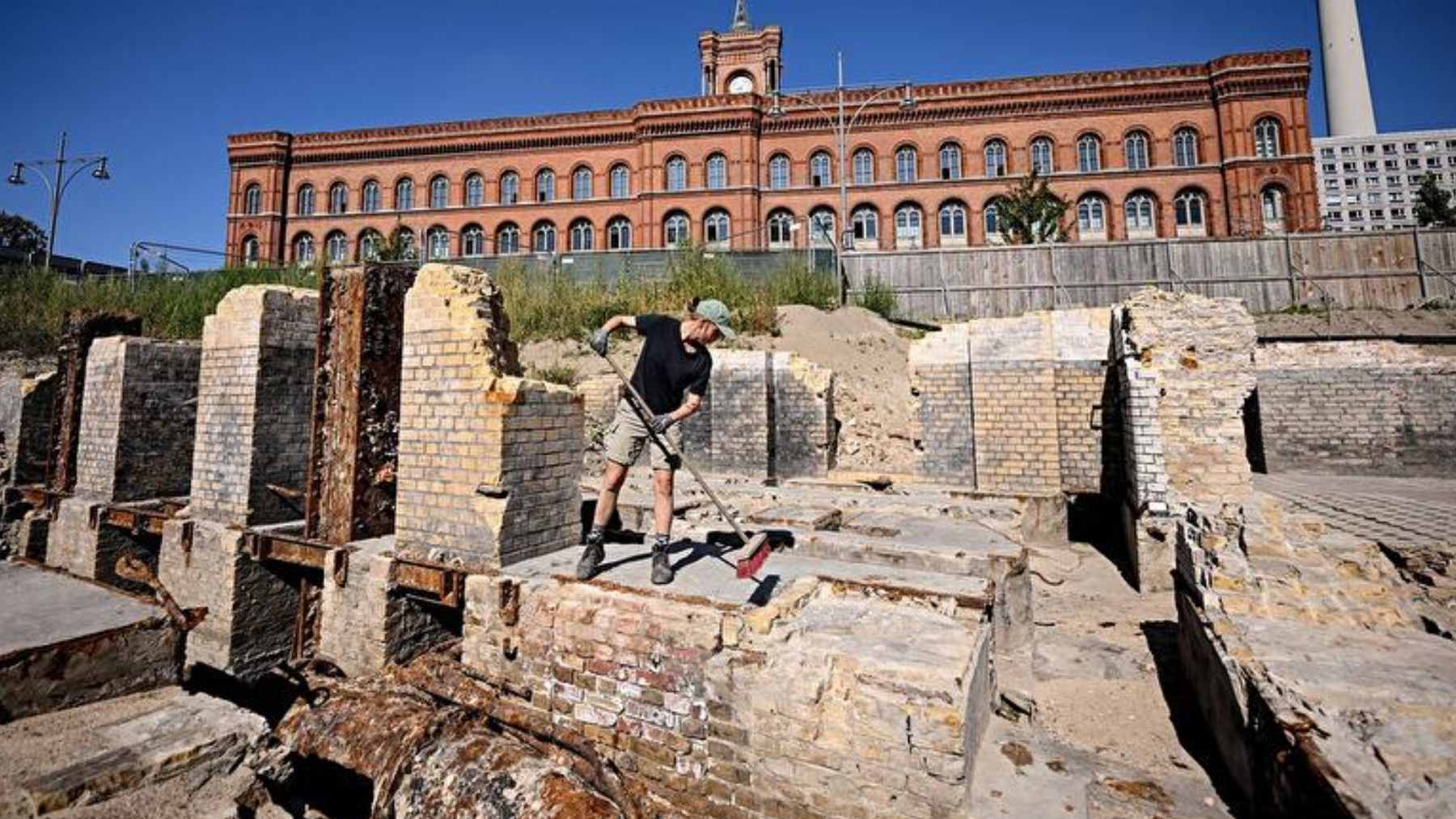
Berlin is digging into itself. At Molkenmarkt, the city’s oldest market square, archaeologists are working through a huge excavation zone near the Red Town Hall before a new residential quarter rises over the same ground. Official project information lists the excavation fields at about 22,000 square meters, or more than 236,000 square feet.
What they are finding is not the polished Berlin of museums, postcards, and glass towers. It is a rougher, older city of wells, latrines, coins, leather shoes, pottery, bones, and burned layers of urban life. The work has become a race between two Berlins, one buried for centuries and one waiting to be built.
A market older than the skyline
Molkenmarkt sits in Berlin-Mitte, close to the Spree River, where medieval trade routes once helped shape the early city. Berlin.de describes it as the oldest market square in Berlin and notes that trade took place there even before the first documented mentions of Cölln in 1237 and Berlin in 1244.
That matters because the modern city has buried much of this origin story under traffic, asphalt, war damage, and redevelopment. The current dig reaches about 13 feet deep in places, cutting through layers that include medieval cellars, later buildings, wartime damage, and 20th-century urban planning.
Everyday objects tell the story
This is not a dig built around kings and palaces. The most powerful finds are ordinary, almost intimate objects that once belonged to people who cooked, traded, prayed, repaired shoes, carried coins, and drew water from wells.
Among the discoveries are medieval wooden cellars, early modern waste pits, baroque vaults, and objects from daily life. A figurine of St. Catherine from the 15th century was also found at Molkenmarkt, offering a small clue about household devotion in the medieval city.
There are coins, too. Berlin’s official update says archaeologists found five and a half medieval denarii from the 13th century, along with a child’s leather shoe, a bone flute from the 14th century, and marbles from the 17th century. Who dropped them? No one can say for sure. That uncertainty is part of the pull.
The latrines are history’s black boxes
Some of the richest evidence comes from the least glamorous places. Medieval waste pits and latrines can preserve what official documents rarely record, including food remains, discarded tools, seeds, bones, and broken household goods.
It sounds strange at first. But a latrine can tell archaeologists what people ate, what they threw away, and which objects were too damaged or too ordinary to keep. The trash, in this case, is the archive.
Berlin’s Molkenmarkt project says medieval backyards contained many waste shafts made from wood and sometimes brick. From these, archaeologists recovered many everyday objects that help make the lives of medieval Berliners more visible.
A race before apartments rise
The clock is moving. A new neighborhood with apartments is planned for the site, and Berlin’s official 2025 update says excavations may continue until the end of 2027. Building construction is expected to begin in 2029, with the first buildings possibly occupied in 2032.
That schedule changes the feel of the work. Archaeologists cannot simply dig when the moment feels right. They must document, recover, conserve, and interpret the evidence before construction advances.
Eberhard Völker, project manager of the Molkenmarkt excavation, called it “the largest urban core excavation in Germany” and said the team is “excavating everyday life.” That is the heart of the story. Berlin is not only saving rare objects. It is trying to rescue the texture of ordinary survival.
PETRI turns finds into public archaeology
A few steps away, PETRI Berlin is turning archaeology into something visitors can actually watch. The archaeology lab opened to the public on June 24, 2025, as a cooperation between the Museum of Prehistory and Early History and the Berlin State Monuments Office.
Inside, glass workshops let visitors look over the shoulders of specialists as they prepare finds for research and exhibition. It is a simple idea, but a powerful one. Instead of hiding conservation behind closed doors, PETRI makes the process part of the exhibit.

That is especially important for fragile finds such as leather. A dark clump pulled from damp soil can shrink, stiffen, or lose meaning if it dries too quickly. With careful treatment, it can become readable again, sometimes as something as personal as a child’s shoe.
Bones, dignity, and the city’s age
PETRI is also connected to the older history of Petriplatz, where excavations uncovered the foundations of a medieval Latin school, traces of early settlement, and remains linked to St. Peter’s Church. The site is tied to Cölln, the twin city across the Spree from early Berlin.
Human remains recovered from the former Petrikirche churchyard were analyzed and returned to an ossuary. According to Staatliche Museen zu Berlin, 3,787 graves were excavated and analyzed, giving researchers insight into residents buried there from the beginning of settlement until 1717.
There is a quiet responsibility in that. Bones can reveal stress, illness, nutrition, and the physical toll of work, but they do not reveal names for most of these people. The science matters. So does the dignity.
Berlin is finding itself under Berlin
Molkenmarkt shows how a city can lose sight of its own beginning. World War II destruction, postwar rubble, and later traffic planning helped erase much of the old center from everyday view. For decades, the past was still there, but mostly under roads, parking areas, and construction fences.
Now it is surfacing, object by object. A coin. A shoe. A well. A latrine. Each piece adds something small but stubborn to the bigger picture.
At the end of the day, this excavation is not just about how old Berlin is. It is about what kind of city Berlin remembers itself to be before the next layer of apartments, sidewalks, and traffic noise settles on top.
The official excavation information was published on Berlin.de by the Berlin State Monuments Office.