A University of Florida undergraduate found a little brown mushroom that researchers say is the first known mushroom to contain both psilocybin and deadly amatoxins
Galerina indica, collected at a UF biological station, holds psychedelic and toxic compounds; Florida's state mycologist says it is hard to tell apart.

· 3 min read
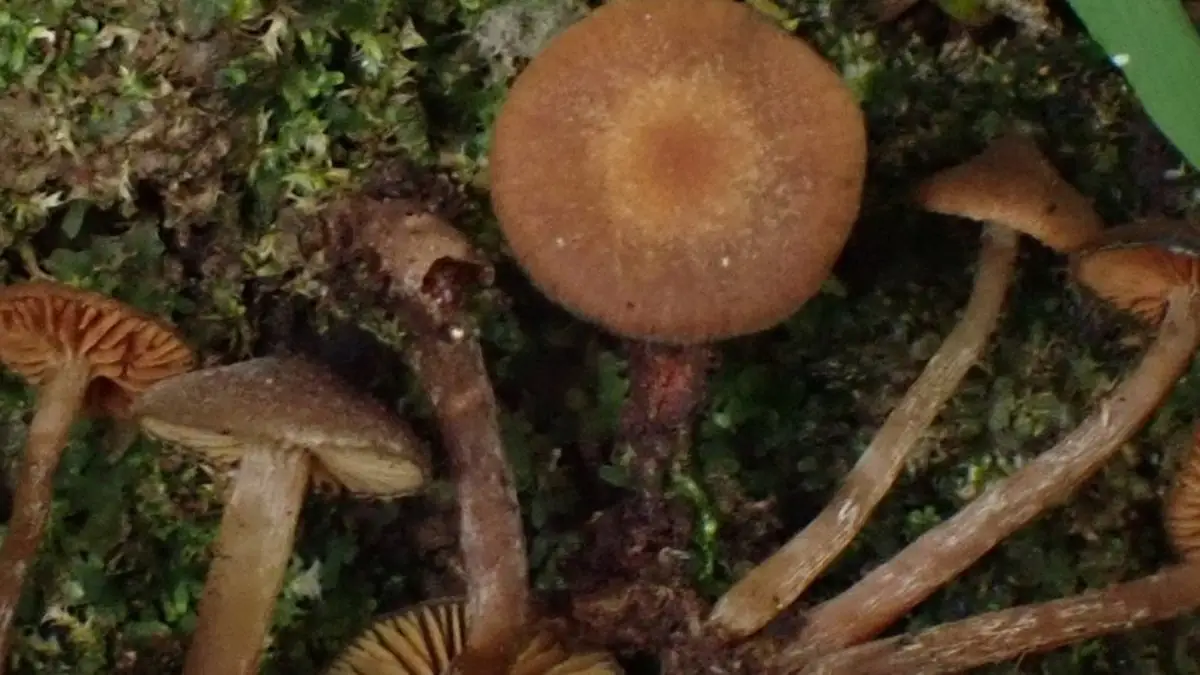
Researchers at the University of Florida say a little brown mushroom collected in the state is the first known to contain both psilocybin and deadly amatoxins. The species, Galerina indica, was found by then-undergraduate Andrew Kunik while he was documenting fungi at a university biological station. Researchers have nicknamed it the "dark magic mushroom" because it combines psychedelic and toxic compounds. The team confirmed it by matching genome work with chemical analysis, and the study appears in the journal Current Biology. Professor Matthew Smith, who is also Florida's state mycologist, says knowing which species grow in the state matters for people and pets that may have eaten a mushroom. He notes these mushrooms are small, brown and hard to tell apart, even for experts. Scientists still do not fully understand why a mushroom would make both compounds. Future experiments that knock out the genes for either one could help answer that question.
Key points
- Undergraduate Andrew Kunik found the mushroom while documenting fungi at the UF/IFAS Ordway-Swisher Biological Station.
- Matthew E. Smith regularly consults with Florida Poison Control, ER doctors and veterinarians on suspected mushroom poisonings.
- The team still does not know why a mushroom would make both compounds, and gene knockout experiments could help find out.
A little brown mushroom collected in Florida is the first known mushroom that contains both psilocybin and amatoxins, according to researchers at the University of Florida. The species, Galerina indica, was found by an undergraduate student and studied by a research team.
The university announced the finding on November 11. The study is published in the journal Current Biology.
Researchers at UF's Institute of Food and Agricultural Sciences (UF/IFAS) say they have identified, for the first time, a mushroom that contains both types of compounds. The species has been nicknamed the “dark magic mushroom,” the university says, because it combines psychedelic and toxic compounds.
Two kinds of compounds
Mushrooms are surrounded by myth and misunderstanding, the UF announcement notes. The announcement says it can seem that mushrooms are either magic, with psychedelic compounds, or poisonous, with amatoxins.
Psilocybin is a naturally occurring Schedule I controlled substance, according to the university. Amatoxins are found in deadly mushrooms, and some of them are responsible for fatal mushroom poisonings, the university says.
The university describes Galerina indica as a species that contains both compounds in a “remarkable chemical cocktail.”
Found at a biological station
The discovery began with Andrew Kunik, who was then an undergraduate student. He was working in the lab of Matthew E. Smith, a professor in the UF/IFAS Department of Plant Pathology.
Kunik found the unusual mushroom while documenting fungi at the UF/IFAS Ordway-Swisher Biological Station. The station is a research, teaching and extension facility of the university, established to further the study and conservation of unique ecosystems, according to its website. Its conservation mission includes collecting long-term monitoring data on the facility's habitats and species.
The team was interested in the genus Galerina to see whether other species of mushrooms in Florida contain amatoxins, which had not been documented, UF says. Some species in that genus were already known to contain deadly amatoxins.
Why it matters to Florida's mycologist
Besides teaching and research, Smith serves as Florida's state mycologist. Smith says the role involves identifying poisonous or potentially poisonous species.
Smith said: “Part of my job as Florida's state mycologist is to identify poisonous or potentially poisonous species. I regularly consult with the Florida Poison Control as well as ER doctors, veterinarians and others who think that a person or dog may have consumed a mushroom, so it is important to know what species we have and whether they might cause problems for people or pets.”
“These mushrooms are really hard to find. They are small and brown, like hundreds of other mushroom species,” said Smith, senior author of the study. He added that it is hard to tell apart from others, even for a trained expert.
How the team confirmed it
The research team included Ben Lemmond from the Smith lab, and Michael Christopher and Timothy Garret from UF Chemistry. Bryn Dentinger from the University of Utah and Jason Slot from Ohio State University also took part. Together, they found that what looked like a common little brown mushroom turned out to be something very unique, according to UF.
Kunik did the bioinformatics and genome work, while Christopher carried out the chemical analysis. When the two sets of results were matched, they confirmed that both compounds were present, Kunik said.
He added that the team knew such a combination was possible. Even so, the researchers tried not to get too excited until a more rigorous analysis was complete, he said.
An open question
The discovery reveals the extraordinary chemistry hidden in seemingly ordinary mushrooms, according to UF. It also raises new questions about why fungi produce these compounds.
Scientists still do not fully understand why mushrooms produce psilocybin, Kunik noted. Amatoxins may help protect mushrooms from animals that eat them, he said, but their precise ecological role is not entirely clear either.
“Why would a mushroom produce both of these compounds, and what advantage might that give it in nature?” Kunik asked.
The discovery opens the door to future experiments, according to UF. If researchers can knock out the genes for either compound, they could see how the mushroom is affected. That might help reveal what those compounds do in nature.
Kunik is now a postbaccalaureate researcher at Harvard and continues his fungi studies. In his view, small and seemingly uninteresting fungi can conceal extraordinary chemistry that scientists are only beginning to understand.
UF/IFAS / Andrew Kunik
Glossary for this story
- Ecosystem
- A community of living things and the environment they live in, together with the relationships between them.
Javier Niño
Writer at ECOnewsJavier Niño has been a Spanish National Police officer since 2017 and a journalist specialising in employment, labour law and Social Security, with more than seven years of writing experience. At ECOnews he covers environment, energy and sustainability news, focusing on how new regulations and court rulings affect people in their everyday lives.
More from Javier NiñoComments · 0
Rules ›No comments yet. Be the first to share your view.