Blake Link, Illinois graduate student researcher: "I would recommend to farmers that they apply their ammonia in the spring if it's possible"
19 Illinois corn trials: the economic optimum averaged 160 lb of nitrogen per acre with spring ammonia, 174 with fall. Yields were nearly identical.

· 4 min read
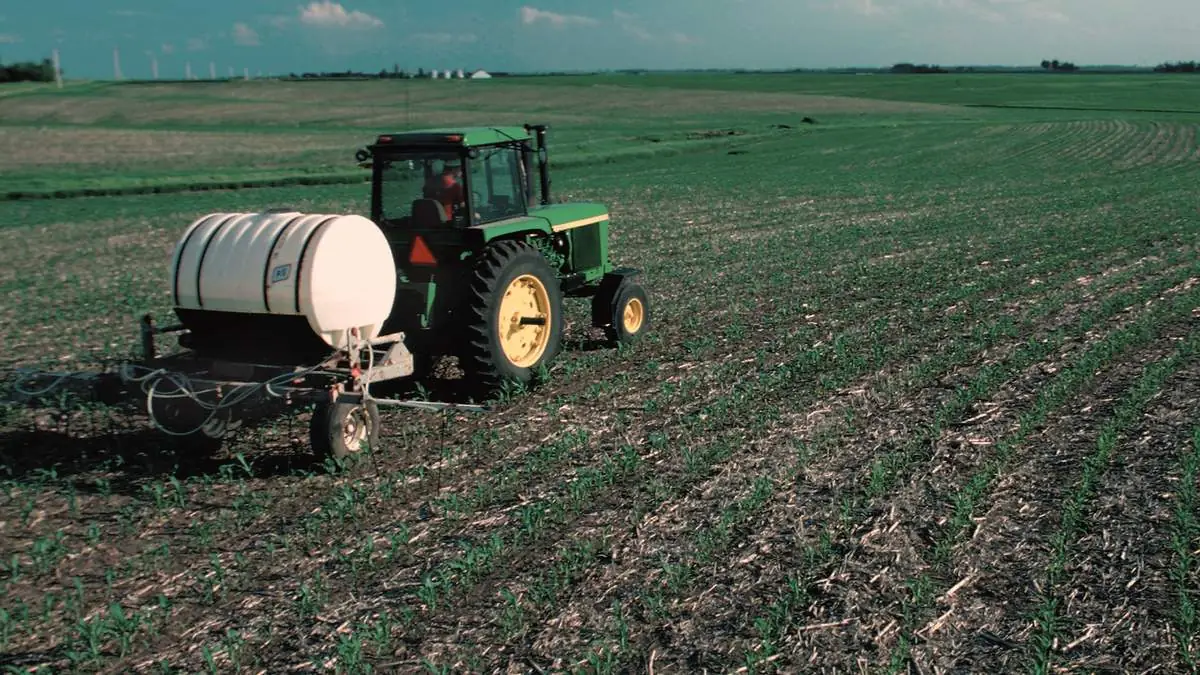
Blake Link, a graduate researcher at the University of Illinois Urbana-Champaign, says farmers who can wait should apply their ammonia in the spring. His team compared fall and spring anhydrous ammonia in nineteen corn trials across Central Illinois, run from 2013 through 2020. At sixteen sites, corn responded about the same to either timing, but at three, spring did better. Across all sites, the economic best rate averaged 174 pounds of nitrogen per acre with fall ammonia and 160 with spring, with nearly identical yields. The study did not measure nitrogen loss directly, so it does not prove the fall plots lost nitrogen. Still, the university says fall ammonia remains an option on suitable soils, if soils are cooling below 50 degrees, an inhibitor is used, and rates follow state guidance.
Key points
- At 16 of 19 Central Illinois trial sites, corn responded about the same to fall or spring anhydrous ammonia; at the other three, spring did better.
- The study did not measure nitrogen loss directly, the University of Illinois says, so it does not prove nitrogen was lost from the fall plots.
- Fall ammonia remains an option on suitable soils when they are below 50 degrees and cooling, with a nitrification inhibitor and rates that follow Illinois guidance.
Blake Link is a graduate student researcher in the Department of Crop Sciences at the University of Illinois Urbana-Champaign. He says farmers who can wait should apply their ammonia in the spring.
His team compared fall and spring anhydrous ammonia in 19 corn trials across Central Illinois. With spring ammonia, the corn needed less nitrogen on average for the same economic goal, the university reported on November 25.
The study did not measure nitrogen loss directly. So the smaller spring rate does not prove that nitrogen was lost from the fall plots, the university says. Earlier Illinois research, however, found more nitrate leaving fields through drainage tiles with fall-applied nitrogen under some conditions.
"I would recommend to farmers that they apply their ammonia in the spring if it's possible," said Link, the lead author. In his view, that lowers the risk of applying more nitrogen than the crop needs.
19 trials, two timings
The trials ran from 2013 through 2020. They followed recommended fall practice. Ammonia went on when soils were at or below 50 F, and every fall treatment included a nitrification inhibitor.
At 16 of the 19 sites, corn responded about the same to either timing. At the other three, spring did better, mainly because the crop needed less nitrogen to reach its best economic return.

Across all 19 sites, the economic optimum averaged 174 pounds of nitrogen per acre with fall ammonia. With spring ammonia, it was 160 pounds. Yields at those rates were nearly identical, and the gap in economic return was not statistically significant, the university says.
"On average, you can use less nitrogen fertilizer applied as anhydrous ammonia if you apply it in the spring," Link said. He added that this was often not the case at an individual site, "but when it was true, it was very much true."
Fall ammonia is still an option
The results do not make fall ammonia a bad practice, the release says. Applying in the fall spreads fieldwork across more of the year. Weather, labor and the acres to cover can also make waiting until spring impractical.
But nitrogen applied in the fall sits in the soil for months before the crop takes it up. That leaves more time for changes that can make it vulnerable to loss, the university explains.
Fall ammonia remains an option on suitable silt loam and silty clay loam soils in central and northern Illinois, the release says. Soils should be below 50 degrees and cooling at a depth of 4 inches. A nitrification inhibitor should be used, and rates should follow current Illinois guidance.
What the state guidance says
John Jones, an Illinois Extension agronomist and assistant professor of crop sciences, is also quoted in the release. The study checked the state's Maximum Return to Nitrogen guidelines, known as MRTN, against the best rate at each site.
"For spring-applied N, 89% of the observed optimum N rates were at or below the MRTN rates recommended by the University of Illinois," Jones said. For fall-applied nitrogen, the figure was 68% of sites.
In other words, only 11% of the spring sites would have gained yield or return from rates above the guidelines. Jones said farmers should specifically target lighter, coarse-textured and well-drained soils when shifting fall nitrogen to a spring preplant timing.
The researchers also looked at weather, drainage and soil type to explain the spring advantage at a few sites. None of those factors explained the differences consistently. Link said predictable weather effects are hard to find in the field.
Why nitrogen timing matters
In a September Illinois Extension blog post summarizing a podcast interview, Jones said fall-applied nitrogen should stay in the ammonium form as long as possible. Once it converts to nitrate, it becomes more vulnerable to loss. He said inhibitors should be used together with proper soil-temperature timing, not instead of it.
Excess nitrogen and phosphorus can fuel algae blooms that deplete oxygen in water, according to the Illinois Environmental Protection Agency. They come from farm fields, city streets and wastewater, the agency says. Nutrients carried down the Mississippi River have created a dead zone in the Gulf that stretches for thousands of square miles.
The state's Nutrient Loss Reduction Strategy aims for a long-term 45% cut in total nitrogen and phosphorus loads from Illinois. Its interim targets were a 15% drop in nitrate-nitrogen and a 25% drop in total phosphorus by 2025.
Link spoke in a news release from the University of Illinois College of Agricultural, Consumer and Environmental Sciences. It was published on November 25, 2026, and is the source of the trial figures here.
Lynn Betts, USDA Natural Resources Conservation Service
ECOnews Newsroom
Writer at ECOnewsA team of journalists specializing in socio-environmental news, sustainability, climate change, the environment, responsible consumption, and innovation. At EcoNews, we provide clear, reliable, and relevant coverage of the environmental and social challenges shaping our era.
More from ECOnews NewsroomComments · 0
Rules ›No comments yet. Be the first to share your view.