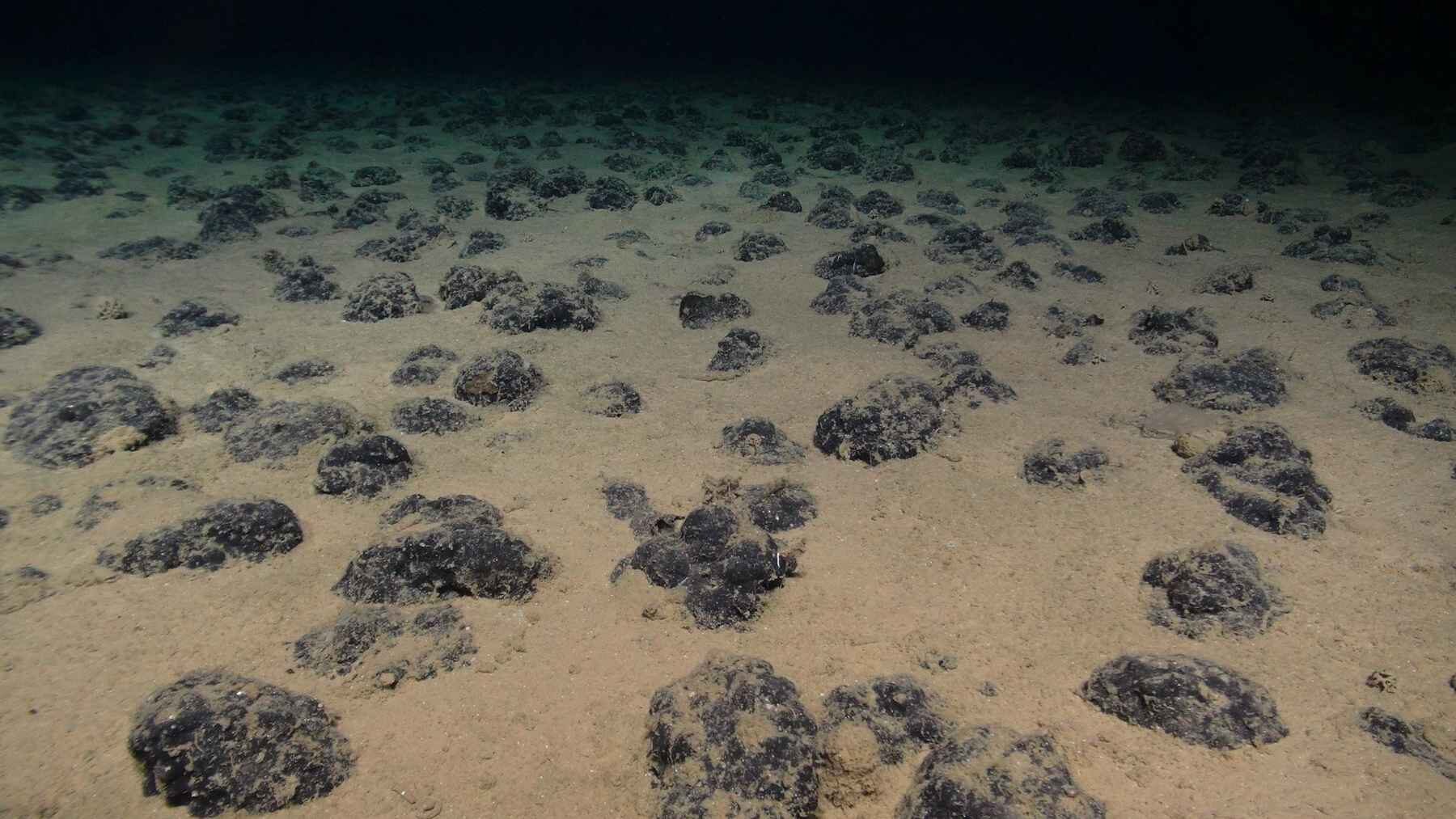
Roughly 2.5 to 3.7 miles beneath the Pacific Ocean, between Hawaii and Mexico, a vast muddy plain is scattered with dark rocks about the size of apples or small potatoes. These polymetallic nodules contain cobalt, nickel, copper, and manganese, the same kinds of metals used in electric cars, power lines, wind turbines, solar systems, and battery storage.
Now comes the difficult part. The Clarion-Clipperton Zone, which covers about 2.3 million square miles, is also one of the least understood ecosystems on Earth, and scientists are still naming basic branches of life there while mining companies and governments debate whether to begin commercial extraction.
Rocks that grew slowly
Polymetallic nodules do not appear overnight. They form layer by layer around a tiny core, such as a shark tooth, a bone fragment, or a small rock, as minerals slowly build up from seawater and seafloor sediments.
That slow growth is part of what makes the mining debate so intense. Some nodules grow only a few millimeters per million years, meaning a rock small enough to hold in your hand may be older than entire human civilizations.
The U.S. Geological Survey estimates that the Clarion-Clipperton Zone holds about 21.1 billion dry tons of polymetallic nodules, making it the largest known field of its kind. By the agency’s assessment, many critical metals in those nodules exceed known global land reserves.
A hidden ecosystem
What lives down there? Far more than scientists expected, and much of it still has no formal name.
A 2023 biodiversity review recorded 5,578 animal species from the Clarion-Clipperton Zone. Only 436 had been formally named, while an estimated 92 percent of recorded species were new to science or still undescribed.
Then came another surprise. In 2026, researchers announced 24 new deep-sea amphipod species from the region, including a new family and a new superfamily, Mirabestiidae and Mirabestioidea. Dr. Tammy Horton said, “To find a new superfamily is incredibly exciting,” because discoveries at that level are rare in modern taxonomy.
Why nodules matter to life
To mining companies, the nodules are mineral resources. To many deep-sea animals, they are real estate.
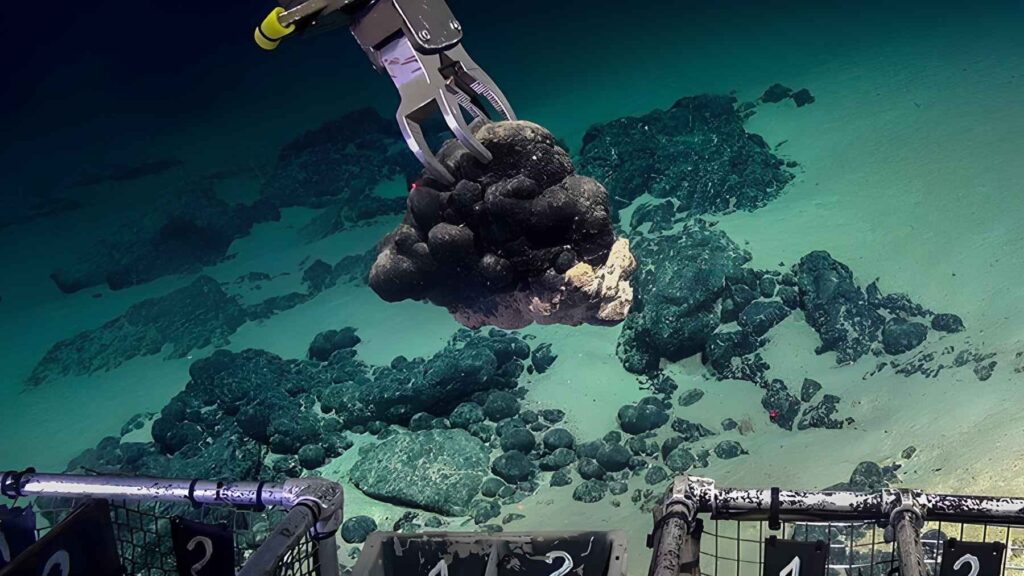
On a soft abyssal plain, these rocks provide one of the few hard surfaces where sponges, anemones, corals, and other organisms can attach. Picture an empty muddy field with scattered stones, except each stone may be a tiny apartment building for life that has adapted to darkness, cold, and crushing pressure.
That matters because mining would not simply pick up loose rocks and leave everything else unchanged. In practical terms, removing nodules could also remove habitat that took millions of years to form and may not return on any human timeline.
The mining race
The International Seabed Authority was created to regulate mineral activity in international seabed areas and protect the marine environment. As of January 2026, the authority reported 31 exploration contracts in force, but it has not approved commercial exploitation in the international seabed area.
Pressure is rising anyway. In April 2025, the United States issued an executive order aimed at speeding access to offshore critical minerals, including nickel, cobalt, copper, and manganese. Supporters argue that deep-sea nodules could help diversify supply chains and reduce dependence on land-based mining.
On the other hand, at least 40 countries have officially called for a moratorium or precautionary pause on deep-sea mining, according to the ISA’s own media FAQ. The split is clear, and it is not just political. It is also scientific.
Old scars on the seafloor
Past disturbance experiments suggest that abyssal ecosystems recover slowly. In the DISCOL experiment in the Peru Basin, researchers dragged a 26-foot-wide plow across a section of deep seafloor in 1989 to mimic some effects of nodule mining.
Decades later, the scars were still there. A 2019 study found that biological effects remained visible after 26 years, while a 2020 Science Advances study reported long-lasting changes to microbial communities and seafloor functions.
A separate Science Advances study from 2025 put the knowledge gap in blunt numbers. After reviewing 43,681 deep-sea visual dive records since 1958, researchers concluded that humans have visually observed less than 0.001 percent of the deep seafloor, about the size of Rhode Island.
What happens next
This is the uncomfortable truth at the center of the debate. The clean-energy transition needs metals, from the car in the driveway to the grid that keeps the electric bill from becoming even more painful, but the source being considered lies inside a world science is still learning to describe.
At the end of the day, the question is not whether these nodules are valuable. They are. The harder question is whether the world can make a rational risk-benefit decision before it understands what may be lost.
For now, the Clarion-Clipperton Zone remains both a mineral frontier and a biological mystery. Not a small choice.
The official statement was published on International Seabed Authority.