A flooded basement or collapsed tunnel is one of the hardest places for rescuers to search. Now, scientists have equipped remotely guided cockroaches with tiny oxygen-producing suits that kept them moving underwater for as long as three hours.
The system does not carry a miniature tank of compressed air. It makes oxygen as the insect travels, opening a possible route into flooded rubble, oxygen-starved pipes, and other spaces too tight or dangerous for people. The work is still an early laboratory demonstration, but it pushes cyborg insects into territory ordinary rescue robots often struggle to reach.
How a cockroach becomes a cyborg
A cyborg insect is a living animal fitted with electronics that influence where it moves. The work was led by Hirotaka Sato and first author Zifu Fan at Nanyang Technological University in Singapore, with Shinjiro Umezu of Waseda University in Japan.
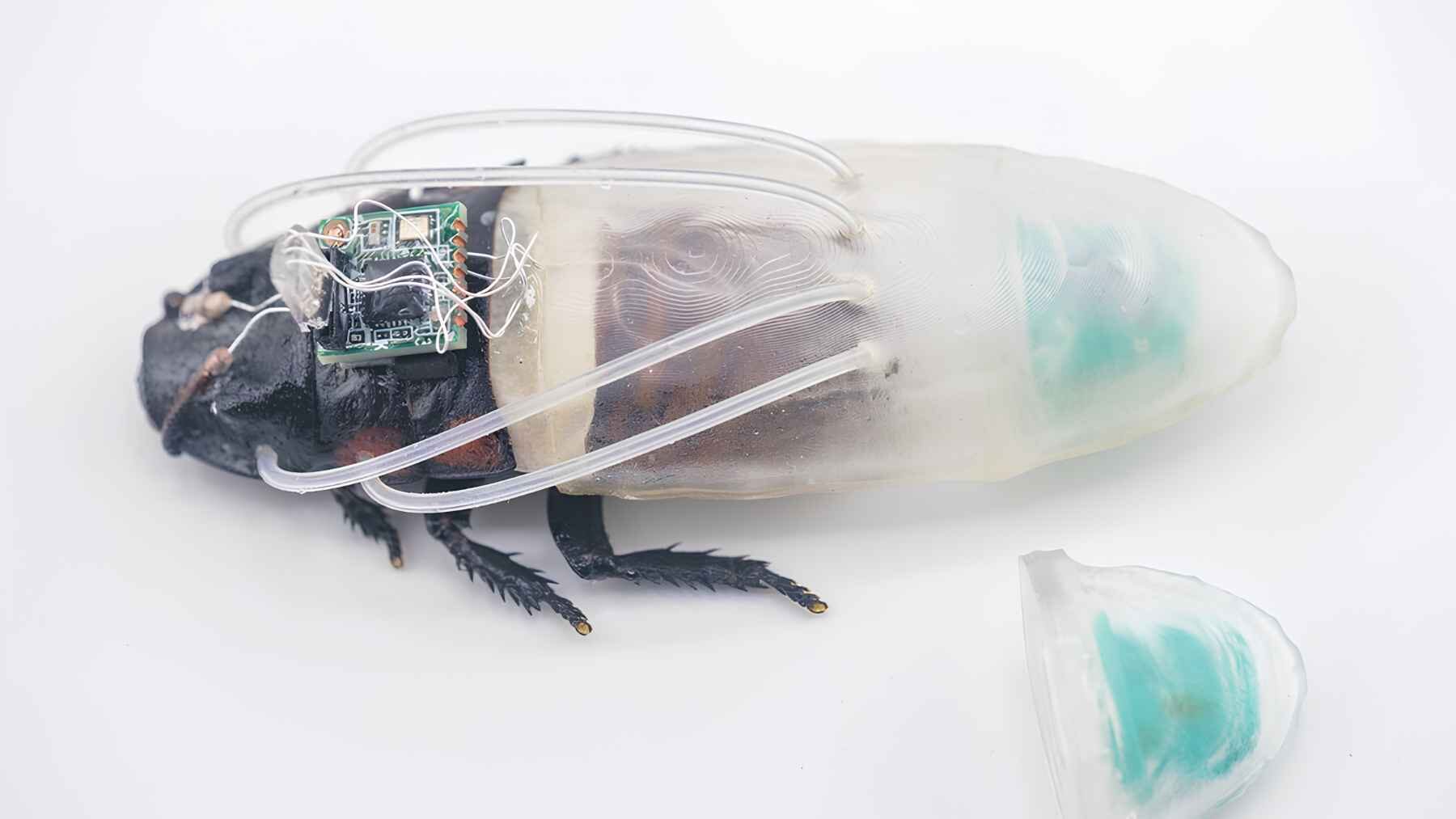
Small electrical signals stimulate parts of the cockroach’s sensory system, prompting it to turn or walk in a chosen direction. Its own legs and muscles provide the motion, while the electronic backpack handles steering and can carry cameras or other sensors. In practical terms, nature supplies the engine.
What the diving suit does
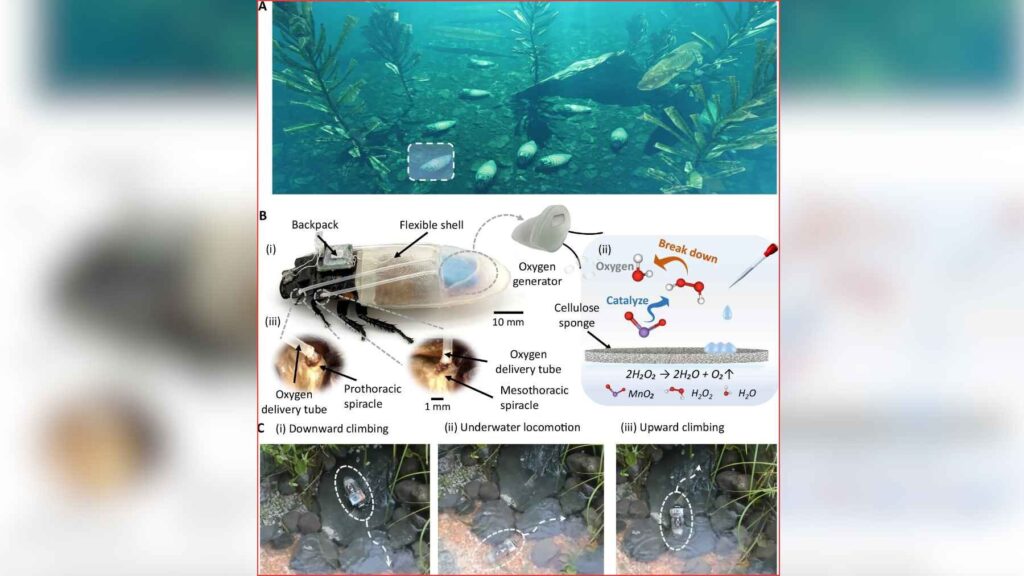
Cockroaches breathe through spiracles, which are small openings along the body that connect to internal air tubes. Underwater, those openings cannot draw oxygen from the surroundings, so the suit routes fresh oxygen to four spiracles through four narrow tubes.
The oxygen comes from a three percent hydrogen peroxide solution and a sponge coated with manganese dioxide. The coating acts as a catalyst, meaning it speeds up the release of oxygen without being consumed. A water-repelling membrane keeps liquid out while allowing gas to pass.
There is no pump or bulky air cylinder. The passive reaction continues inside a soft shell on the insect’s back, working like a miniature oxygen supply that generates gas as needed. Small package, important job.
Three hours underwater
In the main tests, suited Madagascar hissing cockroaches remained active underwater for two to three hours. Cockroaches without the oxygen system stopped moving within about two minutes, while the suited insects initially traveled at roughly 3.1 inches per second underwater, only a little slower than their 3.4-inch pace on land.
After three hours, forward speed had fallen to about 2.1 inches per second, showing that the suit extended survival without preventing fatigue. The researchers also tested depths of about 20 inches and drops of roughly 3.3 feet, and the equipment stayed attached.
The insects crossed a 5.6-foot tunnel containing water and carbon dioxide zones in three separate trials. A compact version with implanted oxygen lines also squeezed through a gap less than one inch high. Five monitored cockroaches behaved normally during the three days after testing, although that small follow-up cannot settle every long-term safety question.
Why insects can help rescuers
Why use a cockroach instead of building a machine from scratch? At this scale, batteries are a stubborn problem, and walking through jagged debris takes complex hardware. A cyborg insect already has efficient muscles, flexible joints, balance, and an instinct for navigating clutter, so electricity can be saved mostly for steering and sensors.
That advantage matters where wheels snag, propellers stir up dust, and rescuers cannot safely crawl. Ten cyborg cockroaches were taken to Myanmar after the March 2025 earthquake and used across five deployments at 12 locations during Singapore’s Operation Lionheart. They did not locate survivors, but the mission produced field data on sensors, handling, and movement through real disaster debris.
The idea has been developing for more than a decade. In 2014, a North Carolina State University team demonstrated microphone-equipped cockroach biobots designed to move toward sounds in collapsed buildings, where Alper Bozkurt noted that “sound is the best way to find survivors.”
What still has to work
The diving suit is a proof of concept, not a tool rescue crews can order today. The experiments used controlled tanks, a short tunnel, and programmed steering, while a real disaster adds mud, currents, sharp rubble, damaged radio links, and searches that may last far longer than three hours.
A practical version would also need reliable navigation and sensors that can identify people rather than simply record movement. The study’s implanted design carried control and sensing equipment, but surgery adds complexity, while the larger removable suit cannot fit through the tightest gaps.
At the end of the day, the decisive test is not whether one cockroach can cross a laboratory tank. It is whether a swarm can deliver trustworthy information through cold, dirty, shifting wreckage while rescuers make time-critical decisions. That step remains ahead.
Could cyborg cockroaches reach Mars
The researchers have raised space exploration as a longer-term possibility, including future tests involving extreme temperatures and radiation. The project leader told New Scientist that “the ultimate goal is to take this technology to space,” but a Mars-ready insect would require far more than an oxygen pack tested in room-temperature water.
There is also a major planetary-protection barrier. NASA limits terrestrial biological contamination of certain worlds so Earth organisms do not damage alien environments or confuse the search for life. Releasing a living cockroach on Mars would therefore raise difficult scientific and policy questions, even if the hardware could survive the trip.
For now, flooded tunnels and collapsed buildings are the nearer frontier. A three-hour underwater walk may sound like science fiction, but it addresses a very Earthbound problem, reaching places where every extra minute could matter.
The full study was published in Nature Communications.