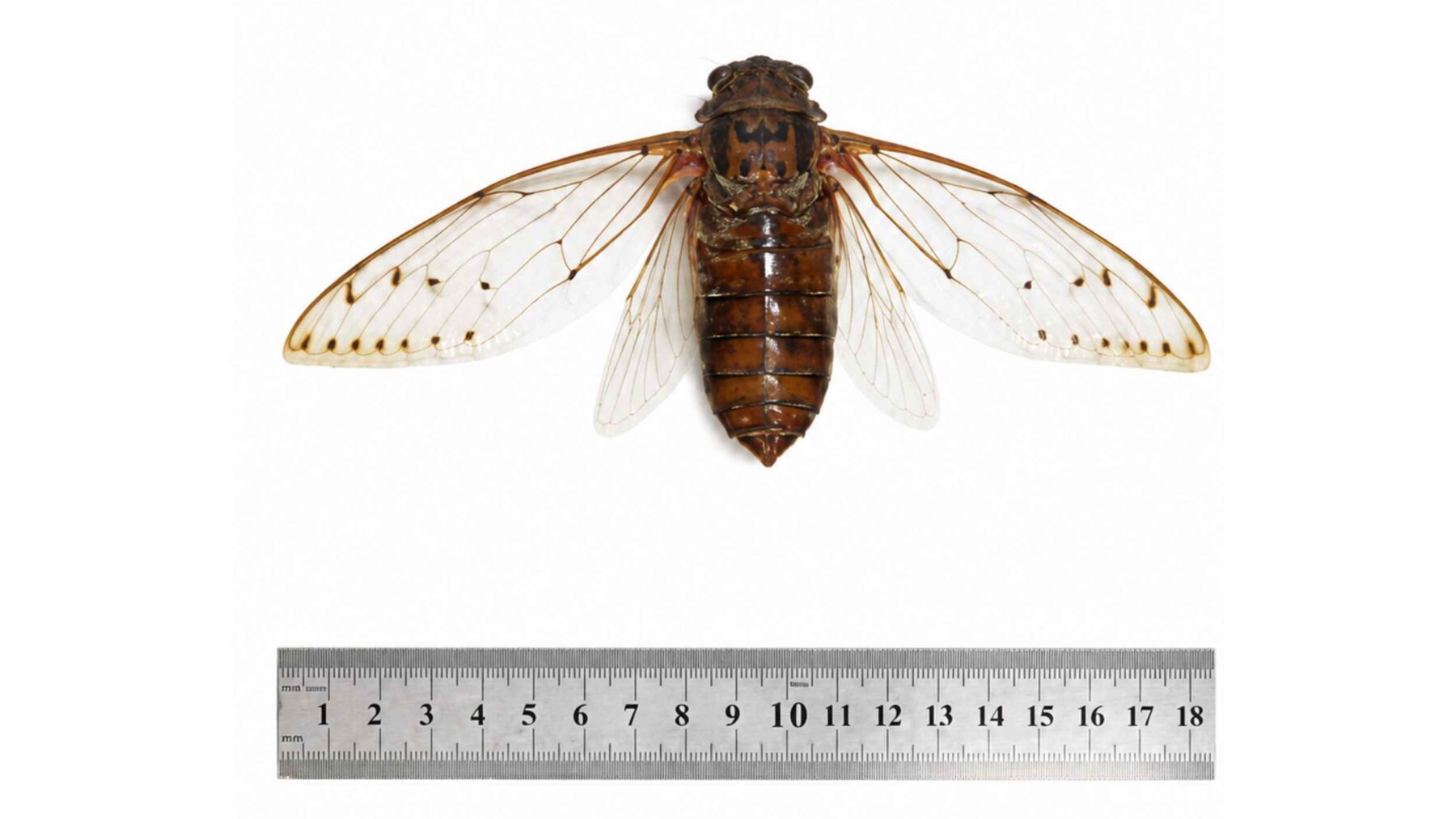
A cicada wing looks almost transparent in daylight. Under a powerful microscope, however, its surface becomes a tightly ordered forest of tiny pillars that researchers have now turned into a silver-coated platform for amplifying molecular signals.
Why build every microscopic feature from scratch when an insect wing already carries a useful pattern? The experiment points to a simpler route for making highly sensitive optical sensors, although the technology is not yet a clinical test or a field-ready pollution monitor.
A hidden structure
The empress cicada, Megapomponia imperatoria, carries rows of nanoscale pillars across its wings. The structures sit in a repeating six-sided pattern and resemble miniature bowling pins, even though the wing looks smooth to the naked eye.
That geometry is useful for surface-enhanced Raman spectroscopy, known as SERS.
The method shines a laser on a substance and reads the scattered light as a molecular fingerprint, but the signal is often faint. A well-designed metal surface acts like a volume knob for that whisper.
Artificial versions of these patterns can be made with advanced nanofabrication tools.
But those methods often take time and money, while the wing arrives with the basic structure already in place. Nature has done the microscopic construction.
Turning a wing into a sensor
Chung-Hung Hong, working with Cheng-Wei Kuo and Hui-Hsin Hsiao at China Medical University and National Taiwan University, said the goal was to combine “biology’s intrinsic nanoscale design” with standard thin-film methods.
The researchers cleaned the wings with solvents and pure water, cut them into small pieces, and attached them to glass supports.
Next, they added a thin silver coating in two ways. Sputtering spread silver more evenly around the natural pillars and produced cylinder-like structures, while electron-beam evaporation deposited the metal differently and left more tapered cones.
The team then used a red laser and rhodamine 6G, a standard reference dye, to compare the designs. Computer simulations helped show where light energy gathered between neighboring pillars.
Five-nanometer gaps
The researchers tested silver films from 20 to 50 nanometers thick, about 0.8 to 2 millionths of an inch. The strongest performance came at 45 nanometers, about 1.8 millionths of an inch, before extra silver began sealing the gaps into a continuous film.
At that thickness, the spacing between the cylindrical pillars narrowed to about five nanometers, roughly one-fifth of a millionth of an inch.
Those tiny spaces created “hot spots,” zones where the light’s electromagnetic field became unusually strong and boosted the Raman signal. That tiny difference mattered.
Experimental enhancement factors for the cylindrical design were generally in the tens of millions, depending on the molecular signal measured.
A 2014 study had already shown that silver-coated cicada wings could work as low-cost SERS surfaces, but the new research focuses on how coating method and gap shape control performance.
Promise and limits
In practical terms, stronger molecular signals could support future sensors for biomedical diagnostics and environmental monitoring.
The authors also see a path toward portable devices for detecting pathogens and pollutants, possibly using other natural templates such as butterfly wings or plant leaves.
But this was a laboratory proof of concept. The researchers tested a reference dye, not blood samples, disease biomarkers, drinking water, or factory emissions, and they said future work must establish detection limits and evaluate real samples.
Natural wing templates are not perfectly flat or uniform, which can broaden optical measurements.
Even so, the optimized samples showed good uniformity across their surfaces and from one preparation batch to another, suggesting the biological template can be controlled to a useful degree.
The full study was published in AIP Advances.