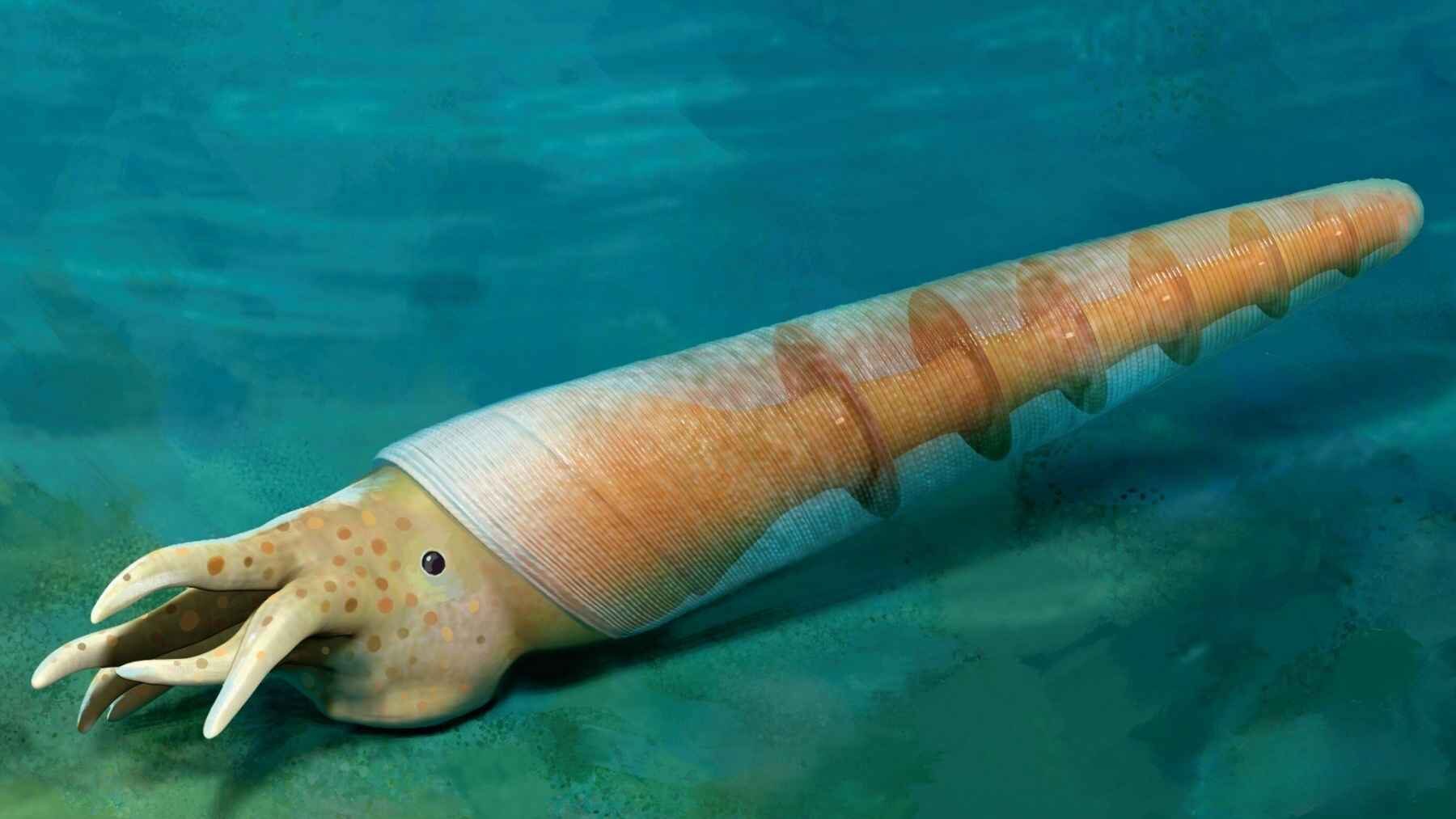
Scientists have discovered a new clue about early ocean life in the days before dinosaurs, known as the early Cambrian period, which began about 540 million years ago. A tiny fossil, newly named Eoceras shaanxiense was found in southern China’s Shuijingtuo Formation and was identified as a cephalopod, the molluscan class to which squid, octopuses, and nautilus belong.
The find is the earliest evidence of cephalopods carrying a ‘siphuncle’, or the tube in the shell that regulates liquid and gas, controlling buoyancy. Eoceras could help to better explain the evolution of this complex system.
A tiny fossil with big implications
Junfeng Guo of Chang’an University and Bing Pan of the Chinese Academy of Sciences led an international group of researchers who classified 32 specimens of “small shelly fossils” from the formation.
The Eoceras dates back 30 million years earlier than the Plectronoceras cambria, the previously believed first cephalopod. Fossil records placed the latter in the late Cambrian period.
What the shell preserved
As opposed to the spiral-shape we usually associate with Nautilus, Eoceras donned a straight, cone-shaped shell. A segmented tube was identified that canals through the internal partitions, or septa, along its ventral side.
The team believes that as the animal grew, its body advanced away from the narrow end of the cone, leaving chambers behind but maintaining contact with them by way of the tube. This would make it the earliest evidence of a siphuncle.
Why the siphuncle matters
Later chambered cephalopods used the siphuncle as a propulsion and flotation system, allowing them the more vagabond lifestyle we typically associate with the lineage. Newer versions of the system became more sophisticated over time in the management of fluid and gas in the shell.
The study published in Nature calls this feature a “candidate primordial cephalopod siphuncle. Its simplicity is exactly what intrigues researchers.
Evolution caught midway
The research leans on a three-phase evolutionary sequence beginning with straight shells with multiple septa. The sealed segmented siphuncle came next, followed by the modern siphuncle with connecting rings and septal necks.
According to the theory, Eoceras appeared sometime between earlier chambered sea creatures and later cephalopods with more complex buoyancy regulation. However, researchers do not track their evolution in the direction of modern squids or octopuses.
Seeing inside a tiny shell
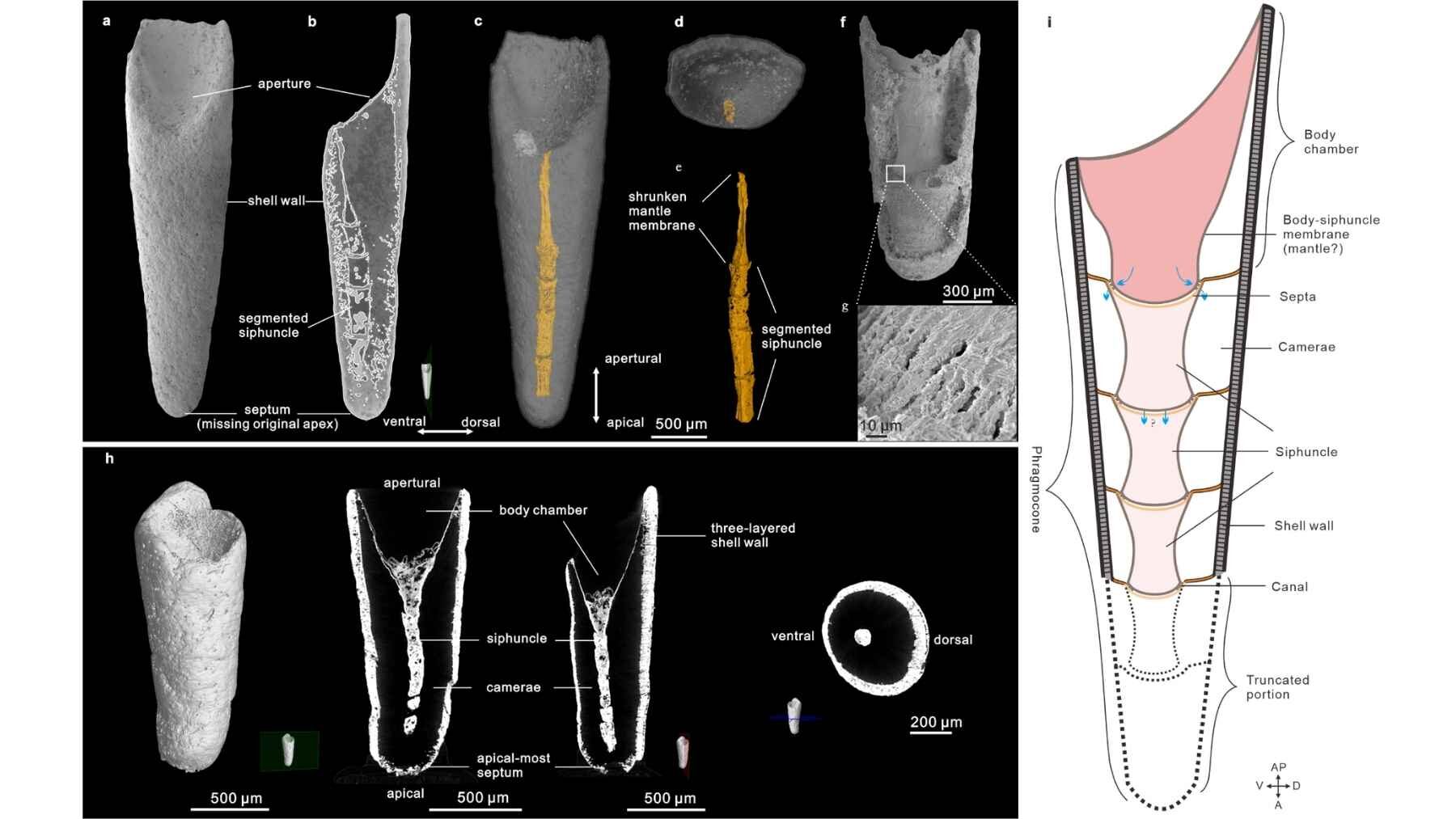
Researchers used scanning electron microscopy and micro-computed tomography (micro-CT) to examine the tiny fossils, only millimeters in length. This technology allows experts to map out their internal anatomy with precision.
The team open-sourced its raw micro-CT data through the Dryad repository, allowing other experts to examine the evidence freely.
It likely stayed near the seafloor
Due to its simplistic flotation system, Eoceras probably never ventured far from the seafloor. The specimen contains no remains of its soft body, so reconstructing its movement or lifestyle would be speculative at best.
In any case, Eoceras shaanxiense is still a fascinating look into a deeper past in molluscan evolution.
The study was published in Nature on July 29, 2026.