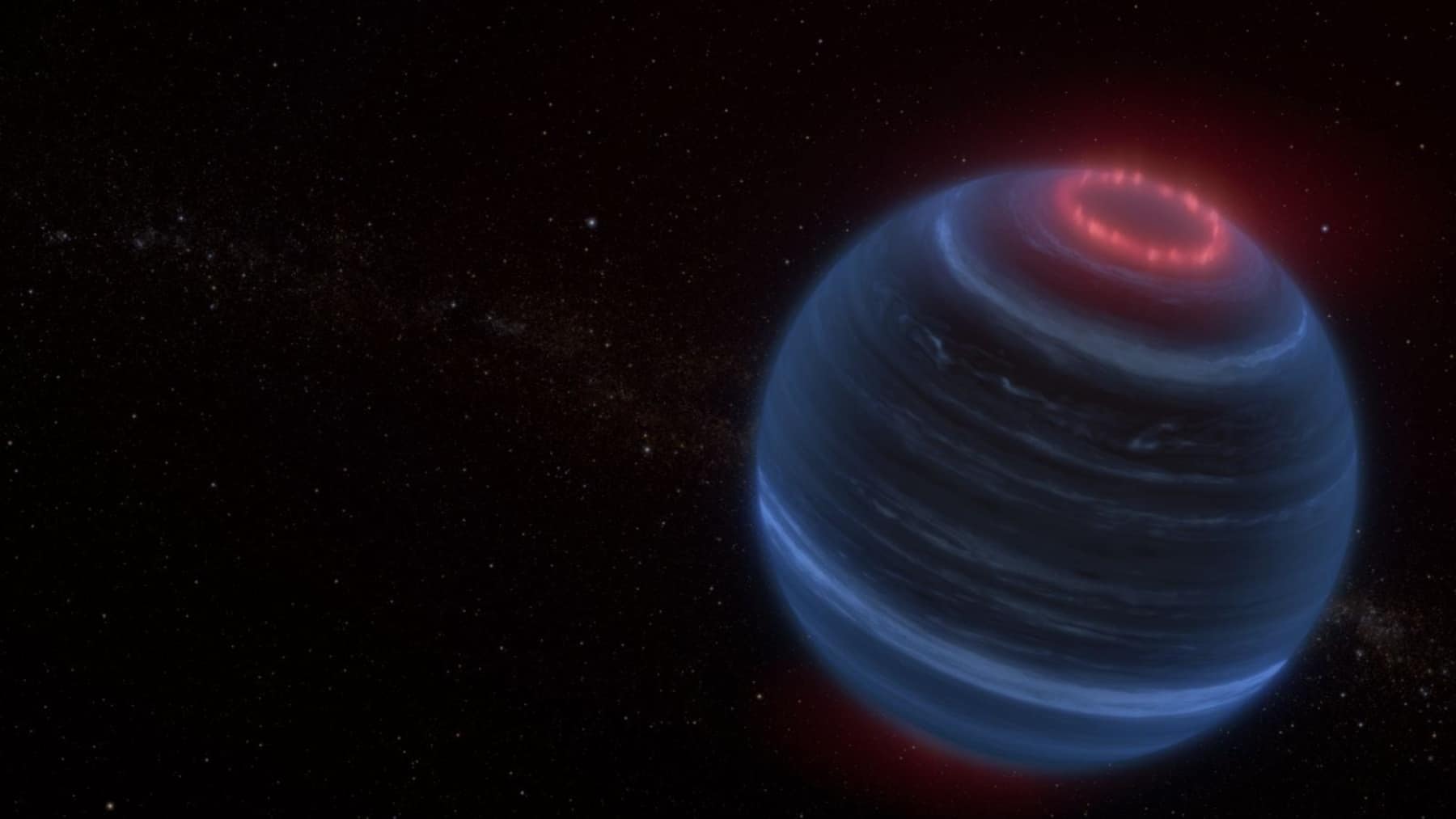
We need to keep in mind that some space bodies don’t follow the rules. This is because they form like stars, live like planets, and confuse astronomers with their hybrid behavior. Now, one of these objects, which until recently was considered “useless” in the process of forming planetary systems, has just become the center of NASA’s attention. And it’s not just because of its mysterious appearance or undefined nature, but because it may harbor planets.
Not a star, not a planet: Could failed stars give birth to worlds too?
The idea that every star has a disk around it that can spawn planets seems almost a consensus, right? Since Hubble’s first observations of the Orion Nebula, science has imagined that young stars, as they formed, created disks of gas and dust where planets were born. But what if objects that never became full-fledged stars could also do this?
However, with the launch of the James Webb Space Telescope, observing the universe gained a new dimension. And it was by looking at the Orion Nebula region, one of the closest stellar nurseries to Earth, that astronomers noticed something surprising: some protoplanetary disks were orbiting bodies that were not stars.
Brown dwarfs: Failed stars or hidden planet factories?
Here’s the name of the main character in this story: the brown dwarf. It’s born in the same way as a traditional star, collapsing a cloud of gas and dust. But, unlike real stars, it doesn’t accumulate enough mass to initiate nuclear fusion of hydrogen in its core, the process that ignites a star.
That’s why brown dwarfs are (unfairly) called failed stars. They occupy a limbo between the largest planet and the smallest star: they’re larger than Jupiter, but they don’t emit enough light to be easily seen (however, the James Webb Telescope managed to see them, just as it did at this star factory). And that’s where the JWST comes in, as it has already revealed that
- At least 20 brown dwarfs in the Orion Nebula have protoplanetary disks surrounding them.
- Some have a mass equivalent to only 5 Jupiters.
- Two objects were on the borderline between a brown dwarf and a small star.
All of this suggests that brown dwarfs can indeed form planets around them, something that was previously only speculation. According to Kevin Luhman, an astronomer:
“This information will help us fill in the gaps in our knowledge of how brown dwarfs form and their relationship to stars and planets.”
First brown dwarfs beyond the Milky Way: Glimpses of the early universe?
The JWST also looked at NGC 602, a young star cluster located in the Small Magellanic Cloud. This is a neighboring galaxy to our own. And what it found there was no less impressive. Sixty-four objects with masses between 50 and 84 times that of Jupiter were observed, all of which are strong candidates for brown dwarfs.
These are the first possible examples of brown dwarfs outside the Milky Way. It is worth noting that the SMC’s environment is similar to that of the early universe (few metals), making it a natural laboratory for studying how stars and planets emerged billions of years ago. According to Elena Sabbi, an astrophysicist:
“By studying the young metal-poor brown dwarfs newly discovered in NGC 602, we are getting closer to unlocking the secrets of how stars and planets formed in the harsh conditions of the early Universe”.
With this new evidence, we realize they may play an important role in the cosmic puzzle. After all, if a brown dwarf can form planets, what else can it do? Where’s the line between planet, star, and something new we haven’t even named yet? And that’s not the only news to keep an eye on: NASA recently spotted ‘something’ beyond the Milky Way.