This past June, our old friend Voyager 1 just encountered a 90,000ºF wall of fire that we couldn’t even think of getting through. Now, back in 1977, when NASA’s two space probes, Voyager 1 and 2, were launched, we had only one ambitious goal: to explore the outer reaches of the Solar System and, if possible, cross into interstellar space. Well, now in 2025, we have not only achieved that goal, but we have also gone where no other human-made machine has gone before.
A wall of fire outside our Solar System
If before the idea of leaving the Solar System was exactly that, an idea, today, Voyager 1 has gone so far that we have managed to reach a point where the solar wind collides with the interstellar winds. It is a region where physics changes, temperatures soar, and the rules of our cosmic neighborhood no longer apply.
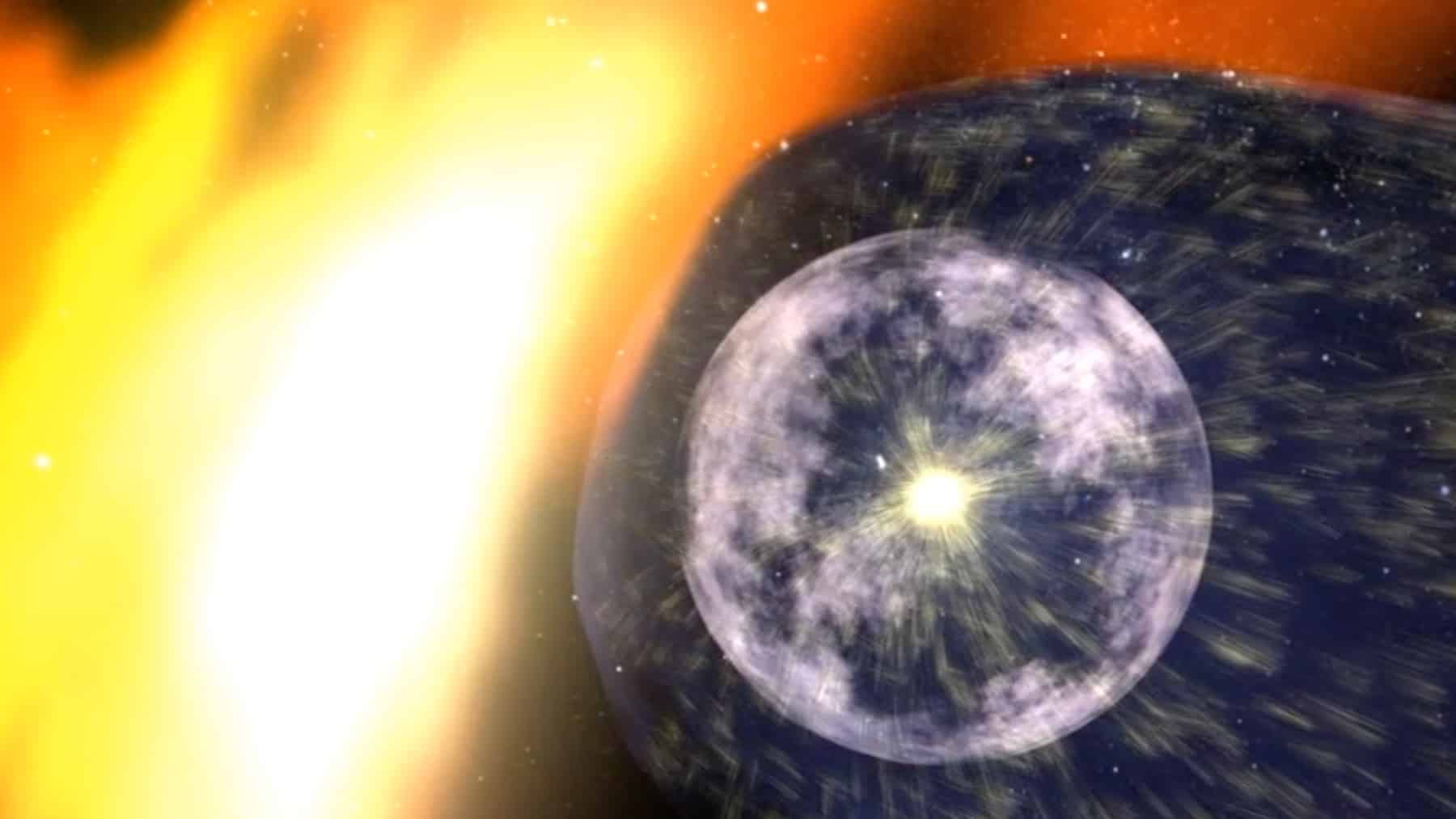
Now, getting into more technical terms, the Voyagers arrived in an area of space known as the heliopause. What would this region be? Well, it is a kind of “invisible border” where the influence of the Sun loses its strength and the dominance of interstellar space begins. This place marks the end of the heliosphere, that gigantic bubble of charged particles expelled by the Sun, which extends for billions of kilometers. And, within it, the solar wind circulates freely. Outside of it, however, it encounters resistance: the interstellar wind, formed by particles emitted by neighboring stars.
Therefore, when these winds collide, a turbulent zone is created, where the pressures balance out and create quite intense physical effects. Scientists already knew that something unique would happen there, but no one was prepared for the thermal violence that the probes would detect.
Inside the 90,000ºF wall of fire
It was at this exact point that the Voyager 1 probe captured a sudden increase in temperature (this was shortly after it was resurrected by NASA). Its sensors ended up registering between 30,000 and 50,000 Kelvin, which, converted to Fahrenheit, gives somewhere between 54,000 and 90,000 degrees. Now you can understand why this region was nicknamed by scientists as the Wall of Fire.
“An observation made by Voyager 2’s magnetic field instrument confirms a surprising result from Voyager 1: the magnetic field in the region just beyond the heliopause is parallel to the magnetic field within the heliosphere,” NASA explained.
It is important to note that even though it is called a wall, it is not solid. It is a super hot zone, with very high-energy particles, largely due to the friction between solar and interstellar winds. To better understand, here is an example of comparison: imagine a cosmic shock wave, similar to the bow of a ship cutting through the ocean; this is the sensation of the heliosphere advancing through interstellar space.
The wall of fire is quite a challenge for us
It wasn’t just the heat that surprised scientists; the discovery of a magnetic field outside the heliosphere that is aligned with the internal magnetic field was also shocking. Okay, but what does all this mean? Well, at least in the region immediately beyond the heliopause, we can see that there is no abrupt break between “our” space and interstellar space; in fact, it is a smoother transition than we thought until then.
Now, on the other hand, this Wall of Fire will end up representing a great challenge for manned missions. This is because, unlike our probes, humans cannot even think of getting close and surviving while crossing a zone with these characteristics. We may have to rely once again on Voyager 1 to carry out more missions, like when it intercepted a signal in space that came from 25 billion km away.