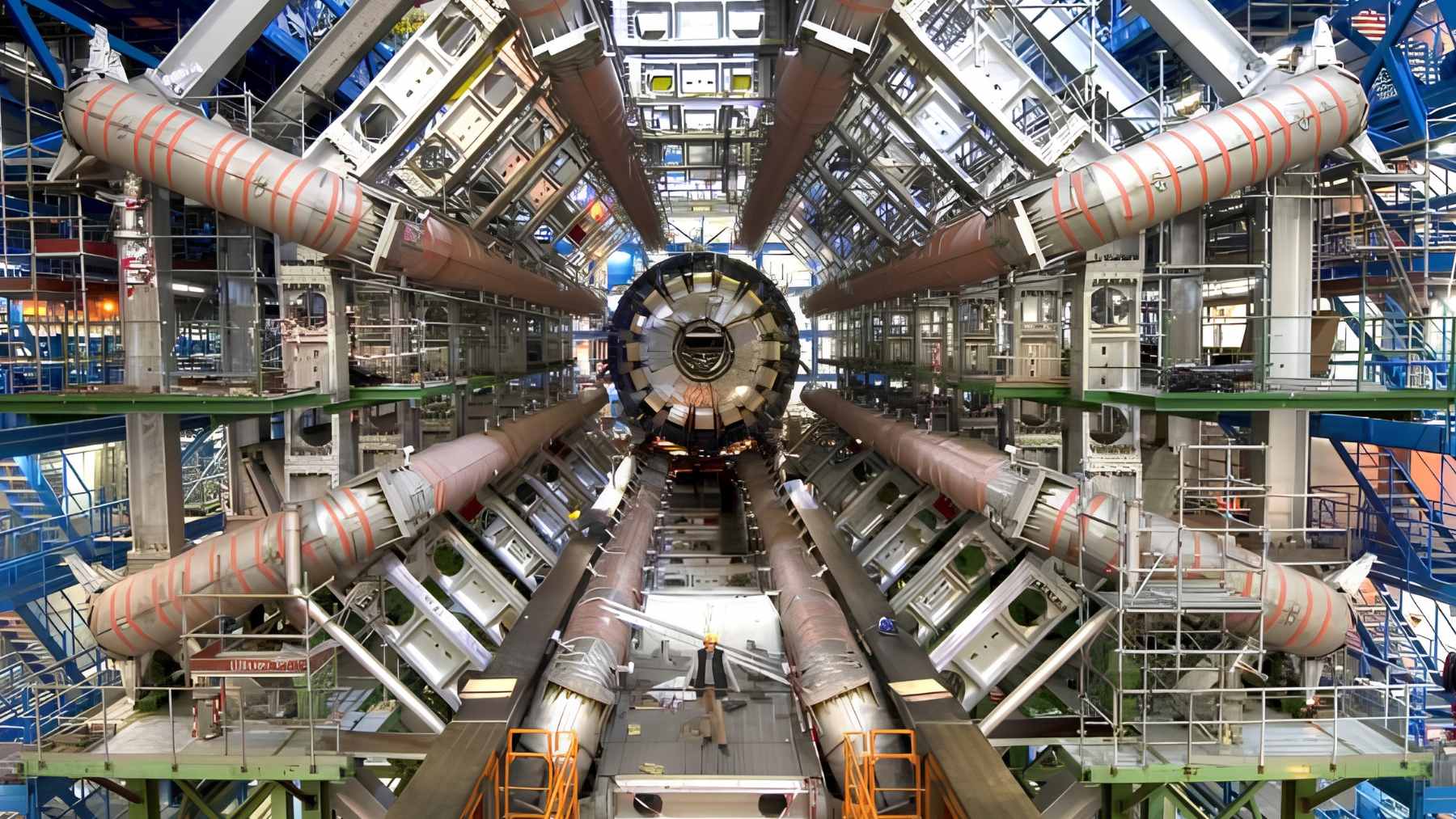
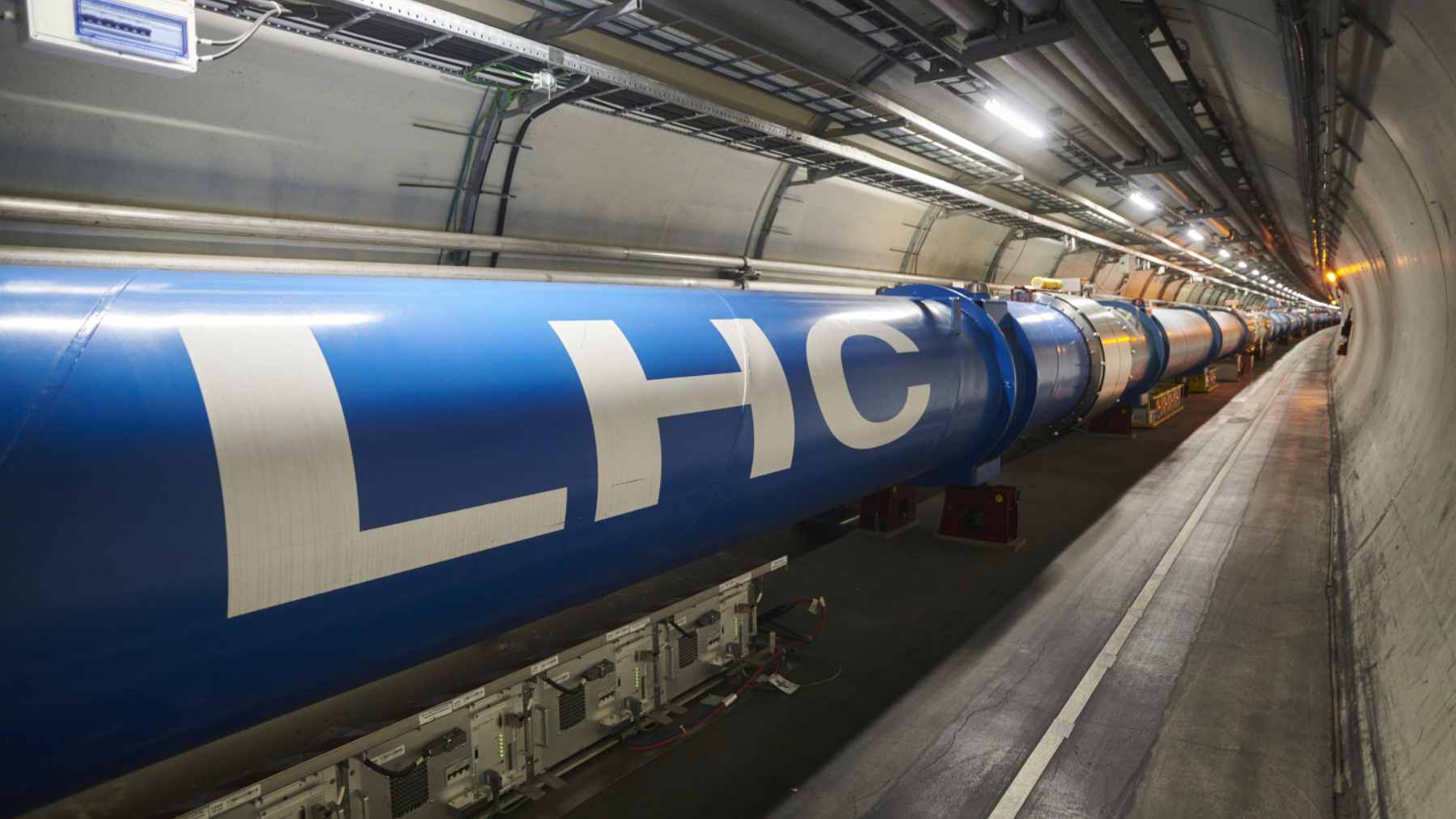
Buried beneath the French-Swiss border, CERN’s Large Hadron Collider (LHC) is already a machine that sounds almost fictional. Its nearly 17-mile ring of superconducting magnets pushes protons to 99.9999991% of the speed of light before smashing them together at four major collision points.
Now, the machine that found the Higgs boson is pointing toward an even bigger question. The European Organization for Nuclear Research (CERN) has completed a feasibility report for the Future Circular Collider (FCC), a proposed 56-mile underground accelerator that could succeed the LHC in the 2040s and probe parts of the universe the Standard Model still cannot explain.
The cold machine under Europe
The LHC is the world’s largest and most powerful particle accelerator. CERN says it uses a 16.6-mile ring of superconducting magnets and accelerating structures in a tunnel with an average depth of 328 feet underground near Geneva, with parts of CERN’s underground infrastructure reaching much deeper.
That scale is hard to picture. Imagine a circular highway hidden underground, except the traffic is made of proton beams moving so fast that each particle circles the ring more than 11,000 times per second.
To make that possible, the magnets must be kept at 1.9 kelvin, or about minus 456 degrees Fahrenheit. That is colder than outer space, and it is why the LHC is as much an engineering story as a physics story.
Why smash protons?
So what is the point of all this? The simple answer is that collisions let scientists briefly recreate extreme conditions similar to those that existed in the earliest moments of the universe, only on a tiny and controlled scale.
At its current nominal proton collision energy of 13.6 TeV, the LHC can produce short-lived particles that vanish almost instantly but leave traces in giant detectors. CERN compares the human-scale energy of a collision to something tiny, but at the particle scale, that energy is packed into an incredibly small space.
The best-known result came in July 2012, when the Higgs boson was discovered. That finding confirmed the final predicted piece of the Standard Model and the mechanism that helps explain how many elementary particles acquire mass.
The universe still has missing pages
The Higgs discovery was not the end of the story. In some ways, it sharpened the mystery.
CERN notes that the Standard Model explains only about 5% of the universe. It does not account for dark matter, the speeding expansion linked to dark energy, or why matter survived over antimatter after the Big Bang.
That is the awkward part. The LHC delivered one of modern science’s greatest confirmations, but the universe still refuses to hand over most of its recipe.
The machine has also helped reveal more than 70 new composite hadrons, particles made from quarks held together by the strong force. These discoveries matter because they test how nature builds matter at its smallest known scales.
A 56-mile successor
CERN’s proposed Future Circular Collider would be far larger than the LHC. The feasibility report describes a preferred 56.4-mile ring at an average depth of about 656 feet, with eight surface sites and up to four experiments.
The plan has two main stages. First would come FCC-ee, an electron-positron collider designed as a Higgs, electroweak, and top-quark factory. Later, FCC-hh would collide protons at around 100 TeV, far beyond today’s LHC energy.
In practical terms, that means the first machine would study the Higgs boson with extreme precision. The second would hunt for heavier particles and new physics that may simply be beyond the LHC’s reach.
The money and the footprint
Big science has a big price tag. CERN’s feasibility report estimates the construction cost of the FCC electron-positron stage, including the tunnel and infrastructure, at 15 billion Swiss francs, or roughly $19 billion at recent exchange rates.
In December 2025, CERN announced that private donors had pledged 860 million euros, corresponding to $1 billion, toward the proposed FCC. The group includes the Breakthrough Prize Foundation, The Eric and Wendy Schmidt Fund for Strategic Innovation, John Elkann, and Xavier Niel.
But the question is not only about money. CERN says any new project at the laboratory should be an example of sustainable research infrastructure, with ecodesign principles, energy reuse, and efforts to limit the environmental footprint. For a machine this large, the electric bill and the climate math cannot be side notes.
What happens next
The FCC is not approved yet. CERN says the feasibility report does not commit its Member and Associate Member States to build the collider, and a decision on construction is expected around 2028.
The European Strategy Group has recommended the electron-positron FCC as the preferred next flagship collider at CERN, with the CERN Council expected to assess that path in 2026. That makes the coming years crucial for particle physics, public funding, and the environmental design of major research infrastructure.
For now, the LHC keeps doing what it was built to do. It turns invisible particles into evidence, and evidence into better questions.
The official press release was published on CERN’s wesite.