What if the most stubborn part of nuclear waste did not have to outlast entire civilizations? Researchers are testing whether particle accelerators can turn long-lasting radioactive leftovers from nuclear power into materials that fade faster.
In February 2026, the U.S. Department of Energy’s Advanced Research Projects Agency-Energy awarded $8.17 million for two projects led by accelerator scientist Rongli Geng that aim to “burn” some of the most problematic components of used nuclear fuel using an accelerator-driven reactor setup.
Geng said, “Instead of having a lifetime of 100,000 years in storage, you can shorten the storage years down to 300.”
A plan to shrink a 100,000-year problem
The work is tied to a federal effort called NEWTON, which is focused on “transmutation,” meaning you deliberately change one isotope into another through nuclear reactions. Think of an isotope as a slightly different version of the same element, and the idea here is to nudge the long-lasting versions into shorter-lasting ones.
In the program’s funding notice, unprocessed used nuclear fuel is described as taking about 100,000 years to cool to a level comparable to natural uranium ore. The same document says separating and recycling key ingredients could reduce that timeline to around 300 years.
Three hundred years is still a long time, and nobody is pretending otherwise. But it turns a problem measured in geology into something closer to infrastructure planning, the kind of timeline governments and utilities already wrestle with.
Why some nuclear leftovers last so long
Used nuclear fuel is not a single “brick” of waste. It is a complicated mix of many radioactive materials, each with its own decay speed, and only some of them drive the headache of very long storage.
A lot of the heat and radiation drops sharply over the first few centuries, but certain heavy elements linger far longer. Those include transuranic elements such as plutonium-239 and americium-241, and “transuranic” simply means heavier than uranium.
The outside spark that powers the reactor
A traditional nuclear reactor needs a self-sustaining chain reaction to keep running. An accelerator-driven system is designed to stay subcritical, so it cannot keep going by itself and instead relies on an external “spark” to stay active, a bit like needing a steady lighter to keep a small campfire going.
That spark comes from a high-power particle accelerator that shoots protons into a heavy target. The impact knocks loose neutrons in a process called “spallation,” and those neutrons can then hit long-lived isotopes in used fuel and transform them into different isotopes that decay faster.
Spallation is already used in major research facilities, not for waste treatment but for making intense neutron beams. At the Spallation Neutron Source at Oak Ridge National Laboratory, an accelerator sends proton pulses into a steel target filled with liquid mercury to generate neutrons for experiments in materials science.
Heat that could become electricity
The same reactions that change the waste also release heat. In principle, that heat can be captured to generate electricity, which is why advocates say the approach could extract additional value from fuel that otherwise becomes a long-term liability.
Does that mean cheaper power next month and a lower electric bill? No, because this is still early-stage engineering, and it is not aimed at quick fixes for today’s storage sites. Still, the idea is to turn part of a safety burden into a usable energy stream, instead of treating it as a one-way expense.
There is a practical catch that often gets missed. The strategy depends on separating out the long-lived components that matter most, because not every part of used fuel needs the same kind of neutron bombardment.
Making the accelerator practical
The biggest barrier is cost, since many high-end accelerators rely on superconducting components that need extreme cooling.
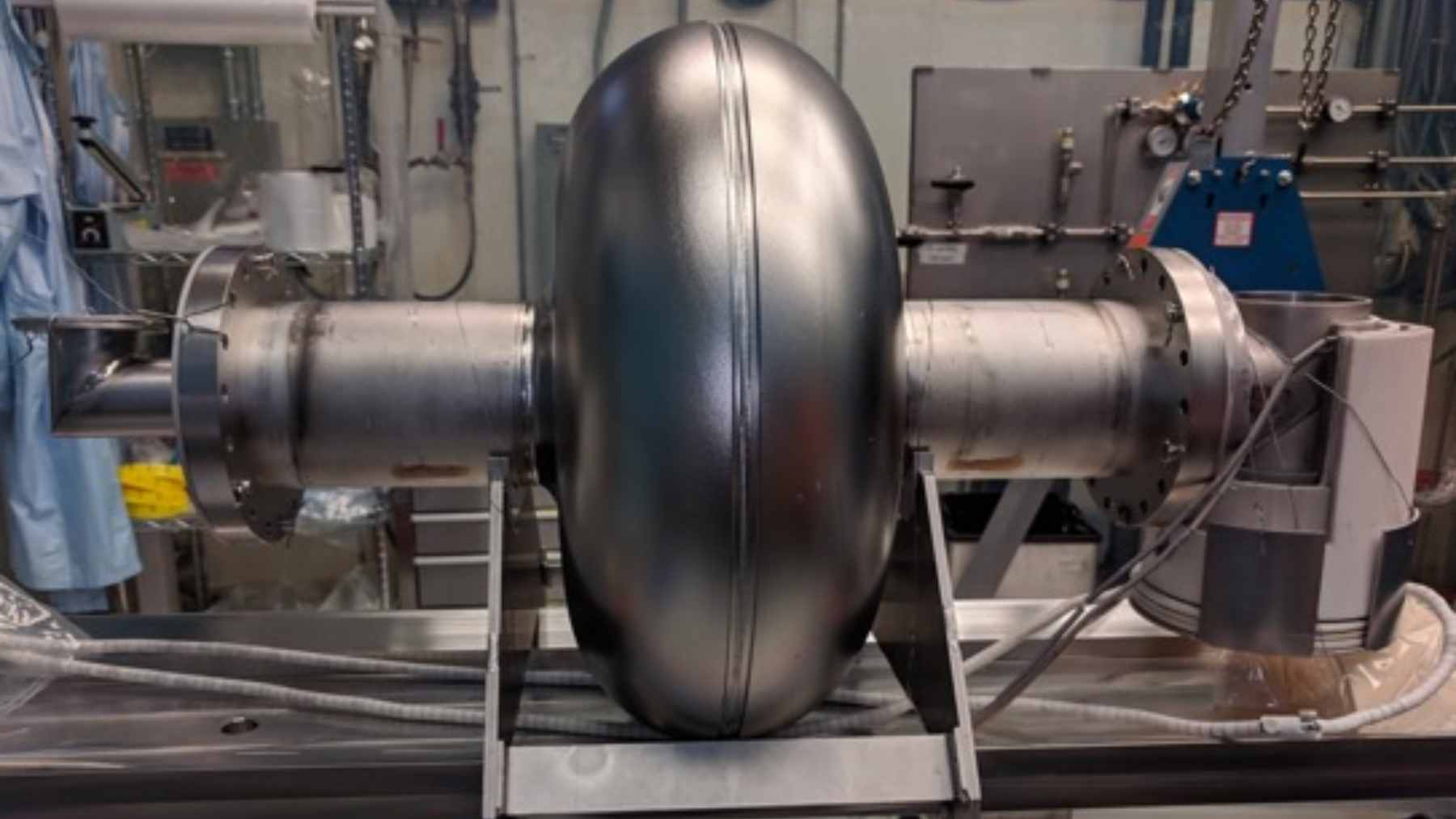
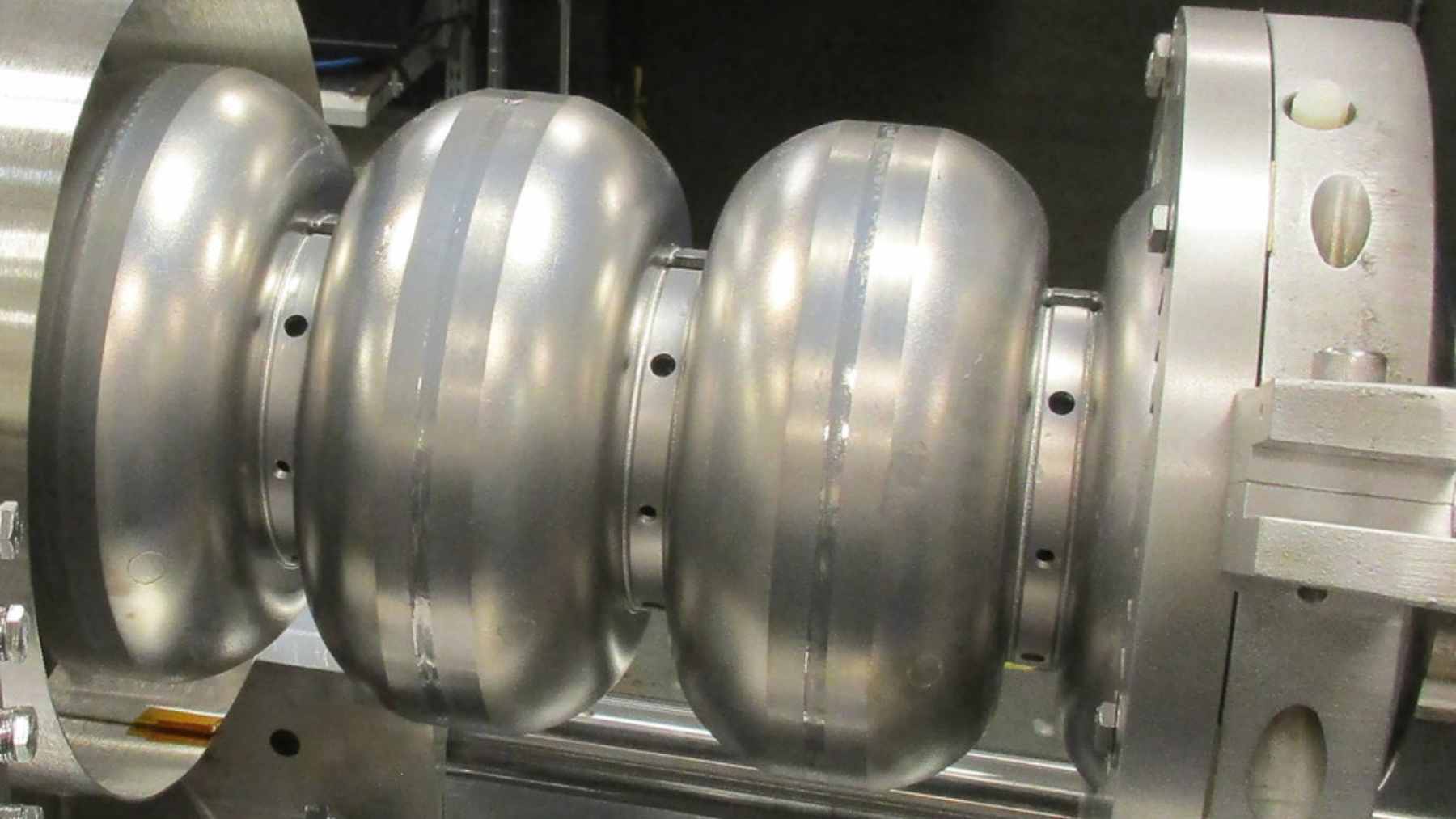
One of the new grants, worth about $4.2 million, focuses on boosting the efficiency of the accelerator’s niobium cavities by adding a thin tin coating so they can run at higher temperatures with more conventional cooling.
That same project also explores a different cavity shape called a “spoke cavity,” aimed at pushing efficiency even further. Partners include RadiaBeam Technology and a Tennessee national lab that already operates a large spallation neutron facility, which helps keep the new design grounded in real hardware.
The second grant, about $4 million, targets the power supply, which must deliver enormous energy to drive the particle beam. It looks at advanced magnetrons, the same kind of device used in microwave ovens, and it brings in Stellant Systems and General Atomics Energy Group to help develop a high-powered unit tuned to an 805 megahertz operating frequency.
Keeping that power matched to the accelerator’s frequency is critical, because wasted energy means higher costs and more heat to manage.
A long road from lab to policy
Even supporters describe this as a technology development push, not a finished waste solution ready for deployment. The broader ambition is to make transmutation economically viable at scale, and to move the toughest part of nuclear waste management from an intergenerational problem toward something societies can realistically plan for.
Other efforts are running in parallel, which helps show how big the challenge is. In June 2025, an Argonne National Laboratory release described separate projects meant to reduce the impact of used fuel, highlighting that no single lab or device is likely to carry the whole load.
Academic researchers have been exploring the basic idea for years, including a 2021 paper in Annals of Nuclear Energy that laid out an accelerator-driven system concept for disposing of U.S. spent fuel inventory.
It is a conceptual design study, meaning it maps out how the system could work rather than reporting on a full-scale facility in operation.
The official press release was published by the Thomas Jefferson National Accelerator Facility.