
The Bonneville Power Administration has cut back more than 1,000 megawatt-hours of wind power generation in the Pacific Northwest to increase its hydroelectric output and protect fish while maintaining the stability of its power grid.
The United States Army Corps of Engineers increased river flow to accommodate runoff coming from melting snow from the largest snowpack in the region since 1997. This in turn boosted hydroelectric output which triggered action under the utility’s new policy to manage the excess power – including that generated by wind turbines.
The federal transmission utility implemented the environmental redispatch policy last week to temporarily limit coal, natural gas and wind power in periods of increased hydropower output. To remain in place until March 30 next year, it plans to keep the supply of power from exceeding demand, and protect fish like salmon and steelhead.
The utility said it reduced all coal, gas and thermal generation to minimum levels beginning 12:00 a.m. on May 18 due to low overnight power demand. As a last resort, the utility cut 200 MW to 350 MW of wind until about 5 a.m. The range is about one-third of the generating capacity of Bonneville Dam, one of the major dams in the Columbia River managed by Bonneville. There are currently more than 3,500 megawatts of wind energy connected to the utility’s system.
The utility has cut around 1,400 megawatt hours of wind power in total. However, Bonneville’s new rule to curtail wind generation at times of high hydropower output as last resort will not compensate wind producers for potential lost revenue.
The American Wind Energy Association said in a statement that the policy is «wrongheaded» and could cost wind companies tens of millions of dollars and stifle investment in wind farms.
“This policy creates significant uncertainty, discriminates against wind energy, and will result in existing projects in the Northwest being seriously harmed economically,” said Tom Vinson, senior director of federal regulatory affairs at the wind industry umbrella group.
“It will also make the Northwest significantly less attractive in the future for wind energy development and the associated jobs, economic development and tax and rental payments,” he added.
So far, the restrictions have been lifted for all non-hydropower generators but limits may be needed in coming days, the utility warns. The Northwest River Forecast Center predicts that this year will bring the highest Columbia Basin runoff volume since 1999.
The utility will provide updates on further generation limits, if any, every 9:00 a.m. and 3:00 p.m. each business day.
Other reasons
The utility said it decided to limit wind generation instead of spilling water over its hydroelectric dams to reduce power output for environmental reasons.
As snow-melt water flows over the land as runoff, it dissolves or otherwise carries a variety of materials that include minerals and gasses to bodies of water likes streams, lakes and rivers. More gas in the bodies of water could raise the occurrence of gas-bubble disease in fish.
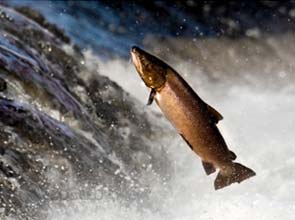
According to the utility, spilling even a bit more water over the dams will create dissolved nitrogen levels that harm the region’s salmon population. The melting Northwest snowpack already pushed dissolved gas levels at most of the eight federal dams on the Lower Snake and Columbia Rivers threatening protected fishes, they said in a statement.
However, Save our Wild Salmon, a conservation group protecting fish in the Northwest, doubted the environmental basis for the policy, saying that the utility can spill more water and still meet water quality standards safe for salmon.
Oregon takes the same position with respect to additional spilled water. The state said spilling water would actually be more beneficial for salmon than the federal utility’s current strategy.
“Rather than being an environmental issue, the policy is a classic case of anti-competitive and discriminatory behavior by a utility with a conflict of interest,” said Rob Gramlich, senior vice president of public policy at AWEA.
“B.P.A. has not sufficiently pursued other measures before curtailing wind, despite its claim that curtailment is a last resort.”
Steve Wright, B.P.A.’s administrator, had earlier said it was “an extremely difficult decision.”
“Despite months of searching through a robust public process, there was no good choice here,» Mr. Wright said.
The agency said it took several steps in order to avoid the need for the policy. Some of the actions they pursued include providing surplus hydropower free or at low prices to encourage utilities to shut coal and natural gas plants, storing water pumped at storage facilities for later use, and maximizing available reservoir space to control runoff.
The Bonneville Power Administration is mandated by Congress to sell power from all federally-owned hydroelectric projects in the Pacific Northwest. It transmits and sells wholesale electricity to eight western states – Washington, Oregon, Idaho, Montana, Wyoming, Utah, Nevada and California.