
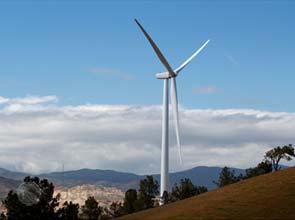
General Electric Company has launched its new onshore wind turbine targeted at the low wind speed market and already received more than 630 megawatts worth of orders from projects in the United States and Brazil.
The 1.6-100 combines parts from G.E.’s 1.5-MW turbine with its 2.5-MW turbine. It is designed to have blades that extend 100 meters— a height of 33 stories — increasing the area it can sweep and capture wind by 47 percent compared with previous models.
Victor Abate, G.E. Power & Water vice president for renewable energy, said increasing the rotor diameter for the 1.6-100 turbine model boosted its annual energy production by as much as 19 percent.
It has also given it the ability to harness power in wind speeds as slow as 7.5 meters per second, considered as low wind environments, according to the International Electrotechnical Commission, which publishes standards for wind turbines among other electrical and electronics equipments.
«By increasing the rotor diameter on the 1.6, our technology now offers customers the highest capacity factor in its class,” Mr. Abate said.
G.E. has been operating a prototype of the wind turbine at Tehachapi, California since February of this year.
The new models seemed to have been warmly received by the market, having already garnered 393 turbines projects in the United States and in Latin America, G.E. officials said when G.E. officially revealed the turbine at the American Wind Energy Council’s Windpower 2011 Conference in California earlier this week.
Illinois-based Invenergy LLC, the largest independent wind power generation company in the United States, is purchasing 233 units for three of its projects in the Midwest United States. This will provide 372.8 MW of power to the country’s grid by 2012.
Three Brazilian companies also ordered a total of 160 turbines for 256 MW worth of projects in the country. G.E. will provide 106 wind turbines to projects developed by Serveng Civilsan, 36 wind turbines to projects developed by Bioenergy, and 18 wind turbines to projects developed by Oleoplan, all to be delivered in 2012.
Size is everything
According to the American Wind Energy Association, a turbine’s swept area is a key indicator in how much power the turbine could produce. Paul Gipe, in his book Wind Power for Home and Business, said that doubling the rotor diameter yields a four-fold increase in swept area, with a corresponding increase in electrical generation.
«Nothing says more about a wind turbine than rotor diameter,” Mr. Gipe said.
Aside from a turbine’s average output, its average rotor diameters have also increased at a somewhat more rapid pace.
A report from Department of Energy noted that the average rotor diameter of wind turbines installed in the United States in 2009 was 81.6 meters, up from 79.4 meters in 2008 and 79.2 meters in 2007. Between 1998 and 1999, the average rotor diameter has increased by 69 percent, or 33.2 meters.