
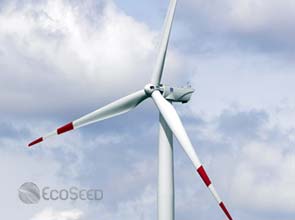
General Electric will work on a $3 million project for the United States Department of Energy to develop gearless wind turbines that can generate close to three times more power than the industrial conglomerates largest model.
G.E. Global Research, the research arm of the Connecticut-based firm, will design direct-drive wind turbines that can generate between 10 to 15 megawatts using superconducting magnets and lightweight materials, the company said in a statement.
G.E. has already started with the two-year project on developing a conceptual design and evaluating its economic, environmental, and commercial impact. The company will decide on how to build and commercialize the turbines in the second phase of the project.
The company currently offers 1.5 MW and 2.5 MW wind turbines for onshore wind farms and an offshore wind turbine rated at 4 MW which also uses direct-drive technology, according to G.E.’s website.
Direct drive turbines are low maintenance because it connects the shaft of the rotor blades directly to a slow-speed generator which uses permanent magnets to produce power.
This compares to traditional turbines that need to connect the rotor shaft to a gearbox first before a generator can produce electricity. Gearboxes ramp up the speed of the rotor shaft from 10 to 60 rotations per minute to about 1,200 to 1,800 rpm, the speed needed by most generators to create electricity.
G.E. said its proposed superconducting magnets for the wind turbines will use less rare earth materials found in almost all permanent magnets for wind turbines, electric and hybrid cars and other renewable energy technologies.
Keith Longtin, wind technology leader for G.E. Global Research, did not say how the company will do this but he is banking on the company’s more than 30 years experience in magnetic resonance imaging to achieve similar success in making better wind turbines.
«The applications are different, but the basic technology is the same,» Mr. Longtin said.
«For M.R.I. systems, we’re applying superconducting magnets to make lower cost systems with higher image quality. For wind turbines, we want to apply them to generate more wind power at a lower cost of electricity,» he added.
The use of lighter composite materials, according to G.E., will enable them to design longer wind blades that enhance wind capture without adding weight and additional cost, further enhancing the wind turbines output and economics.
The proposed direct-drive turbine will also have advanced controls, sensors, and condition monitoring algorithms onboard. These tools allows operators to optimize wind turbine operation based on factors like current wind speed and weather that have a direct impact on a wind farm’s output and operating costs.
Germany’s Siemens AG is already selling direct drive wind turbines rated at 3-MW and 2.3 MW – the last went public just last March suitable for low to moderate wind conditions. Siemens landed its third order for the 3-MW model in the United States in March for Minnesota Power’s Bison 2 wind project in central North Dakota.
The company also plans to offer a larger 6-MW direct drive turbine by the end of the year, which is targeted for large offshore wind farms.
In April, Vestas Wind Systems AS, the world’s biggest wind turbine manufacturer by market share, unveiled a much bigger 7-MW offshore wind turbine planned for mass production in 2015. However, Vestas said it will continue to use gearboxes despite its competitors already having a possible headstart in the direct-drive market.
Vestas has yet to announce plans to pursue direct drive technology.