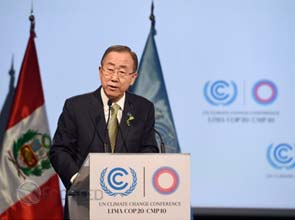
The Secretary-General praised the delegates for setting the groundwork for a more conclusive agreement to be reached in 2015. The 12-day meeting, which gathered 196 Parties to the U.N. Framework Convention on Climate Change, hammered out a new universal treaty which would enter into force by 2020.
United Nations Secretary-General Ban Ki-moon hailed the results of the recently concluded Conference of the Parties in Lima, Peru.
The Secretary-General praised the delegates for setting the groundwork for a more conclusive agreement to be reached in 2015. The 12-day meeting, which gathered 196 Parties to the U.N. Framework Convention on Climate Change, hammered out a new universal treaty which would enter into force by 2020.
“The decisions adopted in Lima, including the Lima Call for Climate Action, pave the way for the adoption of a universal and meaningful agreement in 2015,” the spokesman said in a statement. “The Secretary-General urges all Parties, at their first meeting in February next year, to enter into substantive negotiations on the draft text of the 2015 agreement coming from the conference.”
Also in the statement, Mr. Ban applauded the delegates for having made “important advances” in clarifying their needs for preparing and presenting their so-called Intended Nationally Determined Contributions to the new agreement and in “finalizing the institutional architecture for a mechanism on loss and damage.”
U.N.F.C.C.C. Executive Secretary Christiana Figueres noted that the two-week conference proved to be “very, very challenging” but she nonetheless praised the outcome as it had left “a range of key decisions agreed and action-agendas launched, including how to better scale up and finance adaptation, alongside actions on forests and education.”
“With this C.O.P. and moving on to Paris, we cement the fact that we will address climate change,” she said.
Chief Among the important outcomes, decisions, and “firsts” are: pledges that were made by both developed and developing countries towards the new Green Climate Fund past an initial $10 billion target; several industrialized countries submitted themselves to questioning about their emissions targets under a new process called a Multilateral Assessment; and the call for governments to put climate change into school curricula and climate awareness into national development plans.
Following the conclusion of the climate talks, the Natural Resources Defense Council issued a statement.
“Here’s the good news from the Lima talks: countries around the world now fully understand that early next year they must commit to ambitious reductions in climate pollution and bold measures to slow global warming,” said N.R.D.C. International Program Director Jake Schmidt.
“The progress from Lima must result in pledges for real action by the time the world convenes in Paris. Only together can we avoid the worst impacts of climate change, and for the sake of our children and future generations we must,” he explained.
However, the World Wide Fund for Nature was not satisfied with the outcome of the climate talks.
“Against the backdrop of extreme weather in the Philippines and potentially the hottest year ever recorded, governments at the U.N. climate talks in Lima opted for a half-baked plan to cut emissions,” said Samantha Smith, head of W.W.F.’s Global Climate and Energy Initiative.
“Governments crucially failed to agree on specific plans to cut emissions before 2020 that would have laid the groundwork for ending the fossil fuel era and accelerated the move toward renewable energy and increased energy efficiency,” she pointed out.
Ms. Smith also criticized developed country governments for not elaborating on how they will deliver the long-promised $100 billion per year in climate finance by 2020. She commented that it was “a move that seemingly dismissed the plight of the most vulnerable countries.”
“The outcome in Paris is still a mystery and governments can solve it. But it’s going to be hard road to pull everything together in the next year and churn out an adequate deal based on science and not politics,” Ms. Smith said. – L. Polintan