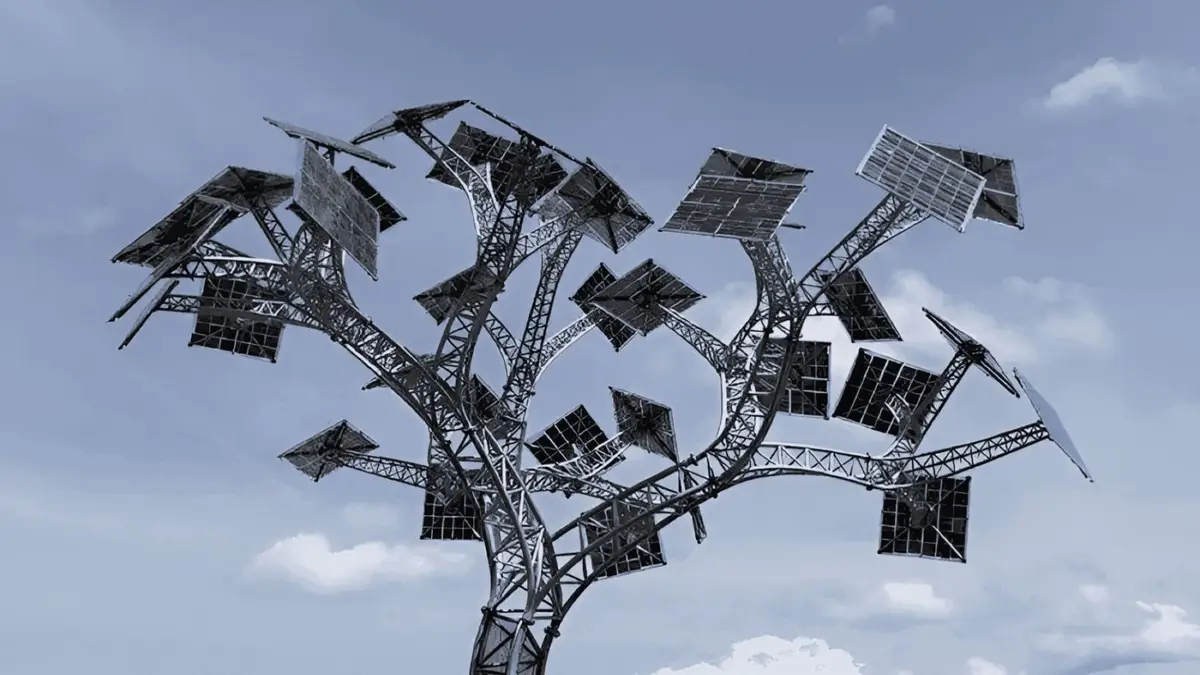
Bristol’s Energy Tree, a sculpture with 36 solar panels, offered free phone charging and Wi-Fi in Millennium Square from 2015
This article was first published on 8 March 2025 and corrected on 28 October 2026 to remove inaccurate statements.

By Javier Niño
· · 4 min read
Add as a preferred sourceFollow ECOnews on GoogleAdd us as a preferred source and you will see more of our stories in Google’s Top Stories when you search.Add on GoogleOpens Google. You can remove it at any time.
· · 4 min read
Listen to the summary1:00
In the middle of Bristol’s Millennium Square stands an amazing green piece of art: the Energy Tree. The metal sculpture, which sources put at 15 to 20 feet tall, designed by Bristol artist John Packer and the Demand Energy Equality project, is not just a pretty sight but a functional one, too. It harnesses solar power to provide the public with free mobile phone charging and Wi-Fi. Installed in 2015, it was given new solar panels in 2018, with the stated aim of keeping it powered for another ten years.
How the Energy Tree’s design draws on nature
The Energy Tree is described by its makers as a biomimicry sculpture. Sculptor John Packer has said its panels are meant to echo how leaves gather sunlight through the day, not to copy their shape. Tree-shaped solar layouts drew wide attention in 2011, when Aidan Dwyer, a 13-year-old from New York, reported that a small model with panels arranged like oak branches did better than a flat array in his own measurements, especially in winter. That was a small home-built test, so it does not show how much a full-size sculpture like this one produces. The project’s own evaluation could not compare the tree’s output with the solar array on the roof of the At-Bristol science centre because of data access issues. Whereas leaves are absent, the tree has 36 solar PV panels. These capture the sun and transform it into usable energy. Demand Energy Equality, the group behind the idea, said the aim was to raise awareness of energy issues.Why you can charge your phone for free in Millennium Square
The second critical feature of the Energy Tree is that it provides free service to the general public. Individuals passing by can recharge their mobile devices via the tree and access free Wi-Fi. This is a good addition for citizens and visitors, promoting the use of renewable energy sources in daily activities. Situated in vibrant Millennium Square, the Energy Tree is accessed by a wide range of users, from students and workers to tourists and families. With free internet access and charging, the Energy Tree gets people to engage with energy issues. By the end of October 2015, its Wi-Fi point, which asks users to answer an energy quiz first, had logged 4,404 answers from an estimated 2,202 people, according to the project’s own evaluation report.New panels in 2018 aimed to keep the tree running for another ten years
In March 2018, the Energy Tree was fitted with brand new solar panels, installed by Demand Energy Equality with help from We the Curious. The group said the aim was to keep it powered for another ten years. The tree was originally launched in 2015 as part of Bristol’s year as European Green Capital. The project could be replicated in other cities and serve as an indication that clean energy and public art are compatible. The convergence of sustainability and art offers an early vision for cities incorporating renewable power into civic landscapes with ease. The new panels also keep the tree working as a hands-on exhibit about sustainability. The more individuals that use the Energy Tree, the more first-hand experience they have with the benefits of solar technology and, thus, more knowledgeable about renewable energy solutions. The project shows how public art can double as a lesson in solar energy.An interactive tree built to teach people about solar energy
The Energy Tree is not only a functional piece of tech—it’s also an interactive display that educates the general public on renewable energy use. By making solar energy available in a physical sense, it invites children and adults alike to become more informed on sustainability. Individuals can see firsthand how sunlight is being converted into electricity, making it more tangible and accessible. This interactive installation also bridges the gap between science and everyday life; with a planet still on the quest for groundbreaking climate solutions, projects like the Energy Tree increase in value toward building an energy-conscious community. As it educates and invites engagement, it challenges others to find out how they, too, can play a part in the forward motion of sustainable living. Millennium Square in Bristol houses the Energy Tree, a lovely illustration of how technology and art can merge in a bid to promote sustainability. With its distinctive design, free public phone charging and Wi-Fi, its 2018 renovation and its educational role, it is a visible example of what small-scale solar can do. In an era when cities around the world seek ways of reducing their carbon footprint, the Energy Tree presents itself as a symbolic model for harnessing the genius of nature in energy exploration. Through the blending of the beauty of natural form and technology, it proves that sustainability need not be utilitarian but aesthetically pleasing as well.This article was first published on 8 March 2025 and corrected on 28 October 2026 to remove inaccurate statements.
Glossary for this story
- Solar power
- Electricity made from sunlight, usually with panels whose cells turn light directly into current.
- Biomimicry
- Copying solutions from nature to design technology, materials or buildings.
- Renewable energy
- Energy from sources that are naturally replenished, such as sunlight, wind, water and biomass.
- Carbon footprint
- The total amount of greenhouse gases released, directly or indirectly, by a person, company, product or activity, usually measured in tons of CO₂ equivalent.
About the writer
Javier Niño
Writer at ECOnewsJavier Niño has been a Spanish National Police officer since 2017 and a journalist specialising in employment, labour law and Social Security, with more than seven years of writing experience. At ECOnews he covers environment, energy and sustainability news, focusing on how new regulations and court rulings affect people in their everyday lives.
More from Javier NiñoComments · 0
Rules ›No comments yet. Be the first to share your view.