A groundbreaking energy project is set to take place in Bavaria with the intention of pushing beyond the limits of what’s possible in terms of renewable power. A German startup, Sinn Power, in partnership with the Jais gravel and crushing plant in Gilching, plans to launch the world’s first floating photovoltaic (PV) system with vertically installed solar panels. Could the world be introduced to energy floating on water soon?
This innovative system is something that the world has never seen and is scheduled to begin construction in September. The beautiful part is that the system can generate 1,8 megawatts of energy, equivalent to 1,800 MWh yearly, by simply harnessing the sun’s power over water. The project can be defined by its top-notch engineering and immense local support, and is a stepping stone towards smarter water usage in an attempt to produce sustainable energy.
Revolutionizing floating solar energy
While floating PV systems are not entirely new, they have remained rather small-scale and have been restricted in Germany, where there are regulations in place to guiding the coverage of water surfaces for solar power. According to the German Renewable Energy Act, approximately 15% of a body of water can be covered with solar panels only. Thus far solar installations on water have not been economically feasible in Germany.
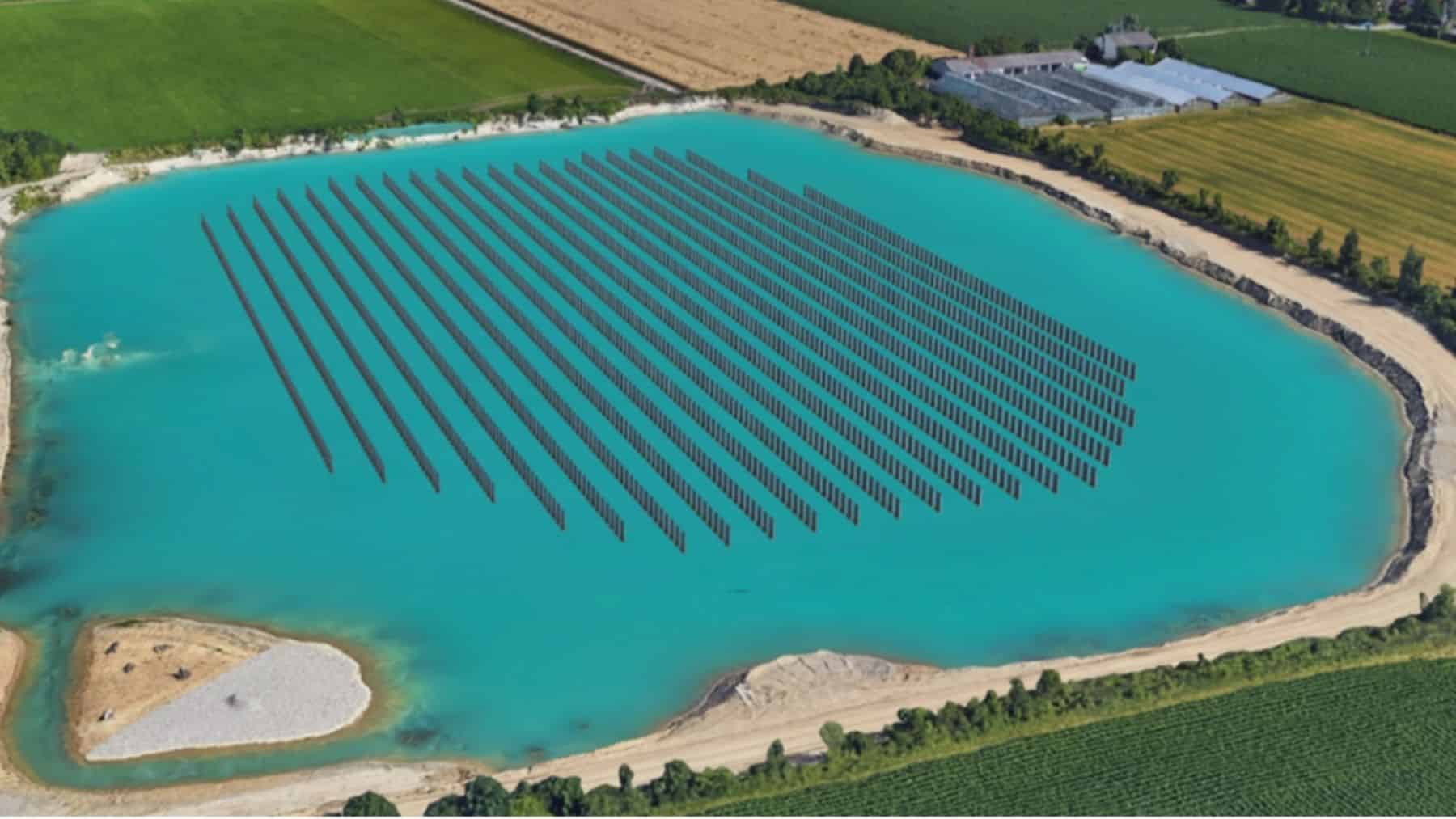
The approach taken by Sinn Power is that of a “Floating-SKIPP” mounting system. The system considers the regulation and is thus patented and purpose-built, allowing for the vertical installation of solar modules. The modules are said to be arranged in an east-west orientation across the lake of the Jais gravel works. The layout doesn’t follow the typical layout of solar panels but reduces the overall surface area required whilst still increasing energy efficiency and complying with regulations. The floating solar vertical alignment is quite a regulatory and revolutionary breakthrough that redefines what solar projects on artificial inland waters across Germany could be in the future.
An efficiently designed solar energy system
The floating system will consist of approximately 2,500 solar modules mounted upright. An added feature of this system is its structures that are able to flex under wind loads, improving durability and system longevity. Modules are said to be spaced at 3,90 meters apart to maximize sunlight capture while minimizing both shadowing and turbulence on the water’s surface. This solar project has some similarities with that of Japan’s 50,000 solar panels floating on water.
Aside from the technical aspects, the floating PV plant is perfectly tailored to the operational profile of the Jais gravel facility. As stated by Gottfried Jais, Managing Director of the gravel plant, the east-west alignment enables the system to generate electricity both in the morning and afternoon. The peak demand times means the power plant will have to be active during daylight hours, especially between March and December. All surplus energy will be put into the public grid, thus maintaining grid stability.
Local and regional support for floating solar systems
The initiative is exciting and promising, more so due to the strong regional support it has received. The project is supported by GWT Starnberg GmbH, the Starnberg district office, and the municipality of Gilching. Lake preparation and the anchoring process are scheduled to start on August 1, 2025, with construction following in the month thereafter.
All stakeholders remain optimistic about the system’s potential to scale. Despite set regulations, this compact and efficient system model is one that will finally make floating solar systems a reality across Germany and beyond.
Demonstrating engineering genius and strong collaboration, the installation of the 1,800 MWh of floating solar energy capacity in Bavaria is more than a milestone, it’s the beginning of Germany’s push towards its climate goals. This project is as innovative as energy floating on a bubble.