We already knew that the Universe would not be infinite, but the fact that its lifespan is shorter than we had previously calculated is news – and a big one. Does this mean you have to act like in the movie Last Holiday? Not necessarily, because even if the predictions have changed, we still have a little time to enjoy here on Earth.
What is the future of the Universe? And how does it impact us?
The million-dollar question for many scientists has always been: what will the future of the universe be like? Some hypotheses are: will it continue to expand forever? Will it collapse? Or even: will it fade away like a star until, at the end, everything goes dark?
Well, this mystery itself has not yet been solved, but what we had as a valid prediction for the Universe was almost infinite. To be more precise, experts determined 10 to the power of 1,100 years (10¹¹⁰⁰) until the end. However, discoveries point to a much more recent date. Scientists from Radboud University in the Netherlands recently published a study revealing that, in fact, the universe should end in a five-vigintillion years: 10⁷⁸ years. That’s right, the universe is decaying much faster than we previously thought.
What does Hawking have to do with the end of the Universe, and why was he right?
Back in the 1970s, more specifically in 1975, Stephen Hawking conceptualized the theory of black hole evaporation, which is now known as “Hawking radiation.” Okay, but what does that mean?
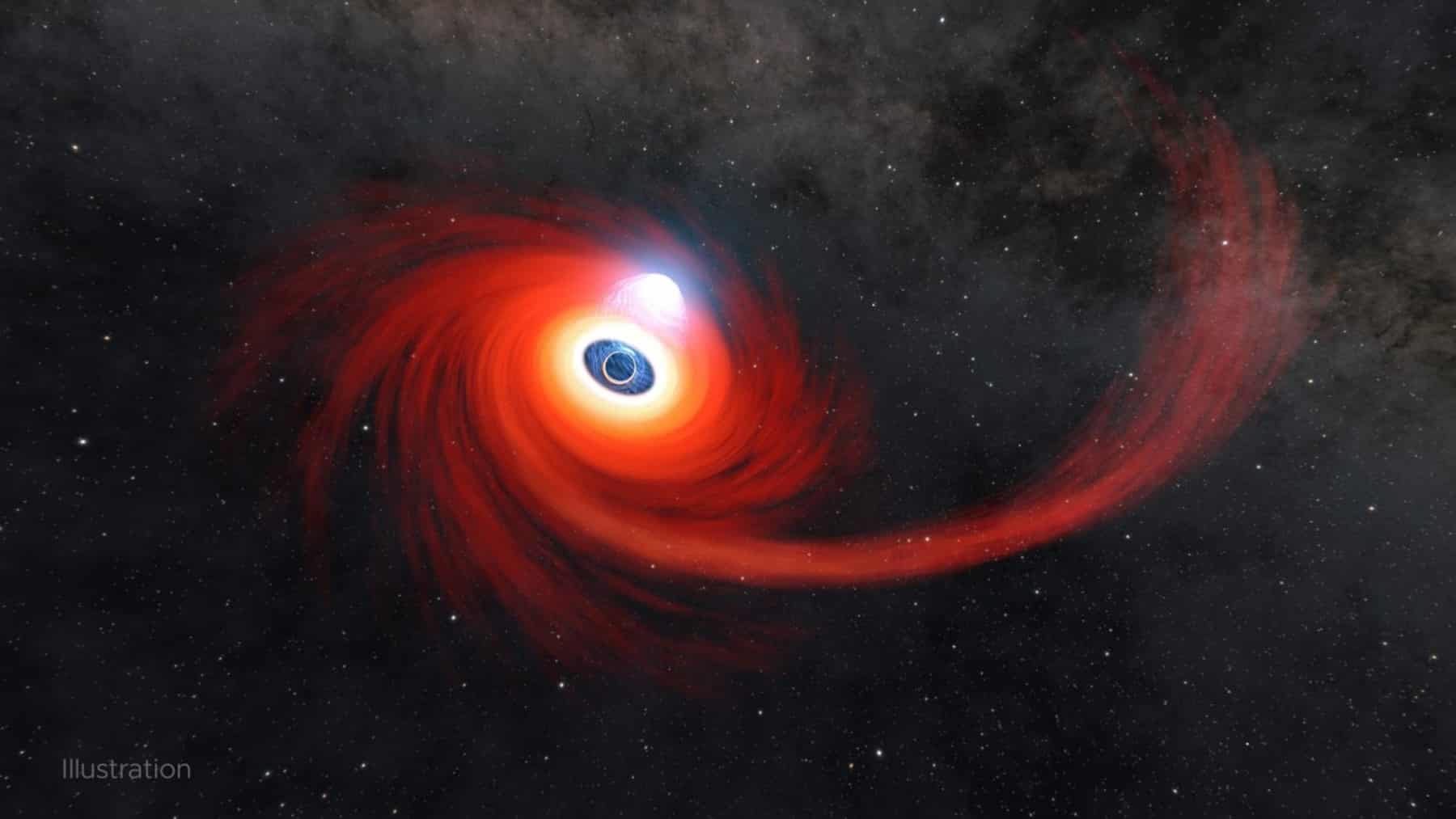
Hawking claimed that particles and radiation could escape from black holes and this would cause them to gradually decay. Interestingly, this theory is completely contrary to Einstein’s, which said that black holes only grow.
Black holes are not the only space phenomenon that could be swallowed
That said, what scientists at Radboud University did was to rethink the calculation of the Universe’s end date by considering Hawking radiation. The result? They discovered that not only black holes, but also any object with a gravitational field (neutron stars and white dwarfs) can evaporate through this same process.
Based on this discovery, the researchers recalculated the universe’s lifetime and found a new number: 10⁷⁸ years. Of course, it’s still an extremely long period, but trillions of times shorter than previously predicted.
So we’re all going to die? There’s no need to panic
Yes. If we stop to think about it, one day we will all die… but it won’t be because the end of the Universe is closer than we expected.
Even though this discovery may be shocking at first, we need to remember that the Universe still has trillions and trillions of years ahead of it. All the new things that this research has brought are expected to occur in such distant times that it is completely beyond our imagination to think about the impacts of humanity.
The study’s lead author, Heino Falcke, a black hole expert, says:
“So the ultimate end of the universe comes much sooner than expected, but fortunately it still takes a very long time”.
Now, if we think about the scientific impacts of this new development, the impacts are significant. Especially because if the universe is really decaying at this rate, all the traditional models used will need to be revised. In addition, of course, it opens up new possibilities for even more research on how quantum effects affect large-scale structures in the cosmos.
And it seems that it is not just the Universe that is running out of time, NASA experts have detected a terrible phenomenon that will affect the Moon, they even say we should start saying goodbye.