Could an ecosystem survive without ever touching the ground? In December 1976, Carl Sagan and astrophysicist Edwin Salpeter explored that possibility in the peer-reviewed Astrophysical Journal Supplement Series. Their hypothetical inhabitants included microscopic “sinkers,” enormous balloon-like “floaters,” and mobile “hunters.”
But the Cornell scientists were not reporting alien life. They were testing whether imagined organisms could grow, reproduce, and remain in suitable atmospheric layers before descending into lethal heat. Nearly 50 years later, the important distinction is still between what physics might permit and what observations actually show.
A world with nowhere to land
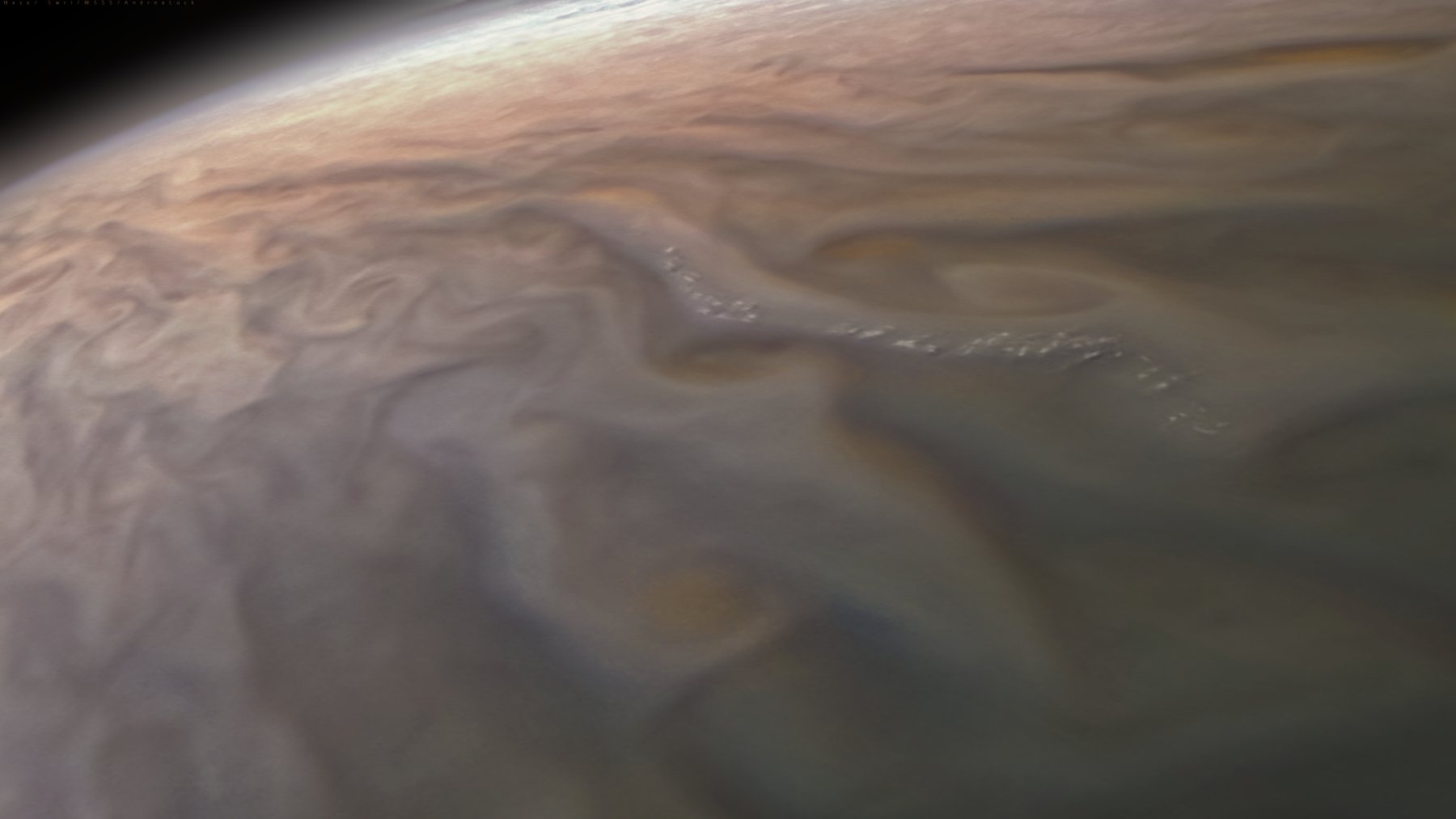
Jupiter’s cloud bands sit in an atmosphere dominated by hydrogen and helium, with no solid surface where a falling organism could settle safely. Farther down, pressure and temperature climb, creating conditions that would destroy familiar biological material.
Sagan and Salpeter called this threat “convective pyrolysis,” the breakdown of organic matter carried into deeper heat. Finding a comfortable temperature somewhere above would not solve the problem, because atmospheric circulation keeps moving material around. Survival would depend on how long an organism could stay in the right conditions.
Tiny sinkers would race against the fall
The researchers borrowed an idea from Earth’s oceans, where microscopic phytoplankton reproduce in sunlit waters even as some individuals sink away. Their imagined Jovian sinkers would likewise capture sunlight and multiply while drifting downward. The population, rather than every individual, was what needed to survive.
Atmospheric mixing could return enough offspring to higher layers to keep that cycle going. But reproduction would have to outpace losses into the depths, making growth rate and sinking speed central to the calculations. Small size could help, because tiny organisms would generally sink more slowly.
Giant floaters would act like living balloons
The proposed floaters took a different approach. Instead of beating wings, these organisms would resemble gas-filled balloons that maintained nearly the same pressure inside and outside. Pumping helium out of their interiors would leave lighter hydrogen, providing lift in Jupiter’s hydrogen-helium atmosphere.
Why make them enormous? As a balloon grows, its volume increases faster than its surface area, allowing more lifting gas relative to the weight of its skin. With an assumed effective skin thickness of about 0.4 inches (1 centimeter), the paper described floaters with kilometer-scale dimensions, though metabolic demands would limit their size.
Hunters added movement to the food web
Hunters would spend energy steering through the atmosphere to encounter other organisms. The paper treated those encounters abstractly, even noting that hunting and mating might not be clearly distinguishable under its assumptions. It did not describe a particular set of teeth, jaws, or other familiar predator features.
A fourth proposed group, “pyrolytic scavengers,” would consume products left as organisms broke down near the hotter lower boundary. These were treated as specialized floaters, not creatures living on a hidden ocean floor.
What Galileo and Juno actually found
Later missions revealed a more complicated setting for those ideas. NASA’s Galileo probe entered Jupiter’s atmosphere in December 1995 and transmitted measurements for less than an hour. It sampled an unusually dry region, so its findings could not simply represent water conditions across the planet.
Juno observations later helped researchers propose a cycle involving slushy ammonia-water hailstones called “mushballs.” In findings reported in 2020, scientists described how these falling particles could carry water and ammonia into deeper layers. That movement illustrates why an atmospheric habitat cannot be judged by temperature alone.
None of those results demonstrated an ecosystem. NASA still describes Jupiter as probably unsuitable for life as we know it, given its extreme and changeable conditions. Its icy moon Europa, with evidence of an ocean beneath its crust, offers a more promising setting.
Water leaves a narrow possibility open
A 2021 study offered a more specific reason not to dismiss every atmospheric layer. Published in Nature Astronomy, it found that parts of Jupiter’s clouds could have temperatures and available water compatible with some known terrestrial microbes. The researchers examined “water activity,” meaning how available water is for biological processes rather than simply how much exists.
That finding did not validate giant floaters or their imagined neighbors. It addressed only part of the habitability question, leaving unresolved whether suitable conditions persist and nutrients remain accessible. Nor did it explain how life would arise there in the first place.
As Sagan and Salpeter cautioned, describing a plausible ecology “cannot, by itself, demonstrate the likelihood of life on Jupiter.”
The later water-activity study was published in Nature Astronomy.