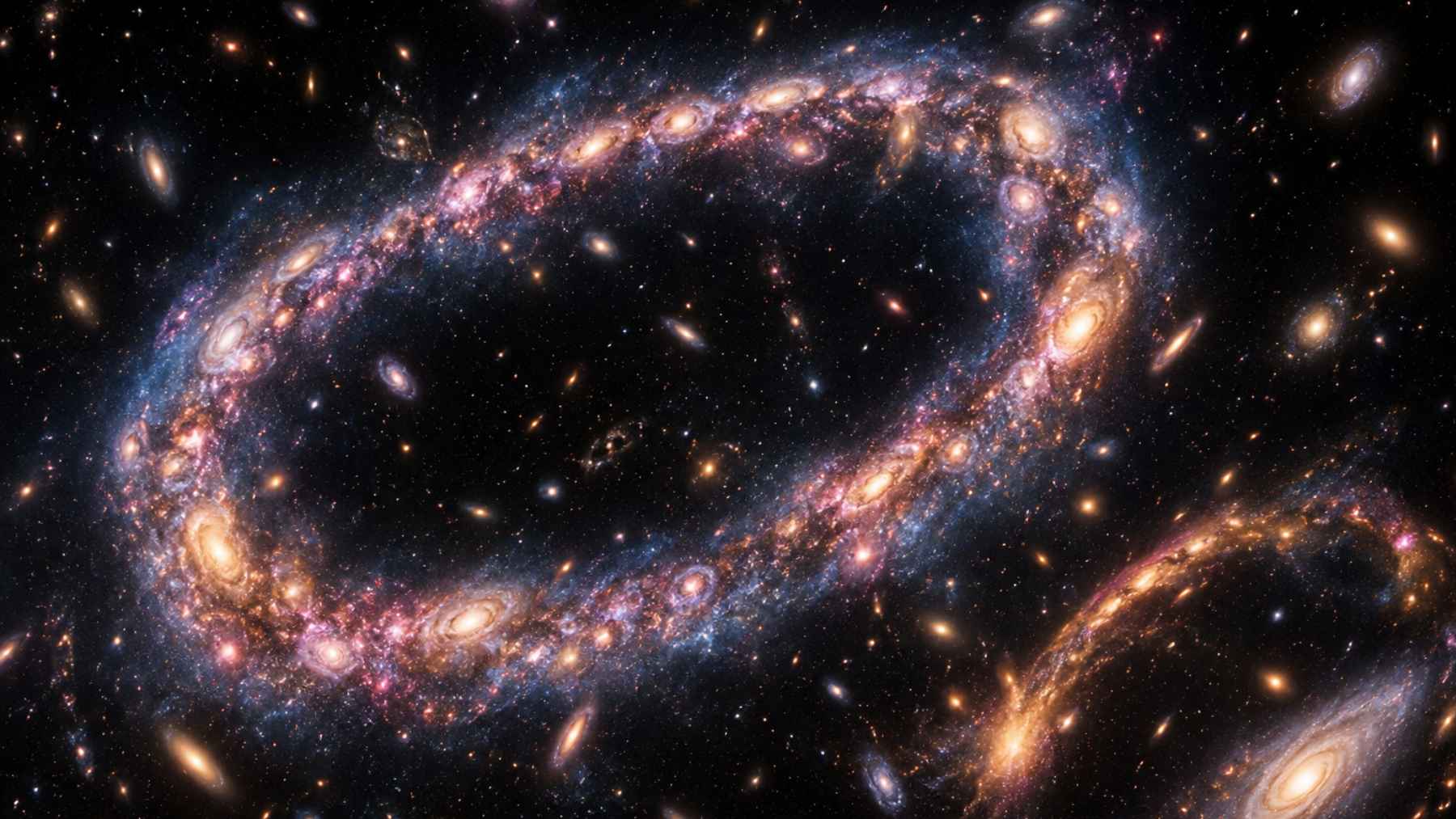
It has come again a time where we will talk about a completely new phenomenon that has been discovered by scientists in the distant Universe. Nicknamed as the Big Ring, a newly observed formation of galaxies has the size of 1.3 billion light years and sits 6.9 billion years away from us.
Unusually large cosmic objects are often found through observations, but this time there’s something special about it. This galaxy cluster stands way too close to another vast cluster called the Giant Arc, so close indeed that it may prompt new discoveries regarding space-time physics or what’s called cosmic “coincidence”.
A ring far larger than expected
The “Big Ring” was discovered by a team led by the PhD Alexia Lopez of the University of Central Lancashire and presented at the 243rd meeting of the American Astronomical Society in 2024 and later reported in the Journal of Cosmology and Astroparticle Physics.
When we lay a first glance the structure looks like an almost perfect circle that is stretched across a huge section. A closer analysis indicates that our point-of-view could be fooling us, because the structure is probably shaped like a corkscrew instead of a ring.
This is so important because we are used to seeing galaxies collected in clusters, walls, and filaments, but the Big Ring has no match when we try to analyse it through standard cosmology previous records.
Why its cosmic neighbor deepens the mystery
The Big Ring is the second large structure that Lopez and her team have found in the same region of the sky. Back in 2021 the Giant Arc was their first announcement: a sweeping arrangement of galaxies.
Generally finding an unusually large structure could be dismissed as a rare statistical accident. Finding two huge clusters so close to each though can pretty much discard the “accident” explanation. Lopez says that “neither of these two ultra-large structures is easy to explain in our current understanding of the universe”.
A challenge to the Cosmological Principle
Our modern cosmology relies in part on the Cosmological Principle: the idea that the Universe should look broadly similar in every direction when viewed on a large scale. Small regions can look crowded or empty if we look at them too close, but when zoomed out those differences usually disappear.
Not for those two guys though. They are so huge they completely shattered the rule. The Big Ring is already wider than the theoretical limit size of 1.2 billion light-years of previously known structures. The Giant Arc is three times as big! The size itself isn’t the problem. It’s the fact that due to their size they make it so that we will have to rethink how we used to view and describe the Universe’s growth.
Why the Big Ring is not a familiar cosmic fossil
Let’s compare the Big Ring to a baryon acoustic oscillation (often shortened to BAO). The BAO’s are enormous spherical patterns byproduct of sound waves that moved through the hot early Universe, long before the expansion and cooling caused the sound waves to freeze into the matter as we know it.
The ring does not appear to be a BAO though, despite the possible comparison. The BAO’s have a limited size of 1 billion light-years, whereas the Big Ring is much bigger. So what are the astronomers looking at? This is a question that hangs over their heads now. The answer could range from an odd alignment of galaxies to evidence that the cosmological soup we had been working on is missing an ingredient.

Cosmic strings and other possible explanations
Ever since the structures were discovered the researchers have been coming up with possible theories. One possibility comes from Roger Penrose’s conformal cyclic cosmology, a model that says the Universe goes through repeated eras of expansion and those ring-like structures may survive as traces of those cycles.
Another proposal involves cosmic strings. Those are theoretical defects in space-time that could have formed in Universes’ early years. The theory implies that their form could have influenced those bigger structures to form around them.
Those are just speculations though. The cosmology theories take a long time to build, and once the previous ones are shattered we need time to find newer explanations. For example, the cosmic strings might not even exist at all.
The search for more giant patterns
Both the Big Ring and the Giant Arc could still be patterns formed by chance and that only look connected because we are so far away from them. Yet the researchers consider that possibility so unlikely that they can’t justify the search for other similar patterns.
More discoveries could completely change their view: if other rings, arcs or corkscrew structures start to be found the evidence that the current model of cosmic evolution needs a revision might be too big to ignore.
For now the Big Ring stays as a reminder that the Universe will always surprise us on different scales.