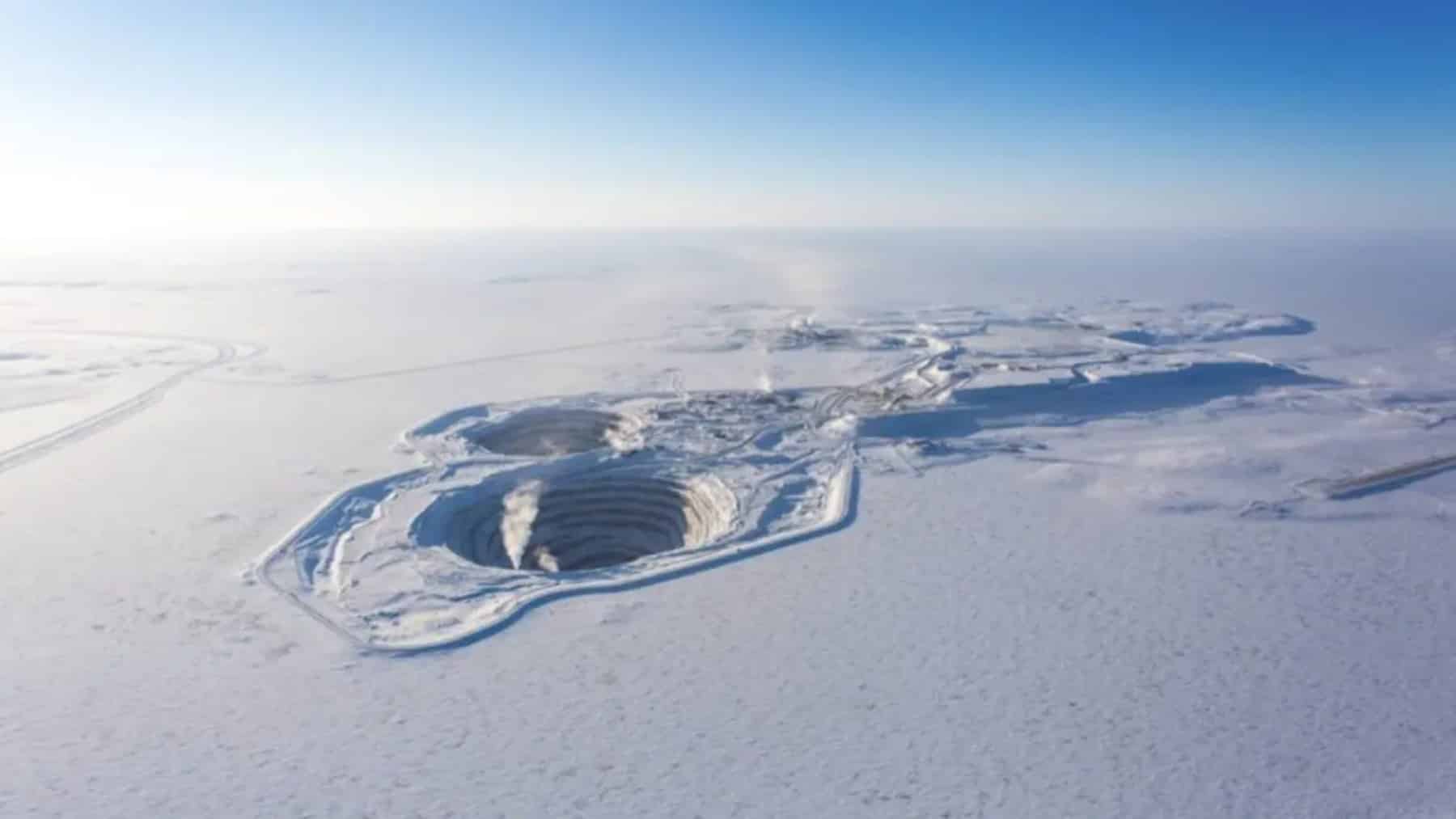
What do you know about the Arctic? More specifically, Arctic Ice? Not much, right? That’s because throughout history, the Arctic has been seen as one of the last truly untouched territories on Earth. It’s a place full of mystery, extremes, and white silence. But in the last few decades, that’s started to change, and the ice has begun to transform, all in a rapid and drastic way. That’s when the region began to reveal that it has iron, oil, and gas — and recently, something unexpected and brilliant was also found.
What’s glowing beneath the Arctic ice?
This whole story began on an expedition of Swedish and Norwegian researchers, who were near the border between Kiruna (Sweden) and Kirkenes (Norway). During this exploration, the sensors they were using ended up capturing a luminous anomaly under the layers of permafrost. At first, everyone believed it was just an equipment failure. However, as we now know, it was not.
In fact, what was under the thick ice, and which probes identified as a persistent glow, was a highly concentrated mineral deposit. It contained phosphorus, rare earth elements, and a specific type of iron ore of exceptional purity, which, to our surprise (and even happiness), are essential materials for the global energy transition.
And the most surprising thing of all is that this discovery will greatly help a mega green transition project by LKAB, a Swedish state-owned mining company, and the attempt by Grangex, another mining company, to reopen the Kirkenes mine. And why are they planning to do this? Well, both focus on strategic metals and carbon-free steel production.
“This ore is very unique and necessary for the green transition of the European steel industry”, highlighted Christer Lindquist, CEO of Grangex.
It looks like we have a new green energy source
In addition to helping this project, experts see this discovery as something beyond geology. This is because it could redefine the clean energy supply chain, making Europe less dependent on unstable markets, such as China and Russia, for the supply of critical minerals. If we stop to think about the current scenario, we will come across minerals such as neodymium, lanthanum, and phosphorus being indispensable for the manufacture of wind turbines, batteries, semiconductors, and fertilizers.
And what do these materials do? Well, they are the hidden engine behind electric cars (like this Japanese car that returned 15 years later), solar panels, and precision agriculture. And almost all of this material, around 90% of the global refining of rare earths, is concentrated in China. In other words, this “shining heart of the Arctic”, as some scientists have already called it, could be the key to European technological independence. And, with that, change the global geopolitical balance…
Arctic Ice’s shine could be the new green gold
Well, if we add up the positives and negatives, we can say that the discovery of the glowing deposit under the Arctic ice is more than a scientific curiosity: it is a wake-up call and an opportunity. This is because our planet is desperately seeking new sources of clean energy and geopolitical independence. Basically, these minerals hidden in the north could become the new green gold of the 21st century.
As Frida Wallnor, the political editor of Dagens Industry, put it, “Climate change can be felt here and now. However, wishful thinking will not save the climate. On the contrary, we need a realistic view of how long it takes to restructure complex businesses.” Now is the time to move forward with well-structured, risk-controlled projects like this inverted turbine, created by a Norwegian project that defied the rules of wind energy.