You’ve probably never felt it. But up there, above the clouds, the ozone layer, and any GPS satellite, a vast anomaly is growing. For decades, scientists have observed a flaw — subtle but persistent — in Earth’s magnetic field. Something that seemed static, but is now expanding and splitting. And most intriguingly, it hovers directly over South America and the South Atlantic. A weak spot in our planetary shield. Literally. This phenomenon, in fact, is gaining NASA’s attention and is more than a scientific curiosity. After all, it affects satellites, causes failures in high-precision instruments, and even forces engineers to create increasingly elaborate contingency plans.
When Earth’s magnetic shield starts to glitch
Earth is surrounded by a magnetic field, a kind of invisible bubble that protects us from the constant bombardment of charged solar particles. Without it, we would be exposed to dangerous levels of radiation. Thanks to this shield that we have a stable atmosphere, satellite communications, and even the Northern Lights.
And of course, this field doesn’t appear by magic: it is generated by the movement of molten iron in the Earth’s outer core, thousands of kilometers deep. This process, called a geodynamo, creates electric currents that power our magnetic field. But, like everything else on our planet, it isn’t perfectly uniform.
This is because several factors affect the stability of this field. One of them is a huge structure of dense rock, called the African Large Low Shear Velocity Province (LLSVP), located beneath the African continent. It interferes with the generation of the field so significantly that, combined with the natural tilt of the Earth’s magnetic axis, it results in a region with much lower magnetic intensity.
The South Atlantic Anomaly — A pothole in space
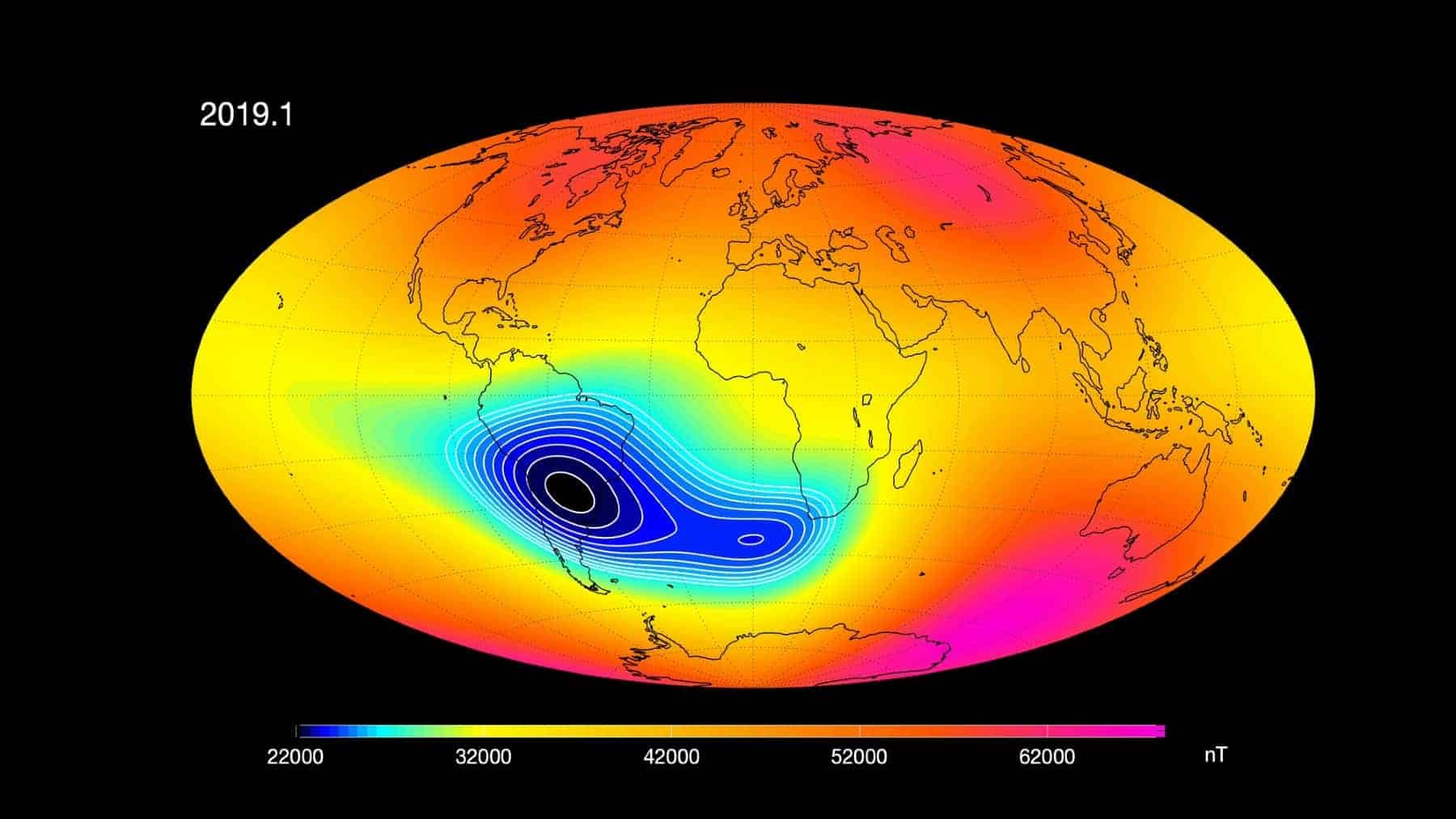
This is precisely where the story’s main character comes in: the South Atlantic Anomaly (SAA). It’s nothing more than a vast area in the sky, between South America and southern Africa, where Earth’s magnetic field is dramatically weaker than anywhere else on the planet. In fact, NASA often compares it to a “pothole”—a hole in the asphalt. Only, in this case, the hole is in the magnetic field itself. And this “flat tire” is getting bigger (no wonder NASA is on alert for this anomaly reaching the US).
How do we know this? Well, when satellites pass through this region, they encounter a shower of high-energy solar particles. This means equipment can fail, sensors can reset, and entire data can be lost. The International Space Station (ISS), for example, passes through the SAA on all its orbits, and although astronauts are protected, external instruments like the GEDI (which measures forests) require extra caution.
And what’s more: since 2020, scientists have noticed that the anomaly is splitting into two distinct zones, each with its own center of minimum magnetic intensity.
Watching the invisible (before it changes everything)
At least we can already say that NASA is already closely monitoring everything. In fact, we already have some missions monitoring the SAA in real time, such as ICON, GEDI, Swarm, and others. Furthermore, data from long ago, like that collected by the SAMPEX mission, feed predictive models that help engineers plan future missions and protect satellites.
And here’s a very important point: even though the South Atlantic Anomaly doesn’t directly affect life on Earth’s surface, it shows us something powerful: our planet is dynamic, changeable, even in its deepest and most invisible systems. This phenomenon will be something NASA won’t be able to take its eyes off; another, in fact, is a galaxy we momentarily forgot to observe, and now all that’s left is a black hole.