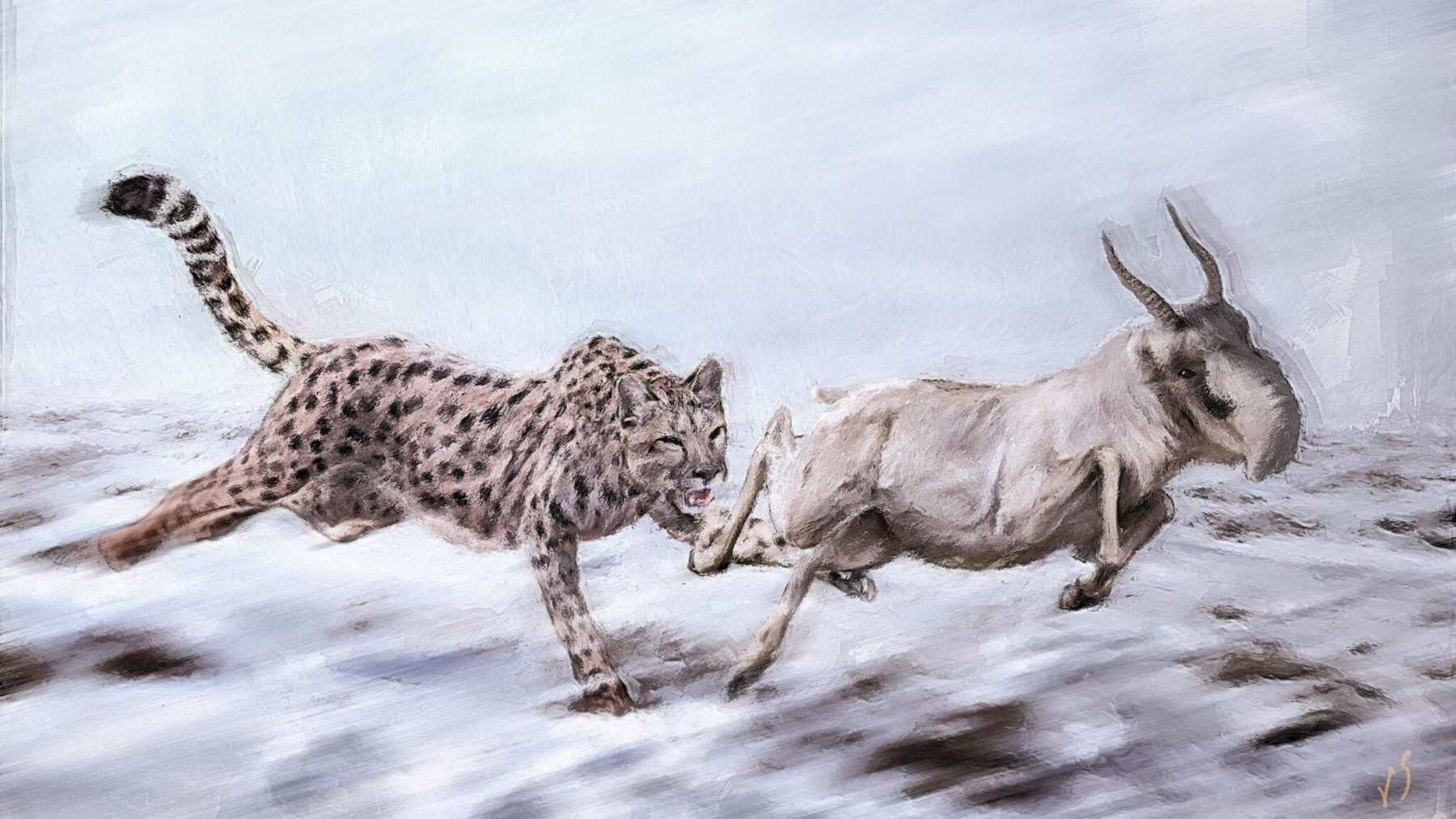
A cat nicknamed the “American cheetah” may have spent part of its Ice Age history eating fish in the Arctic. New research on Miracinonyx trumani suggests that northern populations had a very different menu from their relatives farther south, challenging the familiar picture of a predator built mainly to chase fast prey across grasslands.
The study, published online September 4, 2026, in Current Biology, combines ancient DNA with chemical clues preserved in fossils. It confirms a close relationship with modern pumas and reveals striking dietary flexibility, raising another question about this extinct hunter. Why was an animal capable of living in such different environments unable to survive?
Fossils extend the cat’s range into the Arctic
Led by Molly Cassatt-Johnstone at the University of California, Santa Cruz, the team analyzed DNA from four specimens, one from Wyoming and three from Canada’s Yukon Territory. The fossils represent animals that lived roughly 23,000 to 31,000 years ago.
The Yukon remains had previously been assigned to another species, according to Cell Press. Identifying them as M. trumani extended its known range more than 20 degrees of latitude northward, placing this supposed grassland hunter in the Arctic.
Those northern fossils came from the Traditional Territories of Tr’ondëk Hwëch’in and Vuntut Gwitchin. The university’s announcement acknowledges these communities’ longstanding relationship with the land and the importance of ancient animals to its heritage.
A familiar nickname hid a different family history
The genetic analysis places M. trumani beside the modern puma on the feline family tree. Their lineages separated approximately 2.6 million years ago, making the extinct species a close relative of today’s mountain lion.
That relationship was not an entirely new discovery. Ancient DNA research published in 2005 had already supported the puma connection, while the new work adds much broader genomic evidence and ecological detail.
Its slender build and elongated limbs help explain why the cheetah comparison stuck. But similar features can evolve independently in different lineages, a process called evolutionary convergence, and body shape alone cannot establish an animal’s ancestry or its daily hunting habits.
Chemical clues point to fish on the menu
So how do scientists investigate meals eaten thousands of years ago? The team examined stable isotopes of carbon and nitrogen in the fossils, including nitrogen in individual amino acids, to reconstruct the cats’ diets and positions within ancient food webs.
The Wyoming animal showed a pattern consistent with a predator feeding on land animals, while the Yukon specimens occupied a higher feeding level. The researchers interpret the northern pattern as evidence consistent with eating anadromous fish, such as salmon, which move between marine and freshwater environments.
This is a dietary reconstruction, rather than direct observation of a cat catching a salmon. Even with that distinction, the contrast suggests substantial ecological flexibility and challenges the idea that all populations depended on chasing the same kinds of prey.
Life under extreme daylight left genetic clues
“These cats were remarkably flexible, much like pumas are across their range today,” Cassatt-Johnstone said in the university’s announcement. Their genomes also contained changes that disabled certain genes involved in circadian rhythms, the internal timing systems that help organize daily activity.
The researchers suggest these changes may reflect different demands on biological clocks at high latitudes, where daylight varies dramatically with the seasons. The findings do not establish exactly when the animals slept or hunted.
The team also reported an inactive gene associated with sour-taste reception in M. trumani and the other feline lineages sampled. Because that finding extends beyond the Arctic cats, it should not be treated as proof of a special adaptation for eating fish.
Flexibility did not guarantee survival
The genomes revealed low genetic diversity in the Wyoming and Yukon animals. Yet the researchers found no clear signs of the severe inbreeding or abrupt genetic bottleneck that might suggest a sudden population collapse.
Instead, the evidence points toward a prolonged decline across the Pleistocene. Senior author Beth Shapiro described the pattern simply, saying, “The decline was slow, not sudden,” and suggested that it may have reduced the species’ ability to respond when climate conditions changed.
That remains a possible explanation for its vulnerability, rather than a demonstrated single cause of extinction. The distinction matters because a species can survive with limited genetic variation for a long time, as this cat apparently did.
A broader view of an Ice Age predator
The most revealing change is in how scientists picture this animal’s place in its environment. A cheetah-like silhouette had encouraged a familiar story, while DNA and fossil chemistry reveal a puma relative whose populations used very different food sources.
Its history suggests that understanding an extinct animal requires looking beyond its nickname and appearance. The study was published in Current Biology.
Illustration: Velizar Simeonovski / UC Santa Cruz