Sunlight never reaches the Caribbean’s deepest hydrothermal vents, yet shrimp gather around these isolated patches of seafloor in enormous numbers. How do they find them? A recent expedition involving Florida International University scientists is investigating whether an unusual light-sensitive organ on some shrimp’s backs helps them navigate through the darkness.
Marine biologist Heather Bracken-Grissom and her colleagues returned from a month at sea with samples and observations to investigate that possibility. Their journey included a visit to Beebe/Piccard, the world’s deepest known hydrothermal vent field, roughly 3 miles below the surface. The work has not yet established whether light guides the animals, but it is exploring what they might be able to detect.
A journey to two very different depths
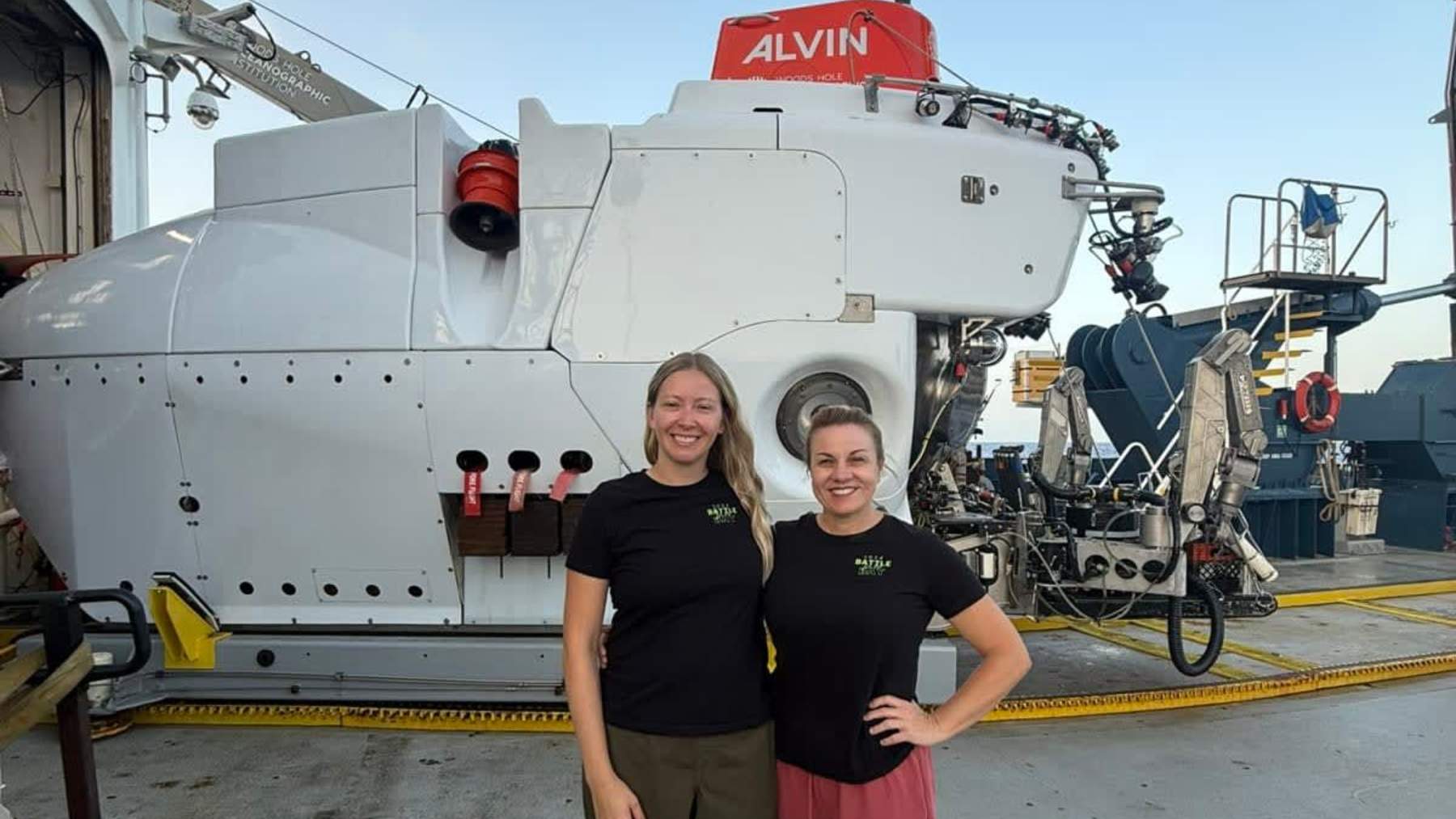
The expedition traveled aboard the research vessel Atlantis, with scientists descending in Alvin, the crewed submersible operated by Woods Hole Oceanographic Institution. It followed research along the Mid-Atlantic Ridge in 2025 and focused this summer on the Von Damm vent field along the Mid-Cayman Rise.
Von Damm lies about 7,500 feet (2,300 meters) underwater, while Beebe/Piccard sits much deeper, around 16,400 feet (5,000 meters). On the expedition’s eighth day, Bracken-Grissom and Daphne Cuvelier of Portugal’s University of the Azores took Alvin down to that deeper field.
“To me, it felt as if I left Earth and was transported to a different planet,” Bracken-Grissom said. Her description captures the unfamiliar setting, where mineral formations rise from the seabed and hot, chemical-rich fluids emerge into cold ocean water.
An eye that does not need a picture
The feature drawing the team’s attention is called a dorsal eye, a light-sensitive organ found on the backs of some vent shrimp. FIU reports that larvae can occur hundreds or thousands of feet from vents, raising questions about how they eventually reach the isolated habitats where adults gather.
An eye does not necessarily work like a tiny camera. Earlier research on the vent shrimp Rimicaris exoculata showed that its dorsal organ detects light without forming images, according to Woods Hole Oceanographic Institution. That distinction matters when asking what information a shrimp might extract from its surroundings.
Think of noticing a faint glow without being able to make out the object producing it. Such sensitivity could be useful underwater, but detecting light and using it to find a distant vent are separate capabilities. The new expedition is investigating that gap.
Where could light come from down there?
One possibility is radiation associated with the hot vent fluids themselves. Previous measurements have documented extremely faint emissions at hydrothermal vents, including a thermal component. The question is whether the available light overlaps with what the shrimp can sense and whether they use it to orient themselves.
Bracken-Grissom’s team is also investigating bioluminescence, light produced by living organisms. Fireflies offer a familiar example of the phenomenon, although the organisms and conditions in the deep sea are very different. Here, the researchers want to learn whether biological light could help shrimp detect or approach a vent ecosystem.
These are possibilities under investigation, not confirmed navigation mechanisms. FIU’s expedition report describes ongoing work on visual sensitivity, genetics and eye anatomy, alongside specialized imaging designed to detect very low light levels.
Life around a vent depends on chemistry
The search for light raises another question. If sunlight cannot reach these communities, what feeds them? NOAA explains that microorganisms at vents use energy from chemical reactions to produce organic matter through chemosynthesis, supporting animals in an ecosystem that does not depend on local sunlight for its primary production.
Nor do the shrimp simply sit in the hottest fluid pouring from the seabed. NASA’s Jet Propulsion Laboratory describes Caribbean vent shrimp occupying the boundary between oxygenated seawater and chemically rich vent water, where mixing creates conditions they can tolerate. Finding a vent, then, is only part of the challenge of living there.
What the expedition could reveal next
The team’s collections extended beyond shrimp to sponges, corals, fish and other animals. Graduate student Maureen Howard documented specimens that even included an unhatched dumbo octopus egg attached to a collected coral. Together with environmental measurements and images, these samples provide material for studying the wider community around the vents.
Understanding the shrimp’s sensitivity could eventually inform technology for detecting exceptionally weak light, according to FIU. That remains a potential application, while the immediate research asks what signals these animals can detect and how those signals might influence their movements.
The university’s official expedition report was published on September 17, 2026, on FIU News.
Photo: Florida International University